
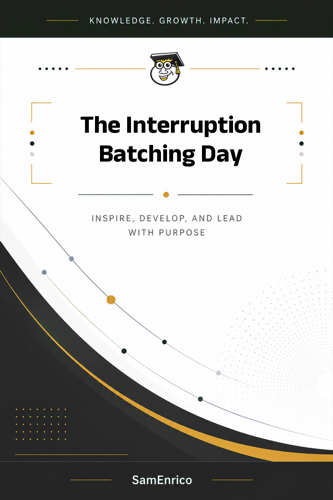
The Interruption Batching Day
Designates one day weekly for all interruptions, l
by Culver Chong
Designates one day weekly for all interruptions, leaving other days for deep work.
Formats
About this book
Free sample
Chapter 1: The Attention Tax--–- The email arrived at 9:14 AM. By 9:17, Sarah had already switched tasks four times. She was drafting a quarterly report when a Slack message pinged. She answered it. Then her phone buzzed with a text from her boss.
She replied. Then she remembered she hadn't checked the sales dashboard. She opened it. Then the email notification popped up again. She clicked it.
By 9:22, she had accomplished nothing of substance. She felt exhausted. She felt busy. She felt, in some strange way, like a hero—juggling, multitasking, holding it all together.But she was not a hero. She was a victim of a lie.The Most Expensive Lie in the Modern Workplace For the past thirty years, knowledge workers have been sold a seductive story: that the ability to handle multiple things at once is a skill, a competitive advantage, a mark of high performance.
We have glorified the person who can answer emails while sitting in a meeting while chatting on Slack while eating lunch. We have rewarded the colleague who replies fastest, who is always online, who never lets a notification go unanswered.This story is wrong. It is not merely inaccurate—it is dangerously, expensively wrong.The research is unequivocal: what we call multitasking is a myth. The human brain cannot process two attention-requiring tasks simultaneously. What we are actually doing is rapid task-switching, and each switch carries a cost.
A cognitive tax. A hidden drain on our mental resources that accumulates over hours, days, and years.This chapter will introduce you to that tax. You will learn its name, its mechanism, and its true cost. You will learn why the busiest people in your office are often the least productive. And you will learn the first step toward escaping the trap: understanding exactly what is stealing your attention.By the end of this chapter, you will never look at your inbox the same way again.The Science of Attention Residue In 2005, a University of Washington researcher named Sophie Leroy made a breakthrough discovery that would reshape how we understand productivity.
Leroy was studying how people transition between tasks—specifically, what happens to the brain when it leaves one task unfinished and…
This is the end of the free sample. Get the eBook to keep going. Buy now
Contents
- Chapter 1
- Chapter 2
- Chapter 3
- Chapter 4
- Chapter 5
- Chapter 6
- Chapter 7
- Chapter 8
- Chapter 9
- Chapter 10
- Chapter 11
- Chapter 12
Details
- Author
- Culver Chong
- Publisher
- SamEnrico
- Language
- English
- Genre
- Non-Fiction, Self-Help, Weekly Planning
- Released
- 2026-06-07
- Pages (approx.)
- 141
- Available as
- eBook, Audiobook

Read better in the ZLOADR app
Your eBooks on your phone or tablet. Sign in with your SamEnrico account and start reading.
More by Culver Chong
 Loneliness Senior Center GuideCulver Chong$11.99
 Preventing Parent BurnoutCulver Chong$11.99
 Vehicle Recurring Dream GuideCulver Chong$11.99
 Grandparent Self EsteemCulver Chong$11.99
 Hypnotic Calm InductionCulver Chong$11.99
 Talking About MoneyCulver Chong$11.99
 Unmaking The Antwerp ThievesCulver Chong$11.99
 The Sasquatch ConnectionCulver Chong$11.99
 The Last Message: The Enigma of the Wow! SignalCulver Chong$11.99
 The Fire Below: Harcourt and the Birth of Modern VolcanologyCulver Chong$11.99
 The Ballad of the Last Outlaw: The Untold Tale of Belle StarrCulver Chong$11.99
 Madrid Protocol Priority ClaimsCulver Chong$12.99
You may also like
 Theme Day Scheduling GuideMarquez Melodee$11.99
 Remote Work Weekly PlanningKopp Suzann$11.99
 Weekly Eisenhower Review GuideVann Elli$11.99
 Weekly Prioritization SystemWalter Ayako$11.99
 Weekly Action Planning WorkbookSmalley Reta$11.99
 Sunday Planning Ritual GuideRivera Guy$11.99
 The Weekly Goal Planning GuideScherer Isaiah$11.99
 Weekly Prioritization WorkbookHein Ashly$11.99
 Weekly Review Scheduling SessionHamilton Rosalie$11.99
 Weekly Review For BalanceDurr Reina$11.99
 Weekly Priority Quadrant ReviewYee Caryl$11.99
 Weekly Action Planning GuideWilks Rayford$11.99