
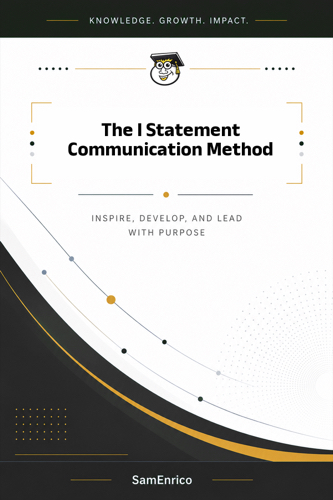
Non-FictionSelf-HelpNonviolent Communication
The I Statement Communication Method eBook
Replaces blaming language with 'I feel' statements
by Loftis Sanda
Replaces blaming language with 'I feel' statements to reduce defensiveness.
Formats
Free sample
Chapter 1: The Blame Trap...--–- You are not a bad person for blaming. You are a human being with a nervous system that has not yet realized you are not being chased by a saber-toothed tiger.Let that land for a moment. Every time you have snapped at your partner, criticized your child, or silently fumed at a coworker, your brain was doing exactly what evolution designed it to do: protect you from a perceived threat. The problem is not your character. The problem is that your amygdala—that almond-shaped cluster of neurons deep in your brain—cannot tell the difference between a verbal accusation and a physical attack.
To your nervous system, “You never listen to me” lands the same way as a rock thrown at your head.This is not metaphor. This is neurobiology.When you hear a “you” statement directed at you, your body releases cortisol and adrenaline. Your heart rate increases. Blood flows away from your prefrontal cortex (the part of the brain responsible for rational thought and empathy) and toward your limbs, preparing you to fight, flee, or freeze. This entire cascade happens in less than a second.
By the time you have consciously registered the words, your body has already decided you are under attack.And here is the cruel irony: the person who spoke those words was probably not trying to attack you. They were likely trying to get a need met. But because they used a “you” statement, both of you are now trapped in a physiological reaction that makes productive conversation nearly impossible.This is the Blame Trap. And this chapter is your way out.The Invisible Architecture of Accusation Before we can dismantle the Blame Trap, we have to see its architecture. Most people go their entire lives without understanding that the words they choose literally shape the biology of the people around them.
A “you” statement is not merely rude or impolite. It is a biological trigger.Consider the difference between these two sentences:“You left the dishes in the sink again.”“When I see dishes in the sink at 10 PM, I feel frustrated because I need order before I can relax.”The first sentence is a “you” statement. The second is an “I” statement. On the surface, they seem to be about the same event. But neurologically, they are as different as a gentle tap on the shoulder and a punch to the gut.The “you” statement activates the other person’s defense system.
Their amygdala floods their body with stress hormones. Their brain scans for evidence to prove you wrong, counter-attack, or escape. They are no longer listening to understand; they are listening to survive.The “I” statement, by contrast, contains no accusation. It is a report of your own experience. When someone hears “I feel frustrated,” their brain does not register a threat.
It registers information. Their prefrontal cortex stays online. They can hear you. They can problem-solve with you.This is not a communication trick. This is applied neuroscience.The War Model of Language Most of us learned to communicate in what I call the War Model of Language.
This model assumes that every conversation is a battle. Someone wins. Someone loses. The best defense is a good offense. If you are not attacking, you are vulnerable.Where did this model come from?
Evolution, again. For most of human history, being wrong in a social context could mean exile from the tribe, which was effectively a death sentence. Our ancestors who were most vigilant about defending their status, their reputation, and their version of events were more likely to survive. The War Model is not a choice; it is a inheritance.But here is what the War Model costs you:It costs you connection. When you are in battle mode, you cannot be in relationship mode.
The two states are neurologically incompatible. You cannot simultaneously prepare to defend yourself and genuinely listen to someone’s vulnerability.It costs you solutions. In a war, the goal is to defeat the enemy. In a relationship, the goal is to solve a problem together. These are not the same thing.
You can “win” an argument and still come home to a cold bed, a resentful coworker, or a child who no longer shares their heart with you.It costs you yourself. Every time you blame, you hand your emotional keys to someone else. “You made me angry” means you are not the author of your own experience. You are a puppet, and the other person holds the strings.The I Statement Communication Method is not about being nice. It is about being effective.
It is about swapping the War Model for a Collaborative Model, where your goal is not to win but to be understood and to understand.The Six Defensive Reactions: How You Already Respond to Blame Before you learn to stop triggering defensiveness in others, you need to recognize how defensiveness shows up in you. The Blame Trap does not just happen to other people. It happens to you. And the way you defend yourself is probably sabotaging you without your awareness.Sharon Strand Ellison, in her groundbreaking work on non-defensive communication, identified six primary defensive reactions. Read this list carefully.
You will recognize yourself in at least three of them.1. Surrender-Betray This is the person who says “You’re right, I’m always wrong” or “Fine, I’ll never do it again” or “Sorry for being such a terrible person.” On the surface, this looks like humility. It is not. It is a form of defense designed to end the conflict by making the other person feel guilty. The surrender-betrayer avoids the actual issue by collapsing into self-criticism, which forces the other person to stop being angry and start offering comfort.
The problem never gets solved. The pattern never changes.2. Surrender-Sabotage This person agrees outwardly while undermining inwardly. “Fine, I’ll take out the trash every night” – and then they “forget” constantly. Or they do the task so poorly that you eventually stop asking.
Surrender-sabotage allows the person to appear cooperative while quietly resisting. It is passive-aggressive by design. The other person feels crazy because you said yes but nothing actually changes.3. Withdraw-Escape This is the silent treatment. Leaving the room.
Shutting down. Going numb. Withdraw-escape can look like calm, but it is not. It is a physiological freeze response. The person’s nervous system has decided that the only safe option is to disappear.
The problem is that withdrawal does not resolve conflict; it freezes it in place. The other person is left standing in a room full of unspoken words, feeling abandoned and unheard.4. Attack-Explain This person responds to criticism with a flood of facts, justifications, and explanations. “You think I’m late? Let me tell you everything I had to do this morning.
First, the alarm didn’t go off, then the traffic was bad, then my boss called, and then…” Attack-explain is not an apology; it is a counter-argument disguised as context. The person is not trying to understand your complaint. They are trying to prove that your complaint is invalid because their reasons are good ones.5. Attack-Blame This is the…
This is the end of the free sample. Get the eBook to keep going. Buy now
About this book
Details
- Author
- Loftis Sanda
- Publisher
- SamEnrico
- Language
- English
- Genre
- Non-Fiction, Self-Help, Nonviolent Communication
- Released
- 2026-06-05
- Pages (approx.)
- 150
- Available as
- eBook, Audiobook

Read better in the ZLOADR app
Your eBooks on your phone or tablet. Sign in with your SamEnrico account and start reading.
More by Loftis Sanda
 Gaslighting Anger Triggers HandbookLoftis Sanda$11.99
 TTC After Vasectomy GuideLoftis Sanda$11.99TTC After Vasectomy GuideLoftis Sanda$11.99
 Walking Meditation for PTSDLoftis Sanda$11.99
 Mountain Path Walking PracticeLoftis Sanda$11.99
 Beneath the Sands of Time: The Lost Codex of AlexandriaLoftis Sanda$11.99
 Understanding Omenn SyndromeLoftis Sanda$17.99
 Trello Remote Internship SecretsLoftis Sanda$12.99
 Teladoc Health SWOTLoftis Sanda$12.99
 Field Operations Team LeadLoftis Sanda$11.99
 How to Start a Personal Trainer Business (Beginners Guide)Loftis Sanda$11.99
You may also like
 Hong Kong Handover 1997Dunn Johnnie$11.99
 Zumba For Postnatal Recovery CourseNeal Christian$11.99
 Zumba for BeginnersLadner Nikia$11.99
 YouTube Comment Mining GuideHumes Pandora$12.99
 Worry Box MeditationCarlin Rudy$11.99
 Workplace Stress MeditationNguyen Lynn$11.99
 Workplace Stress and Sleep RepairHawley Ivory$11.99
 Workplace Perfectionism CureDelaney Jeffry$11.99
 Workplace Injustice Anger GuideWallen Isabelle$11.99
 Work Addiction and Burnout LinkGreenwood Ester$11.99
 Women in Yoga and WellnessBeattie Galina$11.99
 Women in Stand Up ComedyChun Evangeline$11.99