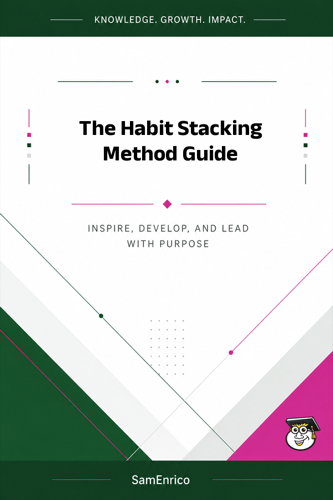
The Habit Stacking Method Guide eBook
Attaches new habits to existing routines for autom
Attaches new habits to existing routines for automatic triggers.
Formats
Free sample
Chapter 1: The Willpower Trap--Most people believe that successful habit-builders possess an extraordinary degree of self-discipline. They imagine early risers gritting their teeth against the comfort of warm blankets, diets maintained through heroic resistance against temptation, and productive workers pushing through exhaustion by sheer force of will. This belief is not merely inaccurate—it is actively harmful. The conviction that habits require willpower has prevented millions of people from making lasting changes, not because they lack character, but because they have been aiming at the wrong target entirely.Consider a simple experiment you can conduct right now. Think about the last time you forgot to brush your teeth.
Chances are, you cannot remember such an occasion. Tooth brushing is so deeply embedded in your daily routine that you perform it automatically, often without conscious awareness. Now think about the last time you forgot to meditate, or stretch, or write in a journal, or drink enough water, or any of the other admirable habits you have tried to establish. The contrast is stark. You remember to brush your teeth nearly every single day of your life.
You forget to meditate with remarkable consistency. The difference between these two behaviors is not a matter of importance or desire. You may genuinely want to meditate more than you want to brush your teeth. The difference is entirely a matter of triggers.The Myth of the Disciplined Elite The self-help industry has spent decades selling a seductive lie: that successful people possess a special reservoir of willpower that the rest of us lack. This lie appears in countless books, seminars, and motivational speeches.
The disciplined elite, we are told, simply want success more. They are willing to suffer more. They have stronger character. The implication is clear: if you are failing to maintain a habit, you are weak.This narrative persists despite overwhelming evidence to the contrary. Research on willpower depletion, conducted by psychologists including Roy Baumeister, has shown that willpower functions more like a muscle than a character trait.
It fatigues with use. It requires energy. It varies dramatically based on sleep, stress, and blood sugar. Treating willpower as a moral quality is like treating running speed as a moral quality—it ignores the vast majority of variance explained by biology, environment, and training.More importantly, the people you admire for their discipline are not actually using willpower most of the time. They have simply arranged their lives so that willpower is unnecessary.
The writer who produces a novel every year does not sit down each morning and force herself to write through sheer grit. She has established a trigger: after pouring her morning coffee, she opens the document. The coffee triggers the writing. No willpower required. The athlete who trains daily does not convince himself to exercise through internal debate.
He has a trigger: after hanging his work bag by the door, he puts on his shoes. The bag triggers the shoes. The shoes trigger the workout.The most disciplined person in any room is rarely the one with the strongest will. It is the one who has designed their environment and routines to make willpower irrelevant.The Plateau of Latent Potential One of the most discouraging experiences in habit formation is the feeling of working hard without seeing results. You meditate for ten days and feel no calmer.
You stretch for two weeks and still feel tight. You write daily for a month and your prose remains clumsy. This experience drives countless people to abandon their habits precisely when success is closest.James Clear, author of Atomic Habits, describes this phenomenon as the Plateau of Latent Potential. Imagine a block of ice sitting in a room at twenty-five degrees Fahrenheit. You raise the temperature to twenty-six degrees.
Nothing visible happens. Twenty-seven degrees. Nothing. Twenty-eight, twenty-nine, thirty degrees. Still ice.
Then, at thirty-two degrees, the ice begins to melt. The single degree of increase from thirty-one to thirty-two produced a visible transformation, but every previous degree was equally necessary. The ice was not stubbornly resisting change. It was accumulating potential.Habit formation follows the same pattern. Each repetition of a habit produces a microscopic change in the neural pathways of your brain.
These changes are invisible. They do not feel like progress. After a week of consistent stretching, you may feel exactly as inflexible as you did on day one. After a month, the difference may still be imperceptible. Then, one day, you touch your toes for the first time.
The transformation appears sudden, but it was built on weeks of invisible accumulation.The tragedy of the Plateau of Latent Potential is that most people quit during the invisible phase. They assume their efforts are failing because they cannot see the results. In truth, they were accumulating potential the entire time. The only missing element was a reliable trigger to keep them showing up long enough to reach the breakthrough.The Habit Loop: Your Brain's Autopilot System To understand why triggers are more powerful than willpower, you must understand the basic architecture of automatic behavior. Every habit in your life—from brushing your teeth to checking your phone to buckling your seatbelt—follows the same four-step pattern.
Psychologists call this the habit loop. Understanding it is the single most important step toward mastering habit stacking.The habit loop consists of four components: cue, craving, response, and reward.The cue is the trigger that initiates the behavior. It can be a location, a time of day, an emotional state, the presence of other people, or—most relevant to this book—a preceding action. When you brush your teeth, the cue might be the sensation of morning breath, the sight of the toothbrush, or the act of walking into the bathroom. The cue is not the behavior itself.
It is the signal that tells your brain to prepare for the behavior.The craving is the motivational force behind the habit. It is not the reward itself but the anticipation of the reward. When you smell coffee brewing, you do not crave the smell. You crave the anticipated pleasure of drinking the coffee. When you see your phone light up with a notification, you do not crave the light.
You crave the anticipated social connection or information. The craving is what gives the habit its energy. Without craving, the cue produces no action.The response is the habit itself—the behavior you perform. This is what most people think of when they imagine a habit. The response can be physical (brushing, typing, stretching), mental (deep breathing, visualization), or emotional (reframing a situation).
The response is the output of the loop.The reward is the benefit you receive from the response. It closes the loop and tells your brain whether the habit is worth remembering. The reward can be intrinsic (the feeling of clean teeth, the satisfaction of progress) or extrinsic (dopamine from a notification, relief from stress). The reward is the reason your brain encodes the habit loop for future use.Here is the critical insight for this book: in habit stacking, the cue is an existing habit. You are not creating a new cue from scratch—that would require willpower.
You are hijacking a cue that already works reliably. Your brain already has a well-worn neural pathway for flushing the…
This is the end of the free sample. Get the eBook to keep going. Buy now
About this book
Details
- Author
- Etheridge Jonah
- Publisher
- SamEnrico
- Language
- English
- Genre
- Non-Fiction, Self-Help, Routine Building
- Released
- 2026-06-06
- Pages (approx.)
- 139
- Available as
- eBook, Audiobook

Read better in the ZLOADR app
Your eBooks on your phone or tablet. Sign in with your SamEnrico account and start reading.
More by Etheridge Jonah
 IBS Low FODMAP SolutionEtheridge Jonah$11.99
 Silent Hunter Game HistoryEtheridge Jonah$11.99
 Workaholism in Retail ManagementEtheridge Jonah$11.99
 Anger for DriversEtheridge Jonah$11.99
 The Iron Duke and the Bridge: Brunel’s Legacy of EmpireEtheridge Jonah$11.99
 Remote Worker Nervous SystemEtheridge Jonah$12.99
 Cooperative Export GuideEtheridge Jonah$12.99
 Understanding Spondyloperipheral Dysplasia Short UlnaEtheridge Jonah$17.99
 Athletic TrainingEtheridge Jonah$11.99
 How to Become a Drop-wire HangerEtheridge Jonah$11.99