
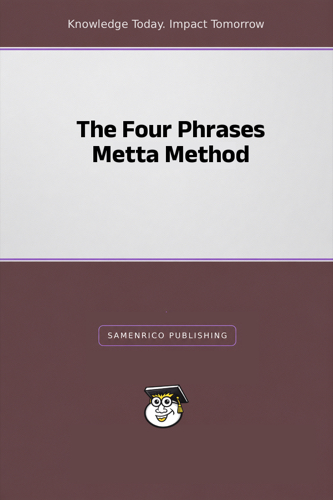
The Four Phrases Metta Method eBook
Breaks down the classic phrases of may you be safe
Breaks down the classic phrases of may you be safe, happy, healthy, and at ease.
Formats
Free sample
Chapter 1: Wishes Are Not Affirmations--–- Most people who try loving-kindness meditation give up because they are doing it wrong. They sit down, close their eyes, and repeat the traditional phrases like a tired parrot: May I be happy, may I be safe, may I be healthy, may I live with ease. They say the words—sometimes for weeks or months—and feel nothing. Or worse, they feel irritated, bored, or actively more angry than when they began. Then they conclude, quite reasonably, that this “Metta” thing does not work for them.
They are not broken. The method is simply missing a crucial instruction manual.This chapter is that missing manual. Before we dive into the specific phrases (Safe, Happy, Healthy, At Ease) and the five stages of practice (Self, Benefactor, Neutral, Difficult Person, All Beings), we must first understand the fundamental mechanics of how Metta actually operates. Think of this chapter as learning the grammar of a new language—not just memorizing vocabulary words, but understanding the syntax, the conjugations, and the hidden rules that transform random sounds into meaningful speech. Without this grammar, the phrases are empty shells.
With it, they become a technology for rewiring the human heart.The Most Common Mistake The most common mistake beginners make is treating the four phrases as affirmations. Affirmations are statements of fact that you repeat to overwrite a false belief. For example, “I am confident” repeated one hundred times to combat social anxiety. Metta phrases are fundamentally different. They are not declarations of how things are.
They are wishes—intentions directed toward a living being. The difference is subtle but world-changing.When you say “May I be safe,” you are not lying to yourself about your current safety. You might be in genuine danger. You might be sitting in a hospital bed, fleeing a war zone, or lying awake at 3 AM while your nervous system screams that the ceiling is about to collapse. The phrase does not deny that reality.
Instead, it adds a second track: even though I am afraid, I am directing a wish of safety toward myself. This is not toxic positivity. It is radical honesty paired with radical kindness.The neuroscientific distinction here is crucial. Affirmations primarily engage the brain’s language centers (Broca’s area and Wernicke’s area) and, when they conflict too sharply with reality, they activate the anterior cingulate cortex—the brain’s error-detection system. That is why “I am confident” feels like a lie when you are terrified.
Your brain literally flags it as false. Metta phrases, however, engage different circuitry: the insula (interoceptive awareness), the temporoparietal junction (perspective-taking), and the ventromedial prefrontal cortex (positive social emotion). They feel different because they are different.The practical implication is this: do not try to believe the phrase. Do not try to feel the phrase. Simply intend it.
Repeat the words as a vehicle for the intention, and let the feeling arise on its own schedule—or not at all. Some days you will feel a flood of warmth. Other days you will feel absolutely nothing. Both are fine. The practice is showing up and directing the wish, regardless of the weather inside your chest.What Wishes Do That Affirmations Cannot A wish has a different psychological structure than a statement.
When you make a wish—on a birthday candle, a shooting star, or a loved one’s eyelash—you do not demand that the universe comply immediately. You do not check your emotional state to see if the wish is “working.” You simply release the wish and let it go. Metta works the same way.Consider the difference between these two inner experiences:Affirmation: “I am safe.” (Your brain checks reality: But I hear strange noises outside. My heart is racing. I just got a threatening email.
Error signal fires. You feel worse.)Metta Wish: “May I be safe.” (Your brain processes this as an intention. No reality check is required because you are not claiming safety exists. You are merely directing a desire for safety. The nervous system can accept this without resistance.)This is why Metta is sometimes called “the practice of the one who has given up.” You give up the demand that the world conform to your wishes.
You give up the requirement that you feel a certain way. You give up the attachment to results. And paradoxically, when you give up those demands, the heart opens more easily than when you were trying to force it open with a crowbar.The Zen master Shunryu Suzuki famously said, “In the beginner’s mind there are many possibilities, but in the expert’s mind there are few.” The beginner at Metta simply repeats the words with curiosity and openness. The “expert” who demands results has already closed the door. Stay a beginner.
Stay curious. Stay willing to be surprised.How Words Rewire the Brain For decades, neuroscientists believed that the adult brain was fixed—that after a certain age, you were stuck with the neural hardware you had. We now know this is false. The brain remains plastic throughout life, constantly rewiring itself in response to repeated experience. This is neuroplasticity.
And Metta practice is one of the most powerful, well-researched tools for directing that plasticity toward compassion and emotional regulation.Richard Davidson, a neuroscientist at the University of Wisconsin, conducted landmark studies on long-term meditators (including Buddhist monks with over 10,000 hours of practice). He found that compared to novices, these expert meditators showed dramatically higher levels of gamma waves (associated with heightened awareness and integration of brain regions) and greater activation in the left prefrontal cortex (associated with positive emotions and resilience). But here is the crucial finding for our purposes: even beginners who practiced Metta for just thirty minutes a day for two weeks showed measurable changes in brain function. Their insula—the region that detects bodily sensations and generates empathy—thickened. Their amygdala—the brain’s fear and anger alarm—showed reduced reactivity to threatening stimuli.Sara Lazar’s research at Harvard Medical School confirmed these findings using structural MRI.
After an eight-week mindfulness-based stress reduction course (which included Metta elements), participants showed increased gray matter density in the hippocampus (learning and memory), the posterior cingulate cortex (self-referential thought), and the temporoparietal junction (empathy and perspective-taking). These changes were not metaphorical. They were physical. The brain had literally reshaped itself.What does this mean for you, reading this chapter? It means that every time you sit down and repeat “May I be safe, happy, healthy, at ease,” you are performing a form of mental weightlifting.
You are putting a demand on specific neural circuits, and those circuits respond by growing stronger, more efficient, and more automatic. After enough repetitions, the kindness becomes reflexive. You do not have to try to be compassionate in a difficult moment; the response simply arises because the underlying brain structure has been rebuilt.This is not magic. It is biology. And it is available to anyone who is willing to put in the repetitions.The Three Enemies of Metta Every genuine spiritual practice has counterfeit versions that look similar but lead in the opposite direction.
Metta is no exception. The Buddhist tradition names two primary enemies. To these, we will add a third based on…
This is the end of the free sample. Get the eBook to keep going. Buy now
About this book
Details
- Author
- Forrester Harriette
- Publisher
- SamEnrico
- Language
- English
- Genre
- Non-Fiction, Self-Help, Mindfulness
- Released
- 2026-06-11
- Pages (approx.)
- 137
- Available as
- eBook, Audiobook

Read better in the ZLOADR app
Your eBooks on your phone or tablet. Sign in with your SamEnrico account and start reading.
More by Forrester Harriette
 The Pet Care Money StressForrester Harriette$11.99
 Drug Dependency Exercise TherapyForrester Harriette$11.99
 Meditation For Anxious BeginnersForrester Harriette$11.99
 Networking for Fitness ProfessionalsForrester Harriette$11.99
 Fire Dream MeaningForrester Harriette$11.99
 Yoga Class Anxiety GuideForrester Harriette$11.99
 Medicaid Parent GuideForrester Harriette$11.99
 Anapanasati for Work StressForrester Harriette$11.99
 Voyage of the Endurance: The Generation Ship That Could Save HumanityForrester Harriette$11.99
 Dirt to Glory: The Rise of Aussie Freestyle LegendsForrester Harriette$11.99
 The Corsair King: Hayreddin Barbarossa and the Rise of the Ottoman NavyForrester Harriette$11.99
 Renewable Energy & Sustainability ManagementForrester Harriette$11.99
You may also like
 Metta Self Compassion FirstFellows Petrina$11.99
 The Observation Lead HandbookToliver Vivien$11.99
 The Noticing Comparison ExerciseAugustine Onita$11.99
 The Eight Week MBSR WorkbookLudwig Norah$11.99
 Spending Urge Surfing HandbookFredericks Refugia$11.99
 Mindfulness of EmotionsStegall Serita$11.99
 Mindfulness for Urge ControlMessenger Tamela$11.99
 Mindfulness for Students HandbookEgan Ira$11.99
 Mindfulness for Relationship RageBranham Elfriede$11.99
 Mindful Sleep InductionHeck Sherril$11.99
 Mindful Parenting for Stressed MomsDugas Tracee$11.99
 Mastering Emotional Self AwarenessSargent Paz$11.99