
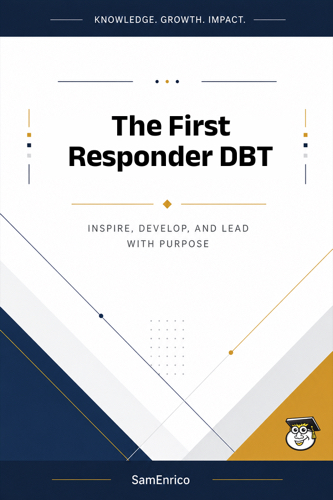
Non-FictionSelf-HelpFirst Responder
The First Responder DBT
Manage high stress calls and emotional aftermath o
by Cano Anglea
Manage high stress calls and emotional aftermath of emergencies.
Formats
About this book
Free sample
Chapter 1: The Biology of the Badge...--–- The first time you feel it, you don't have a name for it. You're sitting in your patrol car at 3:47 AM after a fatal rollover. The call is over. The paperwork is done. The body is gone.
And yet your hands are still shaking. Your heart is still pounding. Your jaw is still clenched. You haven't spoken in forty-five minutes. Your partner asks if you're okay, and you hear yourself say, "Fine," but the word comes out wrong—too flat, too fast, too something.
You are not fine. You are not not-fine. You are somewhere in between, stuck in a body that refuses to believe the emergency has ended.This is the Biology of the Badge. It is not weakness. It is not a diagnosis.
It is not a moral failing. It is the predictable, measurable, inevitable result of a human nervous system doing exactly what it evolved to do: survive. And for first responders—police officers, firefighters, paramedics, dispatchers, emergency nurses, search and rescue personnel—this biological reality is the foundation upon which everything else is built. Before you can learn a single DBT skill, before you can name a single emotion, before you can ask for help or change a behavior, you must understand the machine you are operating. Because right now, without your permission, that machine is running on overdrive.
And it was never designed for the shifts you work.The Two Modes You Live In Your nervous system has two primary operating modes. Think of them as gears in a transmission. You need both. You cannot drive in first gear forever, and you cannot drive in fourth gear forever. But first responders often get stuck in one gear—the wrong gear—for years.Scene Mode (Sympathetic Nervous System)This is your emergency gear.
When you hear the tones drop, when the dispatcher's voice changes, when you round the corner and see the smoke or the wreckage or the screaming family member—your sympathetic nervous system floods your body with adrenaline, cortisol, and norepinephrine. Your pupils dilate. Your heart rate…
This is the end of the free sample. Get the eBook to keep going. Buy now
Contents
- Chapter 1
- Chapter 2
- Chapter 3
- Chapter 4
- Chapter 5
- Chapter 6
- Chapter 7
- Chapter 8
- Chapter 9
- Chapter 10
- Chapter 11
- Chapter 12
Details
- Author
- Cano Anglea
- Publisher
- SamEnrico
- Language
- English
- Genre
- Non-Fiction, Self-Help, First Responder
- Released
- 2026-06-09
- Pages (approx.)
- 143
- Available as
- eBook, Audiobook

Read better in the ZLOADR app
Your eBooks on your phone or tablet. Sign in with your SamEnrico account and start reading.
More by Cano Anglea
 Diabetic Retinopathy PreventionCano Anglea$11.99
 George Washington BiographyCano Anglea$11.99
 TM for Insomnia GuideCano Anglea$11.99
 Self Hypnosis for Fear of DrowningCano Anglea$11.99
 Media Frenzy CoverageCano Anglea$11.99
 Meningococcal Vaccine GuideCano Anglea$11.99
 Emotional Eating JournalCano Anglea$11.99
 Blood and Bootleg: The Deadly Duos of Prohibition-Era AfricaCano Anglea$11.99
 The Inferno of Palermo: How the Sicilian Mafia Burned a City to SilenceCano Anglea$11.99
 How to Produce a Self-tannerCano Anglea$11.99
 How to Produce Fly RepellentCano Anglea$11.99
 Cold Snap Business Insurance GuideCano Anglea$12.99
You may also like
 Hong Kong Handover 1997Dunn Johnnie$11.99
 Zumba For Postnatal Recovery CourseNeal Christian$11.99
 Zumba for BeginnersLadner Nikia$11.99
 YouTube Comment Mining GuideHumes Pandora$12.99
 Worry Box MeditationCarlin Rudy$11.99
 Workplace Stress MeditationNguyen Lynn$11.99
 Workplace Stress and Sleep RepairHawley Ivory$11.99
 Workplace Perfectionism CureDelaney Jeffry$11.99
 Workplace Injustice Anger GuideWallen Isabelle$11.99
 Work Addiction and Burnout LinkGreenwood Ester$11.99
 Women in Yoga and WellnessBeattie Galina$11.99
 Women in Stand Up ComedyChun Evangeline$11.99