
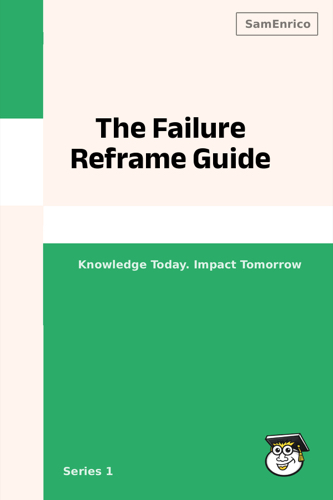
The Failure Reframe Guide eBook
Treat setbacks as learning data not judgments of y
Treat setbacks as learning data not judgments of your worth.
Formats
Free sample
Chapter 1: The Worth-Performance Trap--–- Let me tell you about the most expensive lie you’ve ever been sold. It didn’t come from a politician, a marketer, or a social media influencer. It came from somewhere far more insidious: your own culture, your own schooling, and eventually, your own inner voice. The lie sounds like common sense. It sounds like motivation.
It sounds like this: “You are what you accomplish.”We hear it in kindergarten when we get a gold star for a clean sheet of handwriting and nothing for a messy one. We hear it in little league when the coach cheers the kid who hit the home run and silently benches the kid who struck out. We hear it in high school when the valedictorian gets the scholarship and the C-average student gets a shrug. We hear it in college, in our first jobs, in performance reviews, in performance reviews for the rest of our lives. And by the time we reach adulthood, the lie has become indistinguishable from gravity.
It is simply how the world works. You succeed, you have value. You fail, you lose value. The math feels as certain as addition.But here is the problem that entire industries have been built to avoid: that math is wrong. It is not just slightly inaccurate or in need of minor adjustment.
It is structurally, psychologically, and scientifically backward. And until you dismantle it, every failure you experience will land like a punch to your identity rather than a piece of data for your growth.I learned this lesson in a way that I would not wish on anyone, though I have since come to be grateful for it. Seven years ago, I was fired from a job that I had convinced myself was my destiny. I had spent five years climbing the ladder at a marketing firm, accruing titles and responsibilities the way a hoarder accrues newspapers. I was the youngest department head in the company’s history.
I had a corner office with a window that actually opened, which in corporate real estate is the equivalent of winning the lottery. And then, in the span of a single ninety-minute meeting, it was gone. A re-organization. A new executive who wanted “fresh perspectives.” A severance package delivered in a manila envelope that I still cannot look at without feeling my stomach tighten.The shame did not arrive gradually. It arrived like a flash flood.
In the first hour after the meeting, I told myself that this was a business decision, impersonal and routine. By the second hour, I was already rewriting my entire life story. I had not been fired from a job. I had been revealed. The promotion had been luck.
The corner office had been charity. The five years of eighteen-hour days had been a performance so convincing that even I had believed it, but the truth had finally caught up. I was not a successful young professional who had encountered a setback. I was a fraud who had been caught.That is the Worth-Performance Trap. It is the cognitive fusion of what you do with who you are.
And it is the single greatest obstacle to learning from failure that you will ever face.The Anatomy of the Trap Let us be precise about what we are dealing with. The Worth-Performance Trap is not merely a tendency to feel bad when you fail. Feeling bad is appropriate. Feeling disappointed, frustrated, or even grief-stricken after a significant setback is a sign that you are a functional human being with goals and attachments. The trap is something different.
The trap is the instantaneous, automatic, and often unconscious equation that your brain makes between an outcome and your identity.When you are caught in the trap, you do not experience a failure as an event. You experience it as a verdict. The thought “I did not get the promotion” becomes “I am not promotable.” The thought “I forgot my partner’s birthday” becomes “I am a terrible partner.” The thought “I lost money on that investment” becomes “I am bad with money and always will be.” Notice the grammar of the trap. It moves from the past tense of an action to the present tense of an identity. From “did not” to “am not.” From “forgot” to “am.” From “lost” to “am.”This grammatical shift is not merely semantic.
It is neurological. When your brain encodes an event as a threat to your identity, it activates the same neural circuits that would activate if you were being chased by a predator. Your heart rate increases. Your cortisol spikes. Your prefrontal cortex—the part of your brain responsible for reasoning, planning, and learning—actually downregulates its activity.
In other words, the moment you tell yourself that a failure means you are worthless, your brain literally becomes less capable of learning from that failure.I want you to sit with the cruelty of that for a moment. The trap does not just make you feel terrible. It makes you worse at the very thing you need to do next. It is a self-sealing loop. You fail.
You tell yourself the failure means something fundamental about you. That belief shuts down your learning architecture. Because you cannot learn, you are more likely to fail again. And because you fail again, you gather more evidence for your original, false conclusion. This is how smart, capable, ambitious people get stuck.
Not because they lack talent. Not because they lack effort. Because they lack a way to separate their worth from their performance.Where the Trap Comes From You were not born with the Worth-Performance Trap wired into your brain. Infants do not feel shame when they fall while learning to walk. They feel frustration, perhaps, and sometimes pain, but they do not conclude that the fall means they are fundamentally unworthy of upright mobility.
They simply stand up and try again, often with no apparent memory of the previous failure. The trap is taught.Consider the research of psychologist Carol Dweck, whose work on mindset has reshaped our understanding of achievement and resilience. In a series of classic studies, Dweck and her colleagues gave children a set of increasingly difficult puzzles to solve. Some children, when faced with failure, responded with what Dweck called a “mastery-oriented” pattern: they increased their effort, tried new strategies, and expressed enjoyment of the challenge. Others responded with what she called a “helpless” pattern: they blamed their intelligence, became visibly distressed, and gave up.The critical finding came when Dweck asked the children why failure might have happened.
The mastery-oriented children typically pointed to specific, changeable factors: “I didn’t try hard enough on that one,” or “I used the wrong strategy.” The helpless children pointed to global, unchangeable factors: “I’m not good at puzzles,” or “I’m just not smart enough.” Notice the grammar again. The helpless children had already learned to fuse performance with identity. And they were only five years old.By the time we reach adulthood, this fusion has been reinforced thousands of times. Every graded test, every performance review, every ranking, every competition, every comparison has whispered the same message: your output is…
This is the end of the free sample. Get the eBook to keep going. Buy now
About this book
Details
- Author
- Fredrickson Gisele
- Publisher
- SamEnrico
- Language
- English
- Genre
- Non-Fiction, Self-Help, Failure
- Released
- 2026-06-09
- Pages (approx.)
- 140
- Available as
- eBook, Audiobook

Read better in the ZLOADR app
Your eBooks on your phone or tablet. Sign in with your SamEnrico account and start reading.
More by Fredrickson Gisele
 Divorce and Prenuptial AgreementsFredrickson Gisele$11.99
 Stress and Immune System SuppressionFredrickson Gisele$11.99
 Pillow Hug TechniqueFredrickson Gisele$11.99
 Psychological ED Causes WorkbookFredrickson Gisele$11.99
 Health Insurance After JobFredrickson Gisele$11.99
 Team Creativity for HRFredrickson Gisele$11.99
 Persuasion for NursesFredrickson Gisele$11.99
 The Green Sage of the Nile: Cheikh Anta Diop's Scientific RevolutionFredrickson Gisele$11.99
 The Phantom of La Alameda: Chile's Victorian-Style Unsolved Murder (1967)Fredrickson Gisele$11.99
 How to Produce Paintball and Airsoft VestsFredrickson Gisele$11.99
 How to Produce Cordless ProductsFredrickson Gisele$11.99
 A Collector's Handbook to the Triumph Spitfire Mk3Fredrickson Gisele$11.99
You may also like
 Failure Celebration GuideBritt Lelah$11.99
 Teen Mistakes Growth GuideLangford Diego$11.99
 The Failure Recovery HandbookRawls Jamee$11.99
 Creative Fuel From FailureNewman Hattie$11.99
 Failure Reframing ImposterSosa Lorrie$11.99
 Failure Reframing for ImpostersGustafson Elana$11.99
 Embracing Failure as LearningLove Camille$11.99
 The SMART Failure AnalysisBrannon Kevin$11.99
 Self Talk For Making MistakesSilvia Heike$11.99
 Failure Resume for EngineersMcafee Jamison$11.99
 Workplace Failure RecoverySwafford Mozella$11.99
 Goal Failure Analysis GuidePennington Willa$11.99