
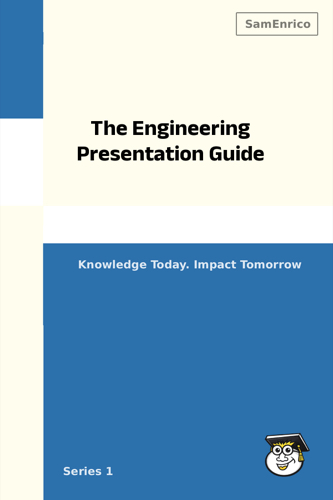
The Engineering Presentation Guide eBook
Explain technical details to non-engineers without
Explain technical details to non-engineers without losing precision.
Formats
Free sample
Chapter 1: The $50 Million Sentence--–- The senior engineer stood at the front of the conference room, pointer in hand, thirty-seven slides deep into a technical presentation that had already lost everyone in the room by slide four. He had explained, with exquisite precision, the von Mises stress distribution across the fillet radius of a pressure vessel. He had shown FEA models in six colors. He had quoted ASME codes from memory. And then he said the sentence that would cost his company fifty million dollars: “The margin against yield is only 0.3, but that’s within the uncertainty band when you consider the knock-on effects of thermal cycling on the weld heat-affected zone.”The CEO, a former marketing executive, turned to the CFO and whispered something.
The CFO shrugged. The VP of Product Development, who had once asked if “torque” was a brand of energy drink, nodded blankly. The meeting ended fifteen minutes later with a polite “Thank you, we’ll take this under consideration.”Six weeks later, the competitor’s product shipped first. The pressure vessel design was, in fact, sound. The margin was acceptable.
The analysis was correct. But no one in that room had understood enough to say yes. And because no one understood, no one could defend the project to the board. The project was canceled. Fifty million dollars in projected revenue vanished.
Not because the engineering was wrong. Because the explanation was wrong.This is the Curse of Knowledge. And this chapter is the antidote.The Paradox of Expertise You would think that knowing more about a subject would make you better at explaining it. It does not. In fact, the relationship between expertise and explainability is inverted.
The more deeply you understand a technical system, the harder it becomes to remember what it was like not to understand it. You have internalized the jargon, automated the mental models, and compressed the complexity into elegant shortcuts that make perfect sense to you and absolutely no sense to anyone else.This is not a character flaw. It is a cognitive bias, studied extensively by cognitive psychologists Elizabeth Newton and Leonid Rozenblit. In a famous 1990 experiment, Newton had participants tap out the rhythm of a well-known song— “Happy Birthday,” “The Star-Spangled Banner”—and then asked listeners to guess the song. The tappers predicted that listeners would guess correctly 50 percent of the time.
The actual success rate was 2.5 percent. The tappers, like engineers, could hear the melody perfectly in their own heads. They could not hear what the listeners heard: random tapping.Every time you present a technical concept to a non-engineer, you are tapping out “Happy Birthday.” And you are convinced they can hear the tune.Three Real-World Failures of Translation Let us examine three cases where the Curse of Knowledge destroyed value, not because the engineering was flawed, but because the explanation failed.Case One: The Bridge That Never Broke (But Was Never Built)A civil engineering firm in the Pacific Northwest was bidding on a pedestrian bridge over a salmon stream. The lead engineer prepared a thirty-slide deck explaining the geotechnical analysis. He showed shear strength graphs, consolidation curves, and bearing capacity calculations.
He explained, correctly, that the soil was prone to liquefaction under seismic loading but that deep foundations would mitigate the risk. The city council, composed of a retired teacher, a small business owner, and a nonprofit director, listened for forty-five minutes. Then the retired teacher asked: “Is the dirt safe or not?”The engineer, frustrated by what he perceived as a simplistic question, responded: “Liquefaction potential is a probabilistic function of peak ground acceleration, soil gradation, and groundwater table elevation. We have modeled it with a 10,000-year return period.”The council voted no. A different firm built a different bridge two years later.
The original engineer’s analysis was correct. But “probabilistic function of peak ground acceleration” is random tapping. “The dirt could turn to jelly in a big earthquake, so we are putting in deep concrete pillars to hold it steady” is “Happy Birthday.” He never said the second version.Case Two: The Software Rollout That Killed Productivity A manufacturing company purchased a $2 million inventory management system. The software engineers who built it were brilliant. The system reduced waste by 22 percent in pilot tests.
But when it rolled out to the warehouse floor, the workers hated it. They did not use the features. They circumvented the safety checks. Productivity dropped by 15 percent for six months before the company abandoned the system and went back to spreadsheets.Why? The training presentation had a slide that said: “The cache will pre-fetch SKU-level demand signals to minimize latency in the event of a batch reconciliation failure.” A warehouse worker asked, “What’s a cache?” The trainer said, “It’s a temporary storage layer.” The worker said, “Like a box?” The trainer said, “Not exactly.” And then the trainer kept going.The workers heard random tapping.
They did not trust the system because no one had explained, in physical terms, what the system actually did. “Cache” should have been explained as “a sticky note on your desk where you write down the things you use most often so you don’t have to walk to the filing cabinet every time.” That explanation is precise enough for a warehouse worker. The engineer’s explanation was precise for another engineer. The mismatch cost $2 million.Case Three: The Engineer Passed Over for Promotion Maria was the best thermal engineer in her division. She had saved her company $8 million by redesigning a cooling system for a high-power transmitter.
She was up for promotion to director. The interview panel consisted of the VP of Engineering (an electrical engineer), the VP of Product (a former product manager), and the CFO (an accountant). Maria prepared a thirty-minute presentation on her technical accomplishments.She showed thermal maps. She explained Nusselt numbers and Reynolds numbers. She walked through the CFD model she had built.
She proved, mathematically, that her design increased heat dissipation by 34 percent.The panel thanked her. They promoted someone else—a less talented engineer who had presented a single slide that said: “We were cooking the transmitter. I added more air. Now it runs cool. Here is the test data.” That engineer understood the Curse of Knowledge.
Maria did not. The VP of Product later told a colleague: “Maria was brilliant, but I had no idea what she was talking about. The other guy made me feel smart.”That feeling—making the listener feel smart rather than exposing their ignorance—is the single most underrated skill in technical communication.The Elegance of Simplicity: What It Is and What It Is Not Let us be precise about what we mean by simplicity, because engineers are right to be suspicious of the word. Simplicity is not dumbing down. Simplicity is not omitting important details.
Simplicity is not lying or exaggerating or using “good enough” approximations when the truth matters.Simplicity is removing noise without touching the signal.Think of a technical explanation as a photograph. A raw image file contains every piece of data the sensor captured—every photon, every bit of color information, every lens artifact. That is your full engineering knowledge. It is complete. It…
This is the end of the free sample. Get the eBook to keep going. Buy now
About this book
Details
- Author
- Reiter Meagan
- Publisher
- SamEnrico
- Language
- English
- Genre
- Non-Fiction, Self-Help, Engineering
- Released
- 2026-06-07
- Pages (approx.)
- 118
- Available as
- eBook, Audiobook

Read better in the ZLOADR app
Your eBooks on your phone or tablet. Sign in with your SamEnrico account and start reading.
More by Reiter Meagan
 Post Workout Nap GuideReiter Meagan$11.99
 Autism Meltdown TriggersReiter Meagan$11.99
 Relationship Self Worth Recovery GuideReiter Meagan$11.99
 Property Management AppsReiter Meagan$11.99
 The Expert Beginner ParadoxReiter Meagan$11.99
 Higher Power Concept GuideReiter Meagan$11.99
 Fibromyalgia and Thyroid DiseaseReiter Meagan$11.99
 Remote Team Burnout PreventionReiter Meagan$11.99Remote Team Burnout PreventionReiter Meagan$11.99
 The Hidden Architects of the Digital Age: Black Pioneers in Computer ScienceReiter Meagan$11.99
 The Silk Road's Last Stand: How a 2015 Cyber War Redrew the Global BorderReiter Meagan$11.99
 Echoes of the Cosmic Dawn: The Antarctic Telescope That Heard the Universe's First BreathReiter Meagan$11.99
You may also like
 Relationship Building for EngineersGetz Cordie$11.99
 Dreaming for Engineering DesignKline Sharee$11.99
 Constraints for EngineersSlaughter Birgit$11.99
 Emotional Intelligence For EngineersWorth Zina$11.99
 Personal Branding for EngineersKimmel Cletus$11.99
 Failure Fear in EngineeringSpalding Richard$11.99
 TRIZ Problem SolvingMcdade Refugio$11.99
 NVC for EngineersCrump Krysta$11.99
 Workaholism in EngineeringHughes Derrick$11.99
 Fear of Failure for EngineersSchott Charline$11.99
 Engineering Student StressBurris Trinh$11.99
 Engineer Imposter SyndromeMoreau Melodee$11.99