
Non-FictionSelf-HelpEmotional Intelligence
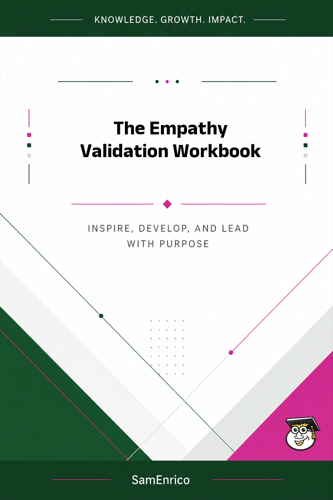
The Empathy Validation Workbook eBook
Teaches reflective listening and emotional acknowl
by Weir Sherril
Teaches reflective listening and emotional acknowledgment to make others feel heard.
Formats
Free sample
Chapter 1: The Fixer’s Fallacy--–- My husband walked through the door at 6:47 PM on a Tuesday, threw his keys onto the kitchen counter with a sound I had learned to dread, and said seven words that would eventually force me to rewrite everything I thought I knew about love.“I think I’m going to get fired tomorrow.”He wasn’t crying. That would have been easier to recognize. He was standing very still, staring at a spot on the wall somewhere to the left of my face, his jaw set in that particular way men are taught means “I am handling this.” His voice was flat. Not calm—flat. The kind of flat that comes after you have already imagined the worst-case scenario so many times that your emotions have simply given up and gone home.And I, his loving wife, his partner, his supposed safe harbor, opened my mouth and said:“No, you’re not.
You’re amazing at your job. And even if they did, you’d find something better in a week. Let’s update your resume tonight just in case.”I meant: I believe in you. I am on your team. You are not alone.He heard: Your fear is irrational.
You are overreacting. I am already planning for your failure.He didn’t speak to me for two hours.Not because he was angry. He wasn’t. He was heartbroken—not at his boss, not at his job, but at me. Because in the moment he had reached for me with the most vulnerable confession he had made in months, I had handed him a resume template instead of my presence.That night, after he fell asleep on the couch (he said he was “just resting his eyes,” and I let him have that lie), I sat in the dark kitchen and Googled something I was too embarrassed to say out loud: Why does trying to help make things worse?What I found changed everything.The Paradox That Breaks Relationships The answer, it turns out, is something psychologists call the Validation Paradox, and it works like this:When someone you love shares pain, your brain automatically jumps into problem-solving mode.
This is not a character flaw. It is not a sign that you are selfish or emotionally stunted. It is a neurological reflex, honed over thousands of years of evolution, that says: Threat detected. Neutralize threat. Protect the tribe.The problem is that emotional pain is not a flat tire.
You cannot jump-start someone out of grief. You cannot renegotiate the terms of their fear. And yet, again and again, we try.The Validation Paradox is the cruel arithmetic of empathy: The more urgently you try to solve someone’s problem, the less heard they feel. And the less heard they feel, the more alone they become. And the more alone they become, the bigger their problem feels.Let me say that again, because it is the single most important sentence in this entire book:By trying to fix the problem, you make the person feel worse.Not because you are bad.
Not because they are ungrateful. But because you have skipped a step. You have jumped from “I hear noise” to “I have solution” without stopping at the tiny, fragile, absolutely essential middle ground: “I see you. I hear you. What you are feeling makes sense.”Michael Sorensen, whose book I Hear You first brought this concept into the mainstream, calls this the difference between the reactive brain and the responsive brain.The Reactive Brain vs.
The Responsive Brain Let me describe two versions of you.The Reactive Brain is the version that shows up when you are tired, stressed, or simply trying to be helpful in a hurry. It asks three questions, and it asks them very fast:How do I end this conversation quickly? (Because discomfort is unpleasant, and your brain wants it gone.)What solution can I offer right now? (Because solutions feel like control, and control feels like safety.)When is it my turn to talk? (Because you have things to say, and your ego is quietly waiting for its cue.)The Reactive Brain is not evil.
It is efficient. It is the brain that has kept humans alive through famines, wars, and awkward office parties. But it is a terrible listener.The Responsive Brain is the version you have to deliberately invite to the table. It asks three very different questions, and it asks them slowly:What is this person actually feeling under the words they are saying? (Not “What is the problem?” but “What is the experience?”)Do they want me to listen, or do they want me to advise?
(And it is willing to accept either answer.)What would help them feel less alone right now? (Not “What would solve this forever?” but “What would make the next sixty seconds bearable?”)Here is what I have learned from training thousands of people in these two modes: almost everyone thinks they are operating from the Responsive Brain. Almost no one actually is.We feel responsive because we are trying to help. We intend to be responsive because we love the person. But our habits, our anxiety, and our deeply conditioned need to be the hero with the answer drag us back into reactivity again and again.The Fixer’s Fallacy—and that is what I have come to call this whole phenomenon—is the belief that offering a solution is the highest form of care.It is not.
It is the lowest.The highest form of care is the willingness to sit in someone else’s darkness without immediately flicking on the lights.The Ego of the Answer Let me be brutal for a moment, because this is a workbook and you came here for honesty, not comfort.The reason you offer solutions so quickly is not entirely about helping them. Part of it—a larger part than most of us want to admit—is about helping you.When someone shares a painful problem, your nervous system registers it as a threat. Not because you are in danger, but because empathy is contagious. Their anxiety raises your cortisol. Their sadness activates your mirror neurons.
You feel their discomfort in your body, and your body wants that discomfort to stop.Offering a solution is the fastest way to make the discomfort stop. You say “Here’s what you should do,” and suddenly you are no longer sitting in the messy, uncomfortable, vulnerable space of not knowing. You are in the clean, controlled space of having an answer.This is the ego of the answer. It is subtle. It wears a disguise called helpfulness.
But it is there, and it is sabotaging your relationships.I know this because I have done it thousands of times. Every time I interrupted a friend’s story with “Have you tried…?” Every time I finished my husband’s sentence because I was impatient for him to get to the point. Every time I said “It’ll be fine” when I had no idea if it would be fine but I needed him to stop feeling bad so I could stop feeling uncomfortable.The ego of the answer…
This is the end of the free sample. Get the eBook to keep going. Buy now
About this book
Details
- Author
- Weir Sherril
- Publisher
- SamEnrico
- Language
- English
- Genre
- Non-Fiction, Self-Help, Emotional Intelligence
- Released
- 2026-06-05
- Pages (approx.)
- 151
- Available as
- eBook, Audiobook

Read better in the ZLOADR app
Your eBooks on your phone or tablet. Sign in with your SamEnrico account and start reading.
More by Weir Sherril
 HRT For Cancer Survivors WorkbookWeir Sherril$11.99
 Test Anxiety TriggerWeir Sherril$11.99
 PCOS Spearmint Tea Anti AndrogenWeir Sherril$11.99
 Laci Peterson Modesto Community TraumaWeir Sherril$11.99
 Silicon Mirage: The Rise and Fall of the First Metaverse TycoonWeir Sherril$11.99
 Patient Care CoordinatorWeir Sherril$11.99
 Understanding Pelvic Dysplasia Arthrogryposis of Lower LimbsWeir Sherril$17.99
 How to Become a Spray-machine TenderWeir Sherril$11.99
 Nestle Health ScienceWeir Sherril$12.99
 Domain Auction Sniping GuideWeir Sherril$12.99
You may also like
 Hong Kong Handover 1997Dunn Johnnie$11.99
 Zumba For Postnatal Recovery CourseNeal Christian$11.99
 Zumba for BeginnersLadner Nikia$11.99
 YouTube Comment Mining GuideHumes Pandora$12.99
 Worry Box MeditationCarlin Rudy$11.99
 Workplace Stress MeditationNguyen Lynn$11.99
 Workplace Stress and Sleep RepairHawley Ivory$11.99
 Workplace Perfectionism CureDelaney Jeffry$11.99
 Workplace Injustice Anger GuideWallen Isabelle$11.99
 Work Addiction and Burnout LinkGreenwood Ester$11.99
 Women in Yoga and WellnessBeattie Galina$11.99
 Women in Stand Up ComedyChun Evangeline$11.99