
Non-FictionSelf-HelpEmpathy Training
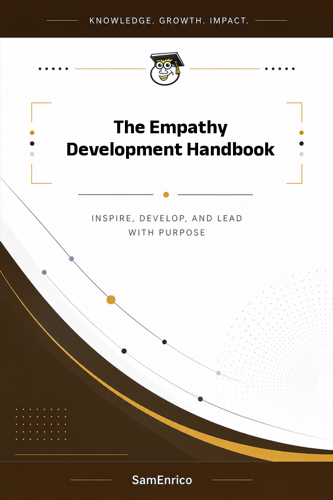
The Empathy Development Handbook eBook
Offers exercises to enhance cognitive and affectiv
Offers exercises to enhance cognitive and affective empathy for better relationships.
Formats
Free sample
Chapter 1: The Empathy Delusion--Most people believe they are empathetic. They are wrong.Not wrong in a cruel way. Not wrong because they are bad people. Wrong in the same way that most drivers believe they are above average—a statistical impossibility that reveals less about driving skill and more about the architecture of self-perception. We are built to overestimate our own virtues, and empathy, perhaps more than any other human quality, is a virtue we desperately want to claim.But wanting to be empathetic and actually being empathetic are two different things.Consider this scene, drawn from research that has been replicated dozens of times across multiple continents.
A woman arrives at a hospital for a routine outpatient procedure. She is nervous but managing. A nurse escorts her to a small room, takes her blood pressure, and asks the standard set of questions: allergies, medications, next of kin. The woman answers mechanically. Then the nurse does something unexpected.
She stops reading from her clipboard. She looks directly at the woman. She says, softly, "You seem really scared right now. I want you to know that's completely normal. Almost everyone who comes through that door feels exactly what you're feeling."The woman's shoulders drop.
Her breathing slows. Her blood pressure, measured again two minutes later, has fallen significantly. This is not a guess. This is data. The nurse did not solve any problem.
She did not offer medication or a faster procedure or a better outcome. She simply recognized an emotion, named it without judgment, and normalized it. That was enough to change the woman's physiology.Now consider a second scene, equally real, equally documented. A husband comes home from work. His wife is sitting on the couch, staring at the wall.
She has just learned that her mother has been diagnosed with early-stage dementia. The husband, seeing her distress, immediately shifts into problem-solving mode. "We'll find the best specialist," he says. "There are new treatments. Your mom is strong.
She'll be fine." His wife says nothing. He tries again. "At least we caught it early. At least she's not in pain." His wife gets up and walks out of the room. The husband is confused.
He was trying to help. He was being positive. He was doing everything right—except he wasn't. He was doing everything wrong.The nurse and the husband are not different kinds of people. They are not one good and one bad.
They are simply operating with different understandings of what empathy actually is and how it actually works. The nurse understood something fundamental that the husband did not: that empathy is not a single thing. It is two distinct skills, and confusing them can damage the very relationships you are trying to save.This is the empathy delusion. And this chapter is where it dies.The Two Empathies You Didn't Know You Had For most of human history, empathy was treated as a unitary concept—a single, mysterious capacity to "feel with" another person. If you had it, you were compassionate.
If you lacked it, you were cold. End of story. This binary thinking has caused incalculable harm, both in personal relationships and in professional settings, because it blinds us to a crucial distinction that neuroscientists and psychologists have spent the last twenty years clarifying.Empathy is not one thing. It is two things. And they are not even located in the same part of the brain.Cognitive empathy is the intellectual ability to identify and understand another person's emotions and perspective.
It is the skill of looking at someone and thinking, Ah, I see why they are angry. Their boss publicly criticized them. That makes sense. Cognitive empathy requires no emotional resonance whatsoever. You can understand why someone is furious without feeling a single flicker of that fury yourself.
In fact, sometimes understanding without feeling is the entire point. Surgeons need cognitive empathy to understand their patients' fear, but if they felt that fear viscerally while holding a scalpel, their hands would shake.Affective empathy is the visceral capacity to share another person's emotions. It is the automatic, often involuntary experience of feeling what someone else is feeling. When you watch a movie and tear up as the protagonist grieves, that is affective empathy. When your friend laughs and you find yourself laughing even though you didn't hear the joke, that is affective empathy.
It is fast, unconscious, and deeply biological—driven by mirror neurons that fire identically whether you experience pain or watch someone else experience it.These two empathies are processed in different neural circuits. Cognitive empathy engages the prefrontal cortex and the temporoparietal junction—regions associated with reasoning, perspective-taking, and mentalizing about others' minds. Affective empathy engages the anterior insula and the anterior cingulate cortex—regions associated with interoception (sensing your own body's state) and emotional salience. You can have high cognitive empathy and low affective empathy. You can have high affective empathy and low cognitive empathy.
You can have both. You can have neither.And here is where the empathy delusion does its damage: most people assume that if they have one, they automatically have the other. They don't. And the mismatch between what you think you are offering and what the other person actually needs is the single greatest source of empathic failure in everyday life.The Manager Who Cried (And the One Who Didn't)Let us make this concrete with two archetypes that will appear again throughout this book: the Overly Affective Empath and the Cold Cognitive Empath.The Overly Affective Empath is the manager who cries with every distressed employee. She feels everything.
When a team member announces a divorce, she tears up. When someone is passed over for promotion, she feels the rejection as if it were her own. Her team appreciates her warmth—at first. But over time, a problem emerges. She is so flooded by others' emotions that she cannot make hard decisions.
She cannot fire someone who needs to be fired because she feels their hypothetical pain too acutely. She cannot deliver critical feedback because she anticipates the recipient's shame and collapses under the weight of it. Her team begins to feel that they have a friend, not a leader. And friends, while lovely, do not run effective organizations. Within eighteen months, her burnout is complete.
She is exhausted, hollowed out, and secretly resentful of the very people she tried so hard to feel for.The Cold Cognitive Empath is the manager who understands everyone perfectly and cares about no one. He can predict exactly how an employee will react to a given stimulus. He can map the emotional landscape of a negotiation with surgical precision. He uses this understanding not to connect but to manipulate. He knows that praising someone publicly before asking for a favor increases compliance by forty percent.
He knows that delivering bad news on a Friday afternoon gives people the weekend to process, which reduces blowback on him. His team respects his intelligence but does not trust him. They sense, correctly, that his empathy is a tool, not a bridge. He is not a sociopath in the clinical sense—he can recognize emotions just fine—but he functions like one…
This is the end of the free sample. Get the eBook to keep going. Buy now
About this book
Details
- Author
- Ritter Vannesa
- Publisher
- SamEnrico
- Language
- English
- Genre
- Non-Fiction, Self-Help, Empathy Training
- Released
- 2026-06-10
- Pages (approx.)
- 154
- Available as
- eBook, Audiobook

Read better in the ZLOADR app
Your eBooks on your phone or tablet. Sign in with your SamEnrico account and start reading.
More by Ritter Vannesa
 Active Listening CourseRitter Vannesa$11.99
 Senior Mentoring Self Esteem CourseRitter Vannesa$11.99
 Adolescent Body Image RescueRitter Vannesa$11.99
 Polish Secret State StructuresRitter Vannesa$11.99
 Orpheus and the Lyre That Conquered DeathRitter Vannesa$11.99
 Litigation LawyerRitter Vannesa$11.99
 Understanding Macular Degeneration, Age-relatedRitter Vannesa$17.99
 Data Presentation Mistakes GalleryRitter Vannesa$12.99
 A Beginners Guide to Drum and bugle corps (modern) (Volume 1)Ritter Vannesa$11.99
You may also like
 Hong Kong Handover 1997Dunn Johnnie$11.99
 Zumba For Postnatal Recovery CourseNeal Christian$11.99
 Zumba for BeginnersLadner Nikia$11.99
 YouTube Comment Mining GuideHumes Pandora$12.99
 Worry Box MeditationCarlin Rudy$11.99
 Workplace Stress MeditationNguyen Lynn$11.99
 Workplace Stress and Sleep RepairHawley Ivory$11.99
 Workplace Perfectionism CureDelaney Jeffry$11.99
 Workplace Injustice Anger GuideWallen Isabelle$11.99
 Work Addiction and Burnout LinkGreenwood Ester$11.99
 Women in Yoga and WellnessBeattie Galina$11.99
 Women in Stand Up ComedyChun Evangeline$11.99