
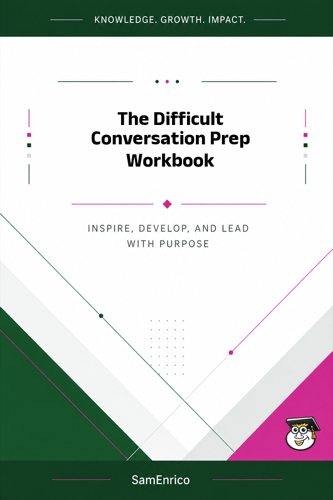
Non-FictionSelf-HelpCommunication Skills
The Difficult Conversation Prep Workbook eBook
Provides pre talk planning sheets and scripts for
Provides pre talk planning sheets and scripts for high stakes discussions.
Formats
Free sample
Chapter 1: The Receipt of Regret--–- Three weeks ago, Maya sat in her parked car for forty-seven minutes. The engine was off. The garage was dark. Her phone showed twelve unread messages from her co-founder, David. The conversation she needed to have—about the way he had publicly dismissed her budget proposal in front of the entire leadership team—had been living in her head for eleven months.
She had rehearsed it so many times that she could recite three different versions: the aggressive one (which she would never say), the weepy one (which she would never allow herself to say), and the careful, professional one (which she kept editing because it never felt quite right). Forty-seven minutes. Then she started the car, drove home, told her partner she was tired, and went to bed. The conversation did not happen. The silence won again.This is not a book about why difficult conversations are hard.
You already know that. This is a workbook about what avoidance costs you—and how to stop paying that price starting today.Every best-selling book on this topic—from Crucial Conversations to Difficult Conversations to Never Split the Difference—agrees on one hidden truth that almost no one talks about: the rumination loop is more damaging than any single difficult conversation could ever be. The conversation you are afraid to have is already happening. It is happening in your head, on repeat, at 2 AM, in the shower, during meetings, while you are trying to fall asleep. And every time you replay it, you are not preparing.
You are bleeding.This chapter is called The Receipt of Regret because we are going to do something uncomfortable: we are going to add up what your silence has actually cost you. Not in vague terms like “stress” or “friction.” We are going to calculate it in hours of sleep lost, dollars of revenue missed, relationships eroded, and opportunities vanished. By the time you finish this chapter, you will have a single sheet of paper—the Cost of Inaction Matrix—that will make one thing undeniable: silence is not safer. It is just slower to bill you.The Fool’s Choice: Why Your Brain Lies to You Let us name the enemy. In Crucial Conversations, Patterson, Grenny, Mc Millan, and Switzler identified a cognitive trap they called the “Fool’s Choice.” It is the false belief that you must choose between two equally terrible options: telling the truth and damaging the relationship, or preserving the relationship and staying silent.
Your brain presents this as a binary. Speak up and risk conflict, or stay quiet and keep the peace.Here is what the research actually shows: silence does not keep the peace. It merely postpones the explosion while adding fuel to the fire.When you avoid a difficult conversation, three things happen inside your nervous system. First, your amygdala—the brain’s threat-detection center—treats the memory of the unresolved issue as an ongoing threat. This means your body is producing cortisol (the stress hormone) every time you think about the person or the topic.
Second, your prefrontal cortex, which is responsible for creative problem-solving, literally has less bandwidth because it is stuck in a loop of rumination. Third, you begin to tell yourself what researchers call “Clever Stories”—narratives that justify your avoidance by making the other person into a villain and yourself into a victim. We will dismantle those stories in Chapter 8. For now, just recognize that the Fool’s Choice is a lie. You have a third option: prepare, then speak.
That is what this entire workbook exists to give you.The Inventory of Silence: What You Are Not Saying Before we can calculate costs, we need to take inventory. On a separate sheet of paper (or in the workbook space provided), answer these three questions honestly. Do not censor yourself. Do not write what you think you should feel. Write what is true.Question 1: What is the one conversation you are avoiding right now that, if you had it successfully, would change something significant in your life or work?
Name it. “The conversation with my boss about my workload.” “The conversation with my partner about feeling unseen.” “The conversation with my sibling about our aging parent.” Write it down.Question 2: How long have you been avoiding this conversation? Be specific. “Three months.” “Eighteen months.” “Five years.”Question 3: In that time, how many times have you rehearsed it in your head? Do not say “too many.” Estimate.
“Fifty times.” “Two hundred times.” “Every single day.”Now look at what you have written. You have already invested time—possibly dozens of hours—into a conversation that has not happened. That time is gone. It produced zero change in your real life. It only produced more anxiety.
This is the first cost of silence: the time tax.The Cost of Inaction Matrix: A Two-Axis Accounting Tool The centerpiece of this chapter is the Cost of Inaction Matrix. Unlike a simple pros-and-cons list, which tends to favor the status quo (because the status quo feels familiar and therefore safe), this matrix forces you to quantify both professional and emotional costs across two time horizons: what has already been lost and what will be lost if you continue avoiding.Draw a large square divided into four quadrants.Top Left Quadrant: Professional Costs Already Incurred What has already happened at work (or in your professional life) because you have not spoken up? Missed promotions? Lost team cohesion? A project that went off the rails because you did not flag a problem early?
A client you lost because you did not address a complaint? Be specific and, where possible, attach numbers.Example: “I did not tell my direct report that her presentations are too disorganized. In the last six months, she has presented to leadership four times. Each time, leadership has asked follow-up questions that she could not answer. I have spent approximately six hours cleaning up after those meetings.
My team has lost credibility. No one has said it, but I can feel the trust eroding.”Top Right Quadrant: Professional Costs Future Projected If you avoid this conversation for another six months, what will happen? Be honest. Will the problem grow? Will you be fired?
Will you quit out of frustration? Will a good employee leave because you failed to give them feedback? Project forward. Use the same specificity.Example: “If I do not give my direct report feedback in the next 30 days, she will present again next quarter. Leadership will notice the same issues.
They will assume I am not managing her. My annual review is in four months. I estimate my bonus could be reduced by 5-10%—approximately $5,000 to $10,000.”Bottom Left Quadrant: Emotional Costs Already Incurred What has your avoidance cost you internally? Sleep loss—how many nights? Anxiety—how many hours of rumination?
Resentment—how many moments of silent seething? Physical symptoms—tight shoulders, headaches, digestive issues? Relationship strain—have you been shorter with your family because you are carrying this weight?Example: “I have lost roughly one hour of sleep per night for the last three months—approximately 90 hours of sleep. I have snapped at my partner three times about unrelated things…
This is the end of the free sample. Get the eBook to keep going. Buy now
About this book
Details
- Author
- Thibodeau Kathe
- Publisher
- SamEnrico
- Language
- English
- Genre
- Non-Fiction, Self-Help, Communication Skills
- Released
- 2026-06-06
- Pages (approx.)
- 148
- Available as
- eBook, Audiobook

Read better in the ZLOADR app
Your eBooks on your phone or tablet. Sign in with your SamEnrico account and start reading.
More by Thibodeau Kathe
 Sofia Coppola GirlhoodThibodeau Kathe$11.99
 Micro Breaks For Burnout Prevention CourseThibodeau Kathe$11.99
 Nipple Self Esteem WorkbookThibodeau Kathe$11.99
 ADHD Child Sleep GuideThibodeau Kathe$11.99
 The Siege of Nis: The Wall-Breaker of the BalkansThibodeau Kathe$11.99
 Student ManagerThibodeau Kathe$11.99
 Understanding Mental Retardation, X Linked, Marfanoid HabitusThibodeau Kathe$17.99
 Workshop Facilitation PromptsThibodeau Kathe$12.99
 OECD Pillar One Tax GuideThibodeau Kathe$12.99
 How to Become a Kiln-operator HelperThibodeau Kathe$11.99
You may also like
 Hong Kong Handover 1997Dunn Johnnie$11.99
 Zumba For Postnatal Recovery CourseNeal Christian$11.99
 Zumba for BeginnersLadner Nikia$11.99
 YouTube Comment Mining GuideHumes Pandora$12.99
 Worry Box MeditationCarlin Rudy$11.99
 Workplace Stress MeditationNguyen Lynn$11.99
 Workplace Stress and Sleep RepairHawley Ivory$11.99
 Workplace Perfectionism CureDelaney Jeffry$11.99
 Workplace Injustice Anger GuideWallen Isabelle$11.99
 Work Addiction and Burnout LinkGreenwood Ester$11.99
 Women in Yoga and WellnessBeattie Galina$11.99
 Women in Stand Up ComedyChun Evangeline$11.99