
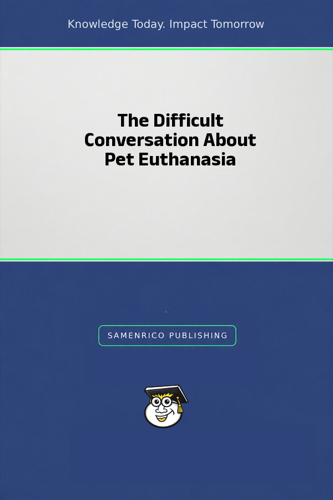
The Difficult Conversation About Pet Euthanasia eBook
How to discuss end of life decisions for beloved a
How to discuss end of life decisions for beloved animals with family.
Formats
Free sample
Chapter 1: The Unspoken Calculus--The decision arrives like a thief in the night—not with a dramatic crash, but with a quiet realization that settles into your bones while you are doing something ordinary. You are filling the water bowl and notice that your dog does not lift their head. You are scooping the litter box and see blood for the third time this week. You are watching your cat struggle onto the bed they have leaped onto ten thousand times before, and this time they miss. In that ordinary moment, something shifts.
You know. You do not want to know. You would give anything not to know. But you know.This is the unspoken calculus that every pet owner eventually faces: the brutal arithmetic of love and suffering, of days and quality, of holding on and letting go. Unlike the sudden death of an animal hit by a car or lost to a rapid illness, euthanasia asks you to do something that feels fundamentally unnatural.
It asks you to choose a time and place for death. It asks you to look at a creature you have protected, fed, and loved and decide that today is the day their story ends. And then it asks you to have a conversation about that decision with the other people who love this animal—a conversation for which no one has ever given you a script.This chapter is called The Unspoken Calculus because that is what the euthanasia conversation truly is: a calculation that families perform together, often without realizing they are doing it, weighing variables that cannot be measured against outcomes that cannot be known. How much suffering is too much? How many good days balance one bad day?
Who gets to decide when the family cannot agree? These questions have no right answers, only the answers that your family can live with. And the only way to find those answers is to talk about them—out loud, together, even when every instinct tells you to stay silent.The Weight of Unspoken Things There is a particular heaviness that enters a home when a pet is dying. It is not the same heaviness as other kinds of waiting. When you are waiting for a job offer or a medical diagnosis or a phone call, the heaviness is anticipatory—a future-oriented tension that can be temporarily forgotten.
The heaviness of a dying pet is different because it is present in every room. The dog who cannot climb the stairs anymore forces you to carry them, and in that carrying, you feel their weight and their fragility simultaneously. The cat who hides under the bed instead of greeting you at the door forces you to search for them, and in that searching, you confront the possibility of their absence. The heaviness is not just emotional. It is physical, spatial, architectural.
Your home becomes a map of your pet’s decline, and every room holds a reminder that time is running out.Most families respond to this heaviness by not talking about it. They dance around it. They make jokes about the dog being “old and grumpy” when what they really mean is “I am terrified that I will have to say goodbye.” They say “We’ll know when it’s time” as if knowledge arrived fully formed rather than being built through difficult conversation. They avoid eye contact when the vet uses words like “quality of life” and “compassionate options.” The unspoken things accumulate like dust, invisible at first, then impossible to ignore.The irony is that the unspoken things are exactly what need to be spoken. The fear that you are prolonging suffering because you cannot bear to let go—that needs to be said aloud.
The worry that your spouse will think you are cruel for suggesting euthanasia—that needs to be said aloud. The secret relief you feel at the prospect of no longer cleaning up accidents or administering medications—that needs to be said aloud, too, because it is normal and human and shared by more people than will ever admit it. The unspoken calculus becomes heavier the longer it remains unspoken. Saying the words out loud does not make the decision easier, but it makes it yours. It makes it shared.
It makes it real.Why This Conversation Is Different Most difficult family conversations follow a recognizable pattern. Someone has done something wrong, and the family must decide how to respond. Someone has received bad news, and the family must figure out how to cope. Someone has made a life change, and the family must adjust. The euthanasia conversation is different because no one has done anything wrong.
The pet is not at fault for aging or getting sick. You are not at fault for considering euthanasia. The conflict that arises is not about blame but about love—specifically, about how love should look at the end of a life.This distinction matters because it changes the stakes of the conversation. When a family argues about a betrayal or a mistake, there is a clear right and wrong, even if it takes time to sort out. When a family argues about euthanasia, there is often no clear right and wrong, only different expressions of the same love.
The family member who wants to wait is not being cruel; they are expressing love by hoping for a miracle. The family member who wants to schedule the appointment is not being cold; they are expressing love by prioritizing the prevention of suffering. The conflict is not between those who love the pet and those who do not. It is between people who love the pet differently.This realization can be liberating or infuriating, depending on your temperament. It is liberating because it means no one is the villain.
Your spouse is not trying to hurt you by refusing to talk about euthanasia. Your parent is not trying to control you by insisting on “doing everything.” They are acting out of love, just as you are. But the realization is also infuriating because it offers no clear path forward. If both sides are right, how do you decide? If everyone loves the pet, whose love wins?
The unspoken calculus has no algorithm. It has only conversation.The Four Hidden Fears Beneath every difficult conversation about euthanasia, there are four fears that almost no one names aloud. These fears drive the conflict, the avoidance, and the pain. Naming them is the first step toward talking about them.The fear of playing God. This is the fear that choosing when an animal dies is an act of arrogance, an overstepping of your rightful role as a caretaker.
It is rooted in genuine ethical questions about the limits of human authority over other lives. For some families, this fear is explicitly religious—the belief that only the Creator should determine the moment of death. For others, it is more diffuse—a sense that death should come naturally, that intervening is somehow wrong. The fear of playing God is powerful because it touches on questions of meaning, morality, and cosmic order. It cannot be dismissed or argued away.
It must be acknowledged.The fear of getting it wrong. This is the fear that you will choose euthanasia too soon…
This is the end of the free sample. Get the eBook to keep going. Buy now
About this book
Details
- Author
- Smalls Cherryl
- Publisher
- SamEnrico
- Language
- English
- Genre
- Non-Fiction, Self-Help, Pet Loss
- Released
- 2026-06-08
- Pages (approx.)
- 137
- Available as
- eBook, Audiobook

Read better in the ZLOADR app
Your eBooks on your phone or tablet. Sign in with your SamEnrico account and start reading.
More by Smalls Cherryl
 Mindful Self Compassion MBSR CourseSmalls Cherryl$11.99
 The Mindful Tech DetoxSmalls Cherryl$11.99
 Ayurvedic Depression GuideSmalls Cherryl$11.99
 Teen Self Esteem and LeadershipSmalls Cherryl$11.99
 Bloodline of the Sun: The Last Pharaoh’s SecretSmalls Cherryl$11.99
 Brazil WhatsApp Marketing for DropshippersSmalls Cherryl$12.99
 Workforce Scheduling AI GuideSmalls Cherryl$12.99
 Trust Operations SpecialistSmalls Cherryl$11.99
 Understanding Methylmalonic AcidemiaSmalls Cherryl$17.99
 How to Start a Cement Business (Beginners Guide)Smalls Cherryl$11.99
You may also like
 Hong Kong Handover 1997Dunn Johnnie$11.99
 Zumba For Postnatal Recovery CourseNeal Christian$11.99
 Zumba for BeginnersLadner Nikia$11.99
 YouTube Comment Mining GuideHumes Pandora$12.99
 Worry Box MeditationCarlin Rudy$11.99
 Workplace Stress MeditationNguyen Lynn$11.99
 Workplace Stress and Sleep RepairHawley Ivory$11.99
 Workplace Perfectionism CureDelaney Jeffry$11.99
 Workplace Injustice Anger GuideWallen Isabelle$11.99
 Work Addiction and Burnout LinkGreenwood Ester$11.99
 Women in Yoga and WellnessBeattie Galina$11.99
 Women in Stand Up ComedyChun Evangeline$11.99