
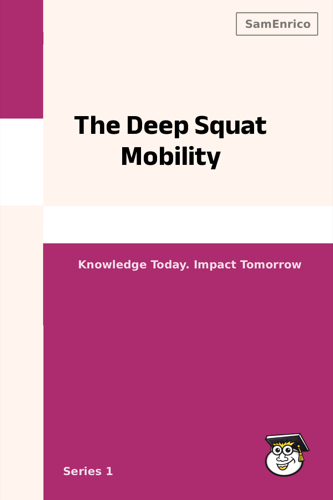
Non-FictionHealth & WellnessSquat
The Deep Squat Mobility eBook
Improve ankle and hip flexion to achieve a comfort
by Lerner Randy
Improve ankle and hip flexion to achieve a comfortable resting squat.
Formats
Free sample
Chapter 1: The Lost Birthright--–- In the summer of 1987, a team of anthropologists working in northern Tanzania filmed something that would quietly haunt the fitness world for decades. The footage showed a ninety-two-year-old Hadza elder named Goro sitting in a full resting squat beside a cooking fire, his heels flat against the hard-packed earth, his spine as neutral as a plumb line, his breathing slow and rhythmic. He remained in that position for forty-seven minutes while tending to a pot of porridge. When he finally stood up, he did so without using his hands, without groaning, without staggering, and without the thousand-yard stare of a man who had just survived an ordeal. He simply unfolded and walked away.The research team had seen this before, of course.
Among the Hadza, a hunter-gatherer community that has lived on the same land for over ten thousand years, the resting squat is as unremarkable as sitting in a chair is to a modern office worker. Toddlers squat to play. Adults squat to rest, to work, to eat, to defecate, to wait. The elderly squat until their final days. No one stretches beforehand.
No one worries about "butt wink" or "ankle dorsiflexion." No one posts videos online celebrating their first unassisted squat at the age of forty-three. The deep squat is not a skill they acquire. It is a birthright they never lose.The anthropologists, most of whom were Westerners in their thirties, tried to imitate Goro. Every single one of them failed. The youngest member of the team, a twenty-six-year-old graduate student, managed to lower herself into something resembling a squat, but her heels lifted two inches off the ground, her lower back rounded like a scared cat, and after twelve seconds she toppled backward onto her tailbone.
The rest of the team fared worse. One postdoctoral researcher reported sharp pain in his groin that persisted for three days.That graduate student's name was Dr. Sarah Ellington, and she is now a professor of evolutionary biomechanics at the University of Cambridge. Twenty years after that humbling day in Tanzania, she published a landmark paper titled "The Ontogeny and Phylogeny of Human Squatting Behavior," which contained a sentence that should have been a wake-up call to the entire fitness industry: "The ability to perform a pain-free, heel-down resting squat is not a specialized athletic achievement. It is a baseline human motor skill that has been systematically erased by the furniture-industrial complex."Here is the uncomfortable truth that Dr.
Ellington's research revealed: you were born knowing how to do this. Every human infant, regardless of genetics, culture, or geography, can perform a perfect deep squat by the time they can pull themselves to stand. Watch a baby pick up a toy from the floor. They don't hinge at the waist like a stiff office worker. They don't round their back and strain their hamstrings.
They drop into a flawless squat—heels down, knees tracking over toes, spine neutral, pelvis open—and they hold that position without effort for as long as they need. Then they stand back up, again without effort, and toddle away.That baby's squat is not the result of stretching, training, or special shoes. It is the natural expression of a human skeleton that is designed to spend a significant portion of its life in a squatting posture. Your hip joints are ball-and-socket joints capable of an extraordinary range of motion. Your ankle joints have a specific bony glide called dorsiflexion that allows your knee to travel forward over your toes while your heel stays planted.
Your spine has a natural curve that can absorb compression and distribute load evenly. Your nervous system has built-in reflexive patterns that know exactly how to coordinate all of these parts into a single, fluid movement.You had all of this the day you were born. And then, slowly, insidiously, you lost it.The Slow Theft of Your Natural Range of Motion Theft is the right word, because you did not voluntarily surrender your squatting ability. It was taken from you by a thousand small, seemingly benign decisions made by people who were not thinking about your long-term mobility. The first thief appeared shortly after you learned to walk: the chair.Before the widespread adoption of seated furniture in the seventeenth and eighteenth centuries, most humans spent a significant portion of their waking hours in either a squatting or kneeling position.
In his 2013 book The Story of the Human Body, evolutionary biologist Daniel Lieberman notes that skeletal remains from pre-agricultural societies show hip and ankle joints with cartilage patterns indicating regular, sustained end-range loading. In plain English: their joints were shaped by the positions they held every day. The squat was not just a position they used occasionally; it was a position their bodies remodeled around.Then came the chair. At first, chairs were status symbols reserved for royalty and clergy. To sit on a chair was to declare yourself above the peasantry who still squatted on the floor.
By the Industrial Revolution, chairs had become ubiquitous. By the twentieth century, the average Westerner was spending eight to ten hours per day in a seated position—not including sleeping. The chair did not merely replace squatting; it made squatting feel unnatural, even humiliating. "Sit like a civilized person" became a phrase parents used to scold children who dared to squat while playing.But the chair was only the beginning. The second thief arrived in the form of the modern toilet.
For most of human history, defecation was performed in a squatting position, which aligns the rectum in a straight line and requires no straining. The raised toilet, introduced in the late nineteenth century and popularized by the 1940s, forces the user into a seated position that requires muscular effort to complete the same biological task. More relevant to this book, the raised toilet means that most Western adults have not squatted to full depth since they were toilet-trained. Decades of never accessing the end range of hip and ankle flexion sends a clear signal to the body: we don't use that range anymore. Let it go.
And the body, ever efficient, obliges.The third thief is the modern shoe. Take a look at the soles of your shoes. Unless you have deliberately sought out minimalist footwear, you will notice that the heel is elevated relative to the toe. This heel-toe drop, typically between eight and twelve millimeters in running shoes and even higher in dress shoes, artificially shortens the Achilles tendon and calf muscles by holding your ankle in a slightly plantar-flexed (toes pointed down) position even when you are standing still. Wear these shoes every day for ten or twenty or forty years, and the calf complex physically shortens.
The range you lose is not dramatic—perhaps ten or fifteen degrees of dorsiflexion. But that ten degrees is precisely the range required to keep your heels on the ground in a deep squat.The fourth thief is the car seat, which does to your hips what raised heels do to your ankles. The typical car seat positions your hips in slight flexion (thighs angled upward relative to your torso) and slight external rotation (knees falling outward). Hold…
This is the end of the free sample. Get the eBook to keep going. Buy now
About this book
Details
- Author
- Lerner Randy
- Publisher
- SamEnrico
- Language
- English
- Genre
- Non-Fiction, Health & Wellness, Squat
- Released
- 2026-06-08
- Pages (approx.)
- 149
- Available as
- eBook, Audiobook

Read better in the ZLOADR app
Your eBooks on your phone or tablet. Sign in with your SamEnrico account and start reading.
More by Lerner Randy
 Remote Work Evenings Off GuideLerner Randy$11.99
 Resentment Release Daily GuideLerner Randy$11.99
 Plant Based Lectin Concerns ManualLerner Randy$11.99
 James Buchanan Dithering DecadeLerner Randy$11.99
 Love in the Time of Cold War: The Kennedy-Khrushchev SummitLerner Randy$11.99
 Understanding Crystal Deposit DiseaseLerner Randy$17.99
 Transaction Management AnalystLerner Randy$11.99
 Negotiation Script PrimerLerner Randy$12.99
 IP Deadline Management ToolsLerner Randy$12.99
 How to Become a ScraperLerner Randy$11.99
You may also like
 Hong Kong Handover 1997Dunn Johnnie$11.99
 Zumba For Postnatal Recovery CourseNeal Christian$11.99
 Zumba for BeginnersLadner Nikia$11.99
 YouTube Comment Mining GuideHumes Pandora$12.99
 Worry Box MeditationCarlin Rudy$11.99
 Workplace Stress MeditationNguyen Lynn$11.99
 Workplace Stress and Sleep RepairHawley Ivory$11.99
 Workplace Perfectionism CureDelaney Jeffry$11.99
 Workplace Injustice Anger GuideWallen Isabelle$11.99
 Work Addiction and Burnout LinkGreenwood Ester$11.99
 Women in Yoga and WellnessBeattie Galina$11.99
 Women in Stand Up ComedyChun Evangeline$11.99