
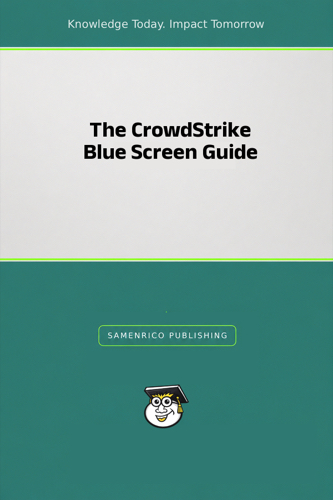
Non-FictionCrisis ManagementIT Disaster Recovery
The CrowdStrike Blue Screen Guide
Step-by-step emergency response protocol for the 2
Step-by-step emergency response protocol for the 2024 global Windows outage affecting airlines, banks, and hospitals.
Formats
About this book
Free sample
Chapter 1: The 1% Lie...--–- On July 19, 2024, at precisely 04:09 UTC, a 4-kilobyte file named C-00000291-*.sys began propagating across the planet. Within seventy-eight minutes, 8.5 million Windows machines were dead. Not slow. Not compromised. Dead.
Blue screens stared back from airport terminals in Sydney, trading floors in London, and intensive care units in Texas. The world didn't stop—but it came terrifyingly close.This is the story of that file. More importantly, this is the story of why everything you think you know about the outage is wrong.The Trigger That Wasn't a Cyberattack Let’s start with the single most important fact of the entire event: This was not a hack. Not a nation-state actor. Not ransomware.
Not a supply chain compromise. Not a zero-day exploit.The culprit was a routine Channel File 291 update from Crowd Strike's Falcon sensor. Channel files are not drivers. They are not kernel extensions. They are small configuration files—typically 4 to 20 kilobytes—that tell the Falcon sensor how to recognize new threat patterns.
Crowd Strike pushes these updates multiple times per day, often without any customer notification, because they are supposed to be harmless data files.Except this one wasn't.Somewhere in the development or validation pipeline, a logic error was introduced into Channel File 291. When the Falcon driver—which runs at the kernel level (Ring 0, the most privileged layer of Windows)—attempted to parse this specific file, it encountered a null pointer exception. In plain English: the driver tried to read from memory address zero, a location that Windows reserves as inaccessible. This is like telling a bus driver to turn left at an intersection that doesn't exist. The bus doesn't keep driving.
It crashes.In Windows, when a kernel-mode driver crashes, the entire operating system crashes with it. The result is the Blue Screen of Death (BSOD) , with error codes 0x50 (PAGE_FAULT_IN_NONPAGED_AREA) or 0x EF (CRITICAL_PROCESS_DIED).Here is what did NOT cause the crash:A malicious attacker A Windows update A hardware failure A misconfigured firewall or network setting User error Here is what DID cause the crash:A 4KB configuration file that passed Crowd…
This is the end of the free sample. Get the eBook to keep going. Buy now
Contents
- Chapter 1
- Chapter 2
- Chapter 3
- Chapter 4
- Chapter 5
- Chapter 6
- Chapter 7
- Chapter 8
- Chapter 9
- Chapter 10
- Chapter 11
- Chapter 12
Details
- Author
- Blaine Kandra
- Publisher
- SamEnrico
- Language
- English
- Genre
- Non-Fiction, Crisis Management, IT Disaster Recovery
- Released
- 2026-06-09
- Pages (approx.)
- 144
- Available as
- eBook, Audiobook

Read better in the ZLOADR app
Your eBooks on your phone or tablet. Sign in with your SamEnrico account and start reading.
More by Blaine Kandra
 Spin Instructor Cueing MasteryBlaine Kandra$11.99
 Anger Reframing TechniquesBlaine Kandra$11.99
 Perfectionism Release WorkbookBlaine Kandra$11.99
 The Testosterone and ED GuideBlaine Kandra$11.99
 Blitzkrieg of the Lowlands: Marlborough's Lightning Campaign (1704)Blaine Kandra$11.99
 Soft Skills Documentation GuideBlaine Kandra$12.99
 BOP Education Product GuideBlaine Kandra$12.99
 Understanding Vagneur–triolle–ripert SyndromeBlaine Kandra$17.99
 Intelligence AnalystBlaine Kandra$11.99
 10 Ways to Use Flax Seed (Recipe Book)Blaine Kandra$11.99
You may also like
 Hong Kong Handover 1997Dunn Johnnie$11.99
 Zumba For Postnatal Recovery CourseNeal Christian$11.99
 Zumba for BeginnersLadner Nikia$11.99
 YouTube Comment Mining GuideHumes Pandora$12.99
 Worry Box MeditationCarlin Rudy$11.99
 Workplace Stress MeditationNguyen Lynn$11.99
 Workplace Stress and Sleep RepairHawley Ivory$11.99
 Workplace Perfectionism CureDelaney Jeffry$11.99
 Workplace Injustice Anger GuideWallen Isabelle$11.99
 Work Addiction and Burnout LinkGreenwood Ester$11.99
 Women in Yoga and WellnessBeattie Galina$11.99
 Women in Stand Up ComedyChun Evangeline$11.99