
Non-FictionSelf-HelpTime Management
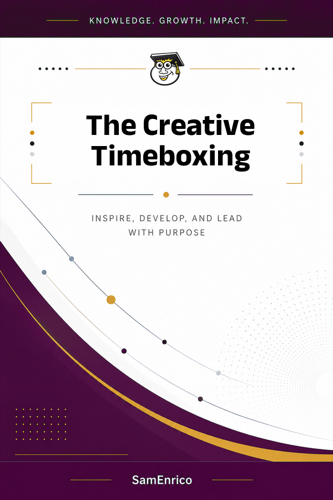
The Creative Timeboxing eBook
Allocates fixed time periods for specific team cre
by Loomis Gena
Allocates fixed time periods for specific team creative tasks.
Formats
Free sample
Chapter 1: The Meeting That Killed Creativity--–- The email arrived at 9:47 AM on a Tuesday. Three words in the subject line: “Brainstorming – please attend.” The body promised two hours of “open thinking” about the new product launch. There would be bagels. There would be a whiteboard. There would be, the email assured everyone, “no bad ideas.”By 11:00 AM, the bagels were gone.
The whiteboard contained exactly seven ideas, three of which were jokes, two of which were impossible, one of which had been proposed at the last three brainstorming sessions, and one of which was genuinely interesting—but no one remembered who suggested it, and by the time someone thought to write it down, the conversation had drifted to the company’s new snack policy.By 11:45 AM, the meeting ended with a consensus that felt familiar to everyone in the room: “We’ll pick this up next week.”No one did. Nothing happened. The interesting idea died, unnoticed and unwept, somewhere between the cold bagels and the snack policy debate.This is not an isolated failure. This is the standard operating procedure for creative teams around the world. And it is a disaster.The Great Creative Lie We have been sold a story about creativity that is not merely incomplete but actively destructive.
The story goes like this: creativity requires freedom. Unbounded time. Open horizons. The muse visits when she pleases, and we must keep the calendar clear so that when inspiration strikes, there is room for her to land.This is a lie.The truth, supported by decades of cognitive science and observed in thousands of creative teams, is precisely the opposite. Creativity requires constraints.
It thrives under pressure. It emerges not from the absence of structure but from the right kind of structure—the kind that channels energy rather than dispersing it.Consider the evidence. In study after study, researchers have found that when people are given unlimited time to solve a creative problem, they produce fewer novel solutions than when they are given a tight deadline. This is not because people work harder under pressure—though they do—but because the presence of a deadline forces a crucial psychological shift. With unlimited time, the brain defaults to analytical thinking: evaluating, filtering, second-guessing.
With a deadline, the brain shifts to associative thinking: connecting disparate ideas, taking risks, generating volume.The clock, in other words, is not the enemy of creativity. The clock is creativity’s forgotten partner.The Anatomy of a Wasted Hour Let us examine the typical creative meeting with the cold precision of a surgeon examining a tumor. The two-hour brainstorming session is the most common form of team creativity in the modern workplace. It is also the most ineffective.Here is what actually happens inside those 120 minutes, based on observational studies of hundreds of creative teams:Minutes 0–5: People arrive late. Laptops are opened.
Phones are checked. The facilitator asks, “Is everyone ready?” No one is.Minutes 5–15: The problem is restated three or four times. Someone says, “Let’s think outside the box.” Someone else writes “synergy” on the whiteboard. The first three ideas are offered by the same two people who always speak first.Minutes 15–45: The “productive” phase—or what passes for it. Ideas are offered randomly.
No structure governs who speaks or for how long. The extroverts dominate. The introverts retreat into their laptops. The facilitator tries to write everything down but misses half of it because they are also trying to manage the conversation.Minutes 45–75: Attention collapses. Someone checks their phone.
Someone else follows. The conversation fragments into side discussions. One subgroup debates a detail that is irrelevant to the main problem. Another subgroup has stopped participating entirely. The whiteboard looks like a crime scene—disorganized, illegible, overwhelming.Minutes 75–105: Fatigue sets in.
The quality of ideas drops precipitously. People begin repeating themselves. The facilitator asks, “Does anyone have anything else?” Silence. Someone says, “I think we’ve covered everything.” They have not.Minutes 105–120: The meeting ends in a rush. Someone volunteers to “send around a summary.” The summary is never sent.
The ideas are never evaluated. The next meeting is scheduled for next week, where the entire process will repeat.This is not a caricature. This is the lived experience of millions of creative professionals. And the cost is staggering. A team of six people spending two hours in a single brainstorming session burns twelve person-hours of creative potential.
If that team holds two such meetings per week—and many hold more—they burn nearly one thousand person-hours per year on meetings that produce nothing actionable.Parkinson’s Law and the Scandal of Unlimited Time In 1955, the British historian Cyril Northcote Parkinson published a satirical observation that has since been validated as a universal law of human behavior. He wrote: “Work expands so as to fill the time available for its completion.”This is Parkinson’s Law, and it is the single most important insight for anyone who wants to understand why creative teams fail.Here is what Parkinson’s Law means in practice. If you give a team two hours to brainstorm, they will take two hours. But they will not use two hours. They will fill two hours.
The first hour will be wasted on false starts, distractions, and social rituals. The second hour will be wasted on fatigue, repetition, and the slow agony of watching a clock that refuses to move faster.The same team, given thirty minutes to produce the same output, will produce it. They will not have time to waste. They will not have time to second-guess. They will not have time to check their phones.
The deadline will force a level of focus and urgency that no amount of “open thinking” can replicate.This is not speculation. This is measurable reality. In controlled studies, teams given tight deadlines for creative tasks consistently outperform teams given loose deadlines—not just in speed but in the quality and novelty of their output. The constraint does not crush creativity. It liberates it.Creative Velocity: A New Metric If we are going to fix creative teamwork, we need a new way of measuring success.
The traditional metrics—hours spent, meetings held, slides produced—are worse than useless. They measure activity, not achievement. They reward busyness, not breakthrough.We need a new metric: creative velocity.Creative velocity is the rate at which a team generates, refines, and ships novel ideas that create value. It has three components:Generation: How many raw ideas does the team produce per hour? Not good ideas—just ideas.
Volume is the prerequisite for quality.Refinement: How quickly can the team move from a raw idea to a tested hypothesis? This includes converging on priorities, building prototypes, and gathering feedback.Shipping: How often does the team produce a tangible artifact—a decision, a prototype, a launched feature—that could not have existed without their creative work?The average creative team has a creative velocity that is terrifyingly low. They generate perhaps ten raw ideas per week. They refine one or two. They ship something actionable perhaps once a month.
The rest of their time is consumed by the hidden costs of unstructured collaboration: waiting, debating, repeating, recovering.The goal of…
This is the end of the free sample. Get the eBook to keep going. Buy now
About this book
Details
- Author
- Loomis Gena
- Publisher
- SamEnrico
- Language
- English
- Genre
- Non-Fiction, Self-Help, Time Management
- Released
- 2026-06-07
- Pages (approx.)
- 133
- Available as
- eBook, Audiobook

Read better in the ZLOADR app
Your eBooks on your phone or tablet. Sign in with your SamEnrico account and start reading.
More by Loomis Gena
 Growth Hormone Receptor GeneticsLoomis Gena$11.99
 TM for Police OfficersLoomis Gena$11.99
 Birthday Memory PegsLoomis Gena$11.99
 Nicotine Withdrawal Anger ManagementLoomis Gena$11.99
 Neurodivergent Workplace StressLoomis Gena$11.99
 Diamond Heist Prison EscapeLoomis Gena$11.99
 HGH And Hair GrowthLoomis Gena$11.99
 Tulip Mania: The First Financial FrenzyLoomis Gena$11.99
 French Green Tax Credits GuideLoomis Gena$11.99
 Hastings: The Last Saxon King's StandLoomis Gena$11.99
 Hannibal's Gambit: The Carthaginian Strategist Who Shaped RomeLoomis Gena$11.99
 The Dancer's Guide to LavoltaLoomis Gena$11.99
You may also like
 Hong Kong Handover 1997Dunn Johnnie$11.99
 Zumba For Postnatal Recovery CourseNeal Christian$11.99
 Zumba for BeginnersLadner Nikia$11.99
 YouTube Comment Mining GuideHumes Pandora$12.99
 Worry Box MeditationCarlin Rudy$11.99
 Workplace Stress MeditationNguyen Lynn$11.99
 Workplace Stress and Sleep RepairHawley Ivory$11.99
 Workplace Perfectionism CureDelaney Jeffry$11.99
 Workplace Injustice Anger GuideWallen Isabelle$11.99
 Work Addiction and Burnout LinkGreenwood Ester$11.99
 Women in Yoga and WellnessBeattie Galina$11.99
 Women in Stand Up ComedyChun Evangeline$11.99