
Non-FictionHealth & WellnessLifelong Learning
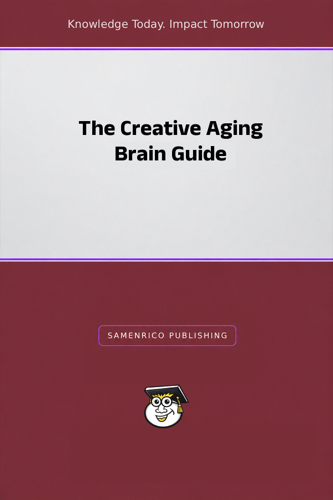
The Creative Aging Brain Guide eBook
Learning new skills in later life builds cognitive
Learning new skills in later life builds cognitive reserve and delays dementia.
Formats
Free sample
Chapter 1: The Uncomfortable Truth--–- Therese sat at her kitchen table, a cup of cold coffee in front of her, staring at the crossword puzzle she had completed in under twelve minutes. She was seventy-one years old, a retired high school principal, and she had done the New York Times crossword every morning for thirty-seven years. That morning, for the first time, she wondered: Is this doing anything at all?Her neurologist had used the phrase "cognitive reserve" during her last annual visit. Therese had nodded along, assuming that her decades of daily puzzles, her book club, her bridge games on Thursday afternoons—all of it—was building some kind of fortress around her brain. But her daughter, a neuroscientist at UCLA, had gently corrected her the previous week.
"Mom," she had said, "crosswords are maintenance. They're like brushing your teeth. Important, but they're not exercise."Therese had felt, for the first time in years, a flicker of something she couldn't name. Not fear, exactly. Something closer to the feeling she'd had on her first day of teaching, standing in front of thirty-seven seventh graders, realizing that everything she thought she knew about classroom management was about to be tested.
Vulnerability. That was the word.This chapter is for every Therese. For every person over fifty who has been diligently doing the "right things" for their brain—the puzzles, the memorization games, the brain-training apps—only to suspect that something is missing. The uncomfortable truth is this: your brain does not grow stronger by repeating what you already know. It grows stronger by struggling with what you do not yet know.
And that struggle feels terrible.The Myth of the Leaky Bucket For decades, the dominant metaphor for aging brains was a leaky bucket. As you get older, the thinking went, your brain slowly loses its contents. Memories drip away. Processing speed drains out. The best you can hope for is to plug the holes—to slow the leaking through mental activity, good nutrition, and luck.This metaphor is wrong.
Not slightly inaccurate. Not oversimplified. Dead wrong.The brain is not a passive container. It is a living organ that responds to demand. Think of it instead as a forest trail.
The trails you walk most often become wide, clear, and easy to navigate. The trails you never walk become overgrown, invisible, eventually disappearing entirely. But here is the part the leaky-bucket metaphor misses: you can always cut new trails. Even at eighty. Even at ninety.
Even with a brain that shows physical signs of Alzheimer's pathology—as we will see in the next chapter with the remarkable story of the nuns who never forgot.This ability to reorganize itself is called neuroplasticity. And it is the single most important fact about your aging brain.The word itself sounds technical, intimidating, like something you would study in medical school. But the concept is simple: your brain changes based on what you ask it to do. When you learn something genuinely new, your brain physically rewires itself. Neurons that were not connected before form new synapses.
Pathways that were weak become strong. In some cases, entirely new neurons are born—a process called neurogenesis, which was thought impossible in older brains until the 1990s.Here is what most people get wrong about neuroplasticity. They think it happens automatically, like a background process running on a computer. It does not. Neuroplasticity is effort-dependent.
It requires focused attention, struggle, and repetition over time. If you are not struggling, you are not triggering the mechanisms that create lasting change.The Maintenance Trap Let us distinguish between two kinds of mental activity: maintenance learning and transformative learning.Maintenance learning is anything you already know how to do. Reading a familiar genre of book. Solving a type of puzzle you have solved a thousand times. Playing a piece of music you have memorized.
Having a conversation in your native language. These activities are not worthless. They keep existing neural pathways active. They preserve what you already have. But they do not build anything new.Maintenance learning is like walking the same loop around your neighborhood every day.
You maintain your ability to walk that loop. Your muscles do not atrophy. But you are not building new endurance, new strength, or new coordination. You are not challenging your cardiovascular system. You are, in the most literal sense, staying in place.Transformative learning, by contrast, is anything that forces you to operate at the edge of your ability.
Attempting a new language. Learning a musical instrument for the first time. Trying to code a simple program. Memorizing a poem in a form you have never studied. Taking a pottery class when you have never touched clay.These activities feel bad.
Not all the time, but much of the time. They feel frustrating, embarrassing, exhausting. You make mistakes constantly. You forget what you just learned. You sound like a child, or worse, like an old person pretending to be young.
The discomfort is so intense that most people quit within the first two weeks.That discomfort is not a sign of failure. It is a sign that neuroplasticity is happening.The Uncomfortable Truth Here is the principle that will guide everything in this book. Call it the Uncomfortable Truth: an activity is neuroplastic only if it requires sustained, uncomfortable focus. If you can do it on autopilot, it is not building cognitive reserve. If it feels easy, you are not growing.
If you are not making mistakes, you are not learning anything new.This principle has profound implications. It means that the brain-training industry—those apps that promise to make you smarter with ten minutes of simple games per day—is largely selling a fantasy. The games feel good because you get better at them quickly. But getting better at a video game that requires you to match shapes or remember sequences of lights is not the same as building general cognitive reserve. You are simply getting better at that specific game.
There is little evidence that such training transfers to real-world cognitive function.It means that doing crosswords—as Therese discovered—is mostly maintenance. Crosswords tap into vocabulary you already have, patterns you already recognize, and strategies you have already mastered. Yes, you might learn a new word occasionally. But the overall cognitive demand is low for someone who has done crosswords for decades. Your brain is on autopilot.It means that the activities most likely to protect your brain are the ones you are most likely to avoid.
Learning a new language in your sixties. Taking up the ukulele. Trying ballroom dance. Memorizing poetry. Building a piece of furniture from raw wood.
Writing a short story in a genre you have never attempted.These activities share three characteristics. First, they require divided attention—you have to hold multiple pieces of information in mind at once. Second, they require error detection and correction—you have to notice when you are wrong and adjust in real time. Third, they produce emotional discomfort—the feeling of being a beginner again, of being seen as incompetent, of failing in front of others.That third characteristic is the one that stops most people. And it is the…
This is the end of the free sample. Get the eBook to keep going. Buy now
About this book
Details
- Author
- Hammond Helen
- Publisher
- SamEnrico
- Language
- English
- Genre
- Non-Fiction, Health & Wellness, Lifelong Learning
- Released
- 2026-06-08
- Pages (approx.)
- 146
- Available as
- eBook, Audiobook

Read better in the ZLOADR app
Your eBooks on your phone or tablet. Sign in with your SamEnrico account and start reading.
More by Hammond Helen
 Sudden Departure Stakeholder Update GuideHammond Helen$11.99
 Cannabis Recovery AffirmationsHammond Helen$11.99
 Uber Airport Wait StrategyHammond Helen$11.99
 Irregular Rhythm WorkbookHammond Helen$11.99
 China SAMR Merger BlocksHammond Helen$11.99
 The Sobriety Contract WorkbookHammond Helen$11.99
 Spouse Memorial IdeasHammond Helen$11.99
 Hands Shake ProtocolHammond Helen$11.99
 The Green War: Chaco's Forgotten Conflict of Blood and SoilHammond Helen$11.99
 The Unbreakable Symphony: How a Blind Pianist Composed the Soundtrack of Olympic GloryHammond Helen$11.99
 The Complete Guide to What's Your Diet Type?Hammond Helen$11.99
 NYC Pop-Up Sales Tax GuideHammond Helen$12.99
You may also like
 Hong Kong Handover 1997Dunn Johnnie$11.99
 Zumba For Postnatal Recovery CourseNeal Christian$11.99
 Zumba for BeginnersLadner Nikia$11.99
 YouTube Comment Mining GuideHumes Pandora$12.99
 Worry Box MeditationCarlin Rudy$11.99
 Workplace Stress MeditationNguyen Lynn$11.99
 Workplace Stress and Sleep RepairHawley Ivory$11.99
 Workplace Perfectionism CureDelaney Jeffry$11.99
 Workplace Injustice Anger GuideWallen Isabelle$11.99
 Work Addiction and Burnout LinkGreenwood Ester$11.99
 Women in Yoga and WellnessBeattie Galina$11.99
 Women in Stand Up ComedyChun Evangeline$11.99