
Non-FictionSelf-HelpQuestioning Skills
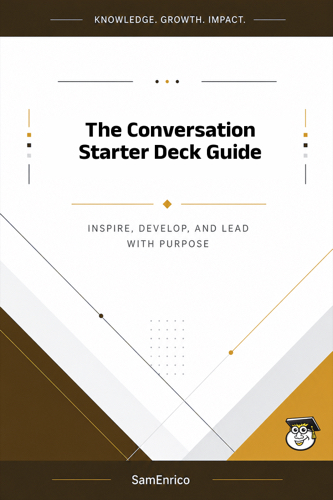
The Conversation Starter Deck Guide eBook
Build a personal mental library of 100 open-ended
by Venegas Wes
Build a personal mental library of 100 open-ended questions for any social setting.
Formats
Free sample
Chapter 1: The Search Engine Problem--–- You are at a party. The music is loud enough to be annoying but not loud enough to drown out the silence that has just landed between you and the person standing three feet away. You have been introduced. Names have been exchanged. A surface-level observation about the room or the weather or the food has been made and acknowledged.
And now there is a pause. Not a comfortable, companionable silence between old friends. The other kind. The kind that stretches like taffy, becoming more awkward with each passing second.Your brain, which moments ago was functioning normally, begins to spin its wheels. It is searching.
Desperately. You can feel the internal algorithm running: Topic. Need a topic. Work? No, that felt dead last time.
Hobbies? They didn't mention any. The news? Too heavy. Too political.
Too something. The other person shifts their weight. You smile. They smile. The silence continues.Then, out of desperation, you hear yourself say: "So...
what do you do?"It is the conversational equivalent of a default homepage. It is not inspired. It is not creative. It is not even particularly effective. But it is there, loaded into your brain's cache, ready to deploy at the first sign of social distress.
The other person answers: "I'm in marketing." Or "I'm a teacher." Or "I'm between things right now." And then what? You ask a follow-up about marketing or teaching or the between-ness, and they answer, and then the silence creeps back in, and you are once again staring at the blinking cursor of your own social operating system.This is the search engine problem. It is the most common, most frustrating, and most solvable failure mode of human conversation.The Anatomy of a Brain Freeze Let us name this experience properly because naming something is the first step to fixing it. The search engine problem occurs when your brain, under the mild but real pressure of a social interaction, cannot retrieve an appropriate, interesting, or useful question from memory. Your prefrontal cortex—the part responsible for creative thinking and decision-making—becomes slightly hijacked by the amygdala, which is busy sounding a low-grade alarm: Stranger.
Potential judgment. Potential rejection. Be safe. Be normal. Don't be weird.In response to this alarm, your brain defaults to the most heavily trafficked neural pathways.
These are the questions you have asked hundreds or thousands of times before. "What do you do?" "Where are you from?" "How do you know the host?" "Nice weather we're having." These are not bad questions. They are simply cheap. They cost little emotional energy to ask and require little vulnerability to answer. But they also pay out almost nothing in return.
They are the vending machine snacks of conversation: easy to obtain, briefly satisfying, and ultimately forgettable.The cruel irony is that the harder you try to think of something original, the more your brain freezes. This is the same phenomenon that occurs when someone asks you to name a favorite movie and your mind suddenly goes blank, remembering only the titles of films you actively dislike. The pressure to perform creates a bottleneck. The more you need a good question, the less accessible your good questions become.This book exists because that bottleneck is not a character flaw. It is a storage problem.Why "Be More Interesting" Is Useless Advice If you have ever googled "how to be better at conversation" or "what to say to strangers," you have encountered a mountain of advice that ranges from unhelpful to actively harmful.
Most of it falls into three categories.The first category is the personality prescription: "Just be yourself." "Be more confident." "Stop overthinking." This advice assumes that your conversational difficulties stem from some internal deficiency of character or nerve. It is the equivalent of telling someone with a broken leg to "just walk normally." The problem is not your personality. The problem is that your brain lacks an organized retrieval system for questions, and under pressure, it panics.The second category is the magic bullet: "Ask 'What excites you right now?'" "Try the FORD method (Family, Occupation, Recreation, Dreams)." "Use this one weird trick to make anyone like you." These tips are not wrong, necessarily. But they are isolated. They are individual arrows without a quiver.
You might remember one or two of them in a low-stakes setting, but when the pressure is on, they vanish from memory just like everything else. A single magic bullet is useless if you cannot find it when you need it.The third category is the exposure cure: "Just talk to more people." "Practice makes perfect." This advice contains a kernel of truth, but it ignores the underlying mechanism. Practicing a flawed system only makes you more fluent at being mediocre. If you go to fifty parties and ask "What do you do?" at every one, you will become very good at asking a very boring question. You will not have improved your conversation skills.
You will have automated your mediocrity.What is missing from all of this advice is a system. An organized, categorized, retrievable system for generating open-ended questions that match the setting, the relationship, and the depth of connection you are seeking.Closed vs. Open: The Fundamental Distinction Before we build the system, we must understand its basic unit: the question itself. All questions are not created equal. They exist on a spectrum from closed-ended to open-ended, and understanding this distinction is the single most important concept in this book.A closed-ended question is any question that can be answered with a single word, a short phrase, or a factual data point.
It often begins with "do," "are," "is," "have," or "did." Examples: "Do you like your job?" "Are you from here?" "Is that your car?" "Have you seen that movie?" "Did you have a good weekend?"The problem with closed-ended questions is not that they are evil. It is that they are conversation loans. You ask one, you receive a brief answer, and then the burden of continuing immediately falls back on you. The other person has done their part—they answered—and now you owe another question. This creates the exhausting ping-pong effect: ask, answer, ask, answer.
Each exchange is a transaction, not a connection.Watch two people trapped in closed-ended ping-pong and you will notice a distinct pattern. Their heads move like they are watching a tennis match. One asks, the other answers and immediately defers back. The asker then asks something else. There is no expansion, no storytelling, no shared discovery.
Just a rapid, low-stakes exchange of data points that neither person will remember ten minutes later.An open-ended question, by contrast, cannot be answered with a single word or fact. It often begins with "what," "how," "why," "tell me about," or "what do you think about." Examples: "What drew you to that line of work?" "How did you end up in this city?" "What do you enjoy about that hobby?" "Tell me about a moment from your weekend that stood out."Open-ended questions are conversation investments. You ask one, and the other person must offer a narrative, an opinion, a memory, or a reflection.…
This is the end of the free sample. Get the eBook to keep going. Buy now
About this book
Details
- Author
- Venegas Wes
- Publisher
- SamEnrico
- Language
- English
- Genre
- Non-Fiction, Self-Help, Questioning Skills
- Released
- 2026-06-07
- Pages (approx.)
- 140
- Available as
- eBook, Audiobook

Read better in the ZLOADR app
Your eBooks on your phone or tablet. Sign in with your SamEnrico account and start reading.
More by Venegas Wes
 Anger De escalation for SoldiersVenegas Wes$11.99
 Mug Book BiasVenegas Wes$11.99
 Childhood Shame Dissolution GuideVenegas Wes$11.99
 Financial Stress TriggersVenegas Wes$11.99
 Returning to Work GuideVenegas Wes$11.99
 Cocaine and Heart DamageVenegas Wes$11.99
 Time Management Student GuideVenegas Wes$11.99
 The Siege of Chittorgarh: The Rajput's Last Stand Against the Mughals (1568)Venegas Wes$11.99
 The Last Voyage of the Mary Celeste: A Ghost Ship’s Silent DepartureVenegas Wes$11.99
 A Collector's Handbook to the Daimler Empress IiVenegas Wes$11.99
 How to Produce Sporting GoodsVenegas Wes$11.99
 Us Domain Registration TimelineVenegas Wes$12.99
You may also like
 Hong Kong Handover 1997Dunn Johnnie$11.99
 Zumba For Postnatal Recovery CourseNeal Christian$11.99
 Zumba for BeginnersLadner Nikia$11.99
 YouTube Comment Mining GuideHumes Pandora$12.99
 Worry Box MeditationCarlin Rudy$11.99
 Workplace Stress MeditationNguyen Lynn$11.99
 Workplace Stress and Sleep RepairHawley Ivory$11.99
 Workplace Perfectionism CureDelaney Jeffry$11.99
 Workplace Injustice Anger GuideWallen Isabelle$11.99
 Work Addiction and Burnout LinkGreenwood Ester$11.99
 Women in Yoga and WellnessBeattie Galina$11.99
 Women in Stand Up ComedyChun Evangeline$11.99