
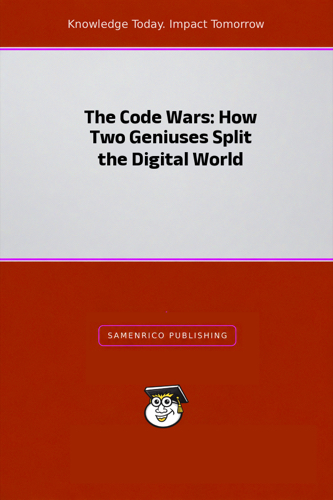
The Code Wars: How Two Geniuses Split the Digital World eBook
Unravel the bitter rivalry between Bill Gates and
by Beasley Lou
Unravel the bitter rivalry between Bill Gates and Steve Jobs that reshaped technology, business, and the very future of computing.
Formats
Free sample
Chapter 1: The Blue Box...--–- In the summer of 1971, before there was Apple, before there was Microsoft, before the personal computer had a name or a shape or a price tag that ordinary humans could afford, two college dropouts built a machine that could hack the phone company. One of them was seventeen years old, a skinny, brilliant engineer who could look at a circuit board the way a pianist looks at sheet music—seeing not components but music, not wires but possibility. His name was Steve Wozniak. The other was sixteen, a magnetic, hungry kid with matted hair and sandals and a gaze that seemed to look through you rather than at you. His name was Steve Jobs.
Together, they built a blue box—a small analog device that emitted specific tones to trick the telephone network into placing free long-distance calls. It was illegal. It was thrilling. And it contained, in embryonic form, everything that would later split the digital world in two.The blue box was not a computer. It was a toy for pirates.
But it was also a prophecy. Wozniak designed it because he loved the puzzle—the elegance of reverse-engineering AT&T’s switching system, the beauty of a perfect tone sequence. Jobs saw it differently. He saw that people would pay for this magic. He took the blue box, found a buyer, negotiated a price, and sold it.
Woz built for love. Jobs sold for power. That division—between the engineer who creates for the joy of creation and the visionary who sells creation for the joy of conquest—would define not only their partnership but the entire digital age.This is the story of how two geniuses took that divide and built from it two separate universes. One universe was beautiful, integrated, and controlled—a garden where everything worked together in perfect harmony. The other was open, messy, and ubiquitous—a bazaar where anyone could build anything, but nothing ever worked quite right.
One was Steve Jobs’ dream. The other was Bill Gates’. And the war between them did not just reshape technology. It reshaped how we live, work, communicate, and imagine the future.The Homebrew Computer Club and the Garage To understand the Code Wars, you must first understand the world before the war began. In the early 1970s, the idea of a "personal computer" was laughable to almost everyone except a small, sweaty tribe of hobbyists who met in garages and auditoriums, swapping schematics and soldering irons.
The most famous of these gatherings was the Homebrew Computer Club, founded in Menlo Park, California, in 1975. It was a chaotic, democratic, utterly uncommercial affair. Members would bring their homemade machines—naked circuit boards with blinking lights and toggle switches—and show them off to applause. No one talked about profit. No one talked about market share.
They talked about freedom.The club was born from the counter-culture. Many of its early members were refugees from the anti-war movement, acid trips, and communal living. They believed that information wanted to be free—not as a slogan but as a metaphysical truth. Computers, in their view, should be tools of liberation, not instruments of corporate control. This was the Hacker Ethic, though no one called it that yet.
It was simply the air they breathed.Into this world stumbled Steve Wozniak, a twenty-five-year-old engineer at Hewlett-Packard who built computers for fun. Woz, as everyone called him, was a gentle giant—prone to pranks, allergic to ambition, and capable of designing a machine on paper that would work the first time it was turned on. He attended Homebrew meetings religiously, showing off his latest creations. His most famous early design was the Apple I—a bare circuit board with no case, no keyboard, no monitor, and no power supply. It was, by modern standards, barely a computer at all.
But it worked. And Woz wanted to give the schematics away for free.Then there was Steve Jobs. He was not an engineer. He could not design a circuit board or write a line of code. But he had something Woz lacked: the ability to see a finished product in his mind and the ferocious will to drag it into existence.
Jobs had dropped out of Reed College after one semester, but he stayed on campus, sleeping on dorm floors and auditing calligraphy classes that would later give the Macintosh its beautiful typography. He had traveled to India, shaved his head, experimented with LSD, and returned to California with a strange certainty: he was destined to change the world.Jobs saw Woz’s Apple I at a Homebrew meeting and had an epiphany. Other clubs were selling circuit boards to hobbyists. But what if someone sold a finished computer—a machine that worked the moment you opened the box? The idea was radical.
In 1976, no one sold assembled computers. You bought a kit, you soldered it yourself, you prayed it would turn on. Jobs proposed that he and Woz start a company. Woz was skeptical. He was happy at HP.
He didn't need money. But Jobs was persuasive—relentless, almost hypnotic. "We'll make a dent in the universe," he said. Woz agreed.They sold Jobs’ Volkswagen bus and Woz’s HP calculator to raise startup capital. They built the first Apple I boards in the Jobs family garage.
They found a local computer store that agreed to order fifty units at $500 each. On April 1, 1976—April Fool’s Day—Apple Computer was born.The Altair and the Ghost of the North But while Jobs and Woz were tinkering in a California garage, another pair of geniuses was working in a dorm room in Cambridge, Massachusetts. Their names were Bill Gates and Paul Allen. And they were about to declare war on the Hacker Ethic.The catalyst was the Altair 8800, a mail-order computer kit released in January 1975 by a tiny company called MITS. The Altair was crude—no keyboard, no screen, just switches and lights.
But it was the first personal computer that ordinary hobbyists could afford, at $439 for a kit. Thousands of orders poured in. The only problem was that the Altair had no software. Without software, a computer is a paperweight.Gates and Allen saw an opportunity. They called MITS and claimed they had written a version of BASIC—the Beginner's All-purpose Symbolic Instruction Code—that would run on the Altair.
This was a lie. They hadn't written a single line of code. But Gates had an idea: he would write it now, on paper, without even having access to an Altair machine to test it.For eight weeks, Gates and Allen worked obsessively in Harvard's Aiken Computation Lab. Allen wrote the code for the Altair’s processor. Gates wrote the interpreter—the software that would translate BASIC commands into machine language.
They had no way to test their work until the night before the demo, when Allen flew to Albuquerque, New Mexico, where MITS was based, carrying a paper tape of the code. He loaded the tape into the Altair. Nothing happened. He checked the code. A bug.
He fixed it by hand, rewriting the paper tape with a pencil. He loaded it again. The machine printed back…
This is the end of the free sample. Get the eBook to keep going. Buy now
About this book
Details
- Author
- Beasley Lou
- Publisher
- SamEnrico
- Language
- English
- Genre
- Non-Fiction, Rivalry
- Released
- 2026-06-03
- Pages (approx.)
- 98
- Available as
- eBook, Audiobook

Read better in the ZLOADR app
Your eBooks on your phone or tablet. Sign in with your SamEnrico account and start reading.
More by Beasley Lou
 Self Hypnosis for Meal Prep HabitsBeasley Lou$11.99
 Parental Anger And Food BattlesBeasley Lou$11.99
 Priority Cheat Sheet GuideBeasley Lou$11.99
 Mindful Dating After AddictionBeasley Lou$11.99
 Beginner Mindfulness for DepressionBeasley Lou$11.99
 The Ballot Heist: How a Single County Flipped a Presidential RaceBeasley Lou$11.99
 Isolate Reactor OperatorBeasley Lou$11.99
 Nonprofit EIN VerificationBeasley Lou$12.99
 Community Freemium StrategyBeasley Lou$12.99
 How to Become a Jewel Grinder IiBeasley Lou$11.99
 Understanding Decompensated PhoriaBeasley Lou$17.99
You may also like
 Hong Kong Handover 1997Dunn Johnnie$11.99
 Zumba For Postnatal Recovery CourseNeal Christian$11.99
 Zumba for BeginnersLadner Nikia$11.99
 YouTube Comment Mining GuideHumes Pandora$12.99
 Worry Box MeditationCarlin Rudy$11.99
 Workplace Stress MeditationNguyen Lynn$11.99
 Workplace Stress and Sleep RepairHawley Ivory$11.99
 Workplace Perfectionism CureDelaney Jeffry$11.99
 Workplace Injustice Anger GuideWallen Isabelle$11.99
 Work Addiction and Burnout LinkGreenwood Ester$11.99
 Women in Yoga and WellnessBeattie Galina$11.99
 Women in Stand Up ComedyChun Evangeline$11.99