
Non-FictionSelf-HelpCognitive Traps
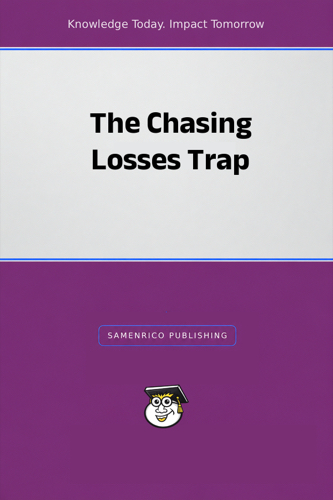
The Chasing Losses Trap eBook
Why gamblers double down after losing and how to s
Why gamblers double down after losing and how to stop the spiral.
Formats
Free sample
Chapter 1: The Twenty-Dollar Lie--–- It begins, as it always does, with a small loss and a smaller lie. The lie is not told to a spouse or a bookmaker. It is told to oneself, in the privacy of a racing mind, and it sounds like this: I can get that back.The setting could be anywhere. A casino carpet designed to hide spills. A kitchen table at 2:00 AM with a phone screen glowing against empty coffee mugs.
A sports bar where the fourth quarter of a basketball game becomes a blur of receipts and clenched jaws. The specifics vary, but the architecture of the moment is always the same. A gambler places a bet. The bet loses. And in the space between the loss and the next breath, something fundamental shifts.The goal of the activity changes.Before the loss, the gambler was playing for entertainment, for excitement, for the idle hope of profit.
After the loss, a new objective emerges, silent and absolute: get even. This is the chasing losses trap. It is not a strategy. It is not a system. It is a psychological state in which the avoidance of a realized loss becomes more powerful than the pursuit of any gain.
And once entered, this state rewires every subsequent decision until the gambler has lost far more than the original bet—often everything.This book is about that moment. About why it happens, why it repeats, and how to stop it before the twenty-dollar lie becomes a twenty-thousand-dollar truth.The Visceral Opening: A Night at the Blackjack Table Let us begin with a man we will call Michael. He is forty-three years old, a project manager at a mid-sized construction firm, married for seventeen years, father of two teenagers. He does not consider himself a gambler. He visits a casino once or twice a year, usually on a weekend trip with friends.
He sets a budget of three hundred dollars. He considers this responsible.On a Saturday night in March, Michael sits at a blackjack table in a casino two hours from his home. He has been playing for ninety minutes. His three hundred dollars has become four hundred and fifty dollars. He is up.
He is calm. He is in control.Then he loses a hand. A sixteen against a dealer's seven. He should have stood. He knows this.
He doubles down on the next hand—a desperate move, out of character—and loses again. His four hundred and fifty dollars becomes three hundred and eighty. Then three hundred. Then two hundred and twenty.And now something changes.Michael is no longer playing to win. He is playing to get back to four hundred and fifty dollars.
That number—four hundred and fifty—has become a fixed point in his mind. It represents not just money but a state of equilibrium. He was there. He was winning. He should still be there.
The loss feels like a theft, and gambling becomes the tool of recovery.He increases his bet. Fifty dollars. One hundred. Two hundred. He tells himself he will stop when he reaches four hundred and fifty again.
But the cards do not cooperate. An hour later, Michael has lost twelve hundred dollars. He has withdrawn money from the ATM three times. He has borrowed two hundred dollars from a friend at the table. He has forgotten about his three-hundred-dollar budget entirely.At 2:00 AM, he walks to his car.
He does not remember the drive home. He only remembers the number: four hundred and fifty. The amount he lost. The amount he chased. The amount that became twelve hundred.This is not a story about weakness or stupidity.
Michael is neither. He is a competent professional, a devoted father, a man who balances spreadsheets and manages complex budgets. But in the chasing losses trap, competence does not protect you. It often makes you more vulnerable, because your brain is wired to solve problems—and a loss feels like a problem that needs solving.The twenty-dollar lie is the belief that a loss can be undone by more gambling. It is the most expensive lie in the history of human wagering, and it is told millions of times every day.Defining the Trap: Beyond a Single Action The chasing losses trap is not a single bet or a single moment of poor judgment.
It is a process—a psychological loop that begins with a loss and ends, if uninterrupted, with catastrophic consequences. To understand the trap, we must distinguish it from ordinary gambling behavior.Recreational gambling is characterized by three features:Predetermined limits (time, money, or both)Emotional neutrality (wins and losses do not trigger identity crises)Easy stopping (the gambler can walk away without internal conflict)The chasing losses trap inverts all three. Limits are abandoned. Losses become personal indictments. Stopping feels impossible because stopping means accepting the loss as final—and that acceptance feels like failure.Consider the difference between these two internal monologues:Recreational gambler after a loss: "Well, that didn't work out.
I'm out my fifty dollars. Time to go home."Chaser after a loss: "I can't leave now. I'm down fifty. If I leave, that fifty is gone forever. But if I stay, I can win it back.
I just need one good hand. One good run. One more chance."The chaser does not see the fifty dollars as a sunk cost. He sees it as a temporary setback, a debt owed to him by the universe, a problem with a solution. The solution, of course, is more gambling.
And more gambling almost always means more losses.This is the central paradox of chasing: losing money creates an urge to risk more money. From a purely rational standpoint, this makes no sense. If a gambler has just demonstrated that his judgment is impaired (by losing), why would he trust that same impaired judgment to make the next decision? If the odds were against him on the last bet, why would they suddenly favor him on the next?But the chasing losses trap is not rational. It is neurological, psychological, and emotional.
And to break it, we must understand its components.The Statistics: How Common Is Chasing?Before we dive into the brain and the mind, let us establish the scope of the problem. Chasing losses is not a niche behavior confined to pathological gamblers. It is the single strongest predictor of transitioning from recreational to problem gambling, and it is present in over eighty percent of treatment-seeking gamblers.Data from multiple sources—including the National Council on Problem Gambling, the Cambridge University Press gambling research series, and longitudinal studies from the University of Michigan—paint a consistent picture:Eighty-three percent of gamblers who meet the diagnostic criteria for Gambling Disorder report chasing losses as their primary compulsion.Among recreational gamblers who have never sought treatment, forty-two percent admit to having chased a loss at least once in the past year.The average chaser loses three to five times the amount of the original loss before stopping or being forced to stop by depletion of funds.Chasing is most common in slot machine players (due to the rapid betting cycle) and sports bettors (due to the illusion of information advantage)…
This is the end of the free sample. Get the eBook to keep going. Buy now
About this book
Details
- Author
- Whittle Kendrick
- Publisher
- SamEnrico
- Language
- English
- Genre
- Non-Fiction, Self-Help, Cognitive Traps
- Released
- 2026-06-08
- Pages (approx.)
- 132
- Available as
- eBook, Audiobook

Read better in the ZLOADR app
Your eBooks on your phone or tablet. Sign in with your SamEnrico account and start reading.
More by Whittle Kendrick
 Boundary Setting for Self WorthWhittle Kendrick$11.99
 Ski Patrol Career ValueWhittle Kendrick$11.99
 Disappointment in Moving AbroadWhittle Kendrick$11.99
 Work Addiction in Doctors and NursesWhittle Kendrick$11.99
 The Vanishing Frescoes of Herculaneum: A Lost Renaissance in AshWhittle Kendrick$11.99
 How to Start a Cereal Milling and Working Machinery Renting (non Agricultural) Business (Beginners GWhittle Kendrick$11.99
 Sidewalk Delivery Robot GuideWhittle Kendrick$12.99
 No Ad KDP Marketing WorkbookWhittle Kendrick$12.99
 Understanding Lecithin Cholesterol Acyltransferase DeficiencyWhittle Kendrick$17.99
 Class B CDL DriverWhittle Kendrick$11.99
You may also like
 Hong Kong Handover 1997Dunn Johnnie$11.99
 Zumba For Postnatal Recovery CourseNeal Christian$11.99
 Zumba for BeginnersLadner Nikia$11.99
 YouTube Comment Mining GuideHumes Pandora$12.99
 Worry Box MeditationCarlin Rudy$11.99
 Workplace Stress MeditationNguyen Lynn$11.99
 Workplace Stress and Sleep RepairHawley Ivory$11.99
 Workplace Perfectionism CureDelaney Jeffry$11.99
 Workplace Injustice Anger GuideWallen Isabelle$11.99
 Work Addiction and Burnout LinkGreenwood Ester$11.99
 Women in Yoga and WellnessBeattie Galina$11.99
 Women in Stand Up ComedyChun Evangeline$11.99