
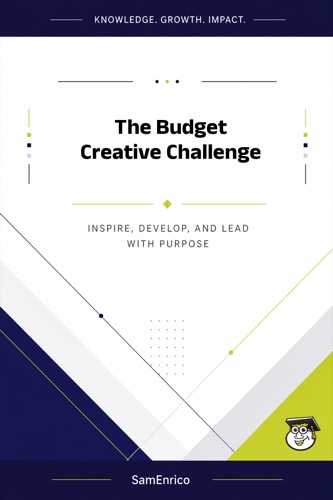
The Budget Creative Challenge eBook
Turns financial limits into innovative solutions.
by Muniz Tess
Turns financial limits into innovative solutions.
Formats
Free sample
Chapter 1: The Comfort Tax...--You are about to discover something that most entrepreneurs never learn until it is too late: having money is not the same as having a solution. In fact, having too much money often guarantees a worse outcome.Let me tell you about my first real failure. Not my first business failure—those were small, honest, and educational. This was different. This was a failure caused by success.Three years ago, I raised $2 million in venture capital for a startup I had built from nothing.
Before the funding, my team of four people operated out of a shared kitchen table. We had no marketing budget, so we wrote personal emails to potential customers. We had no design software, so we used free tools and learned to make them work. We had no paid ads, so we posted in online forums at midnight and answered every single comment. It was exhausting.
It was also exhilarating. We launched our first version in six weeks. It was ugly, barely functional, and customers loved it because it solved their actual problem.Then the money arrived.Suddenly we had a real office. Real salaries. A real marketing budget.
A real designer who charged real money. We stopped writing personal emails and hired an agency. We stopped posting in forums and launched a paid ad campaign. We stopped launching ugly products and spent six months building a perfect version that no one asked for.The result? We burned through $1.8 million in eighteen months and launched a product so over-engineered, so feature-heavy, so expensive to maintain that our original customers didn't recognize it.
They left. New customers didn't show up. We had more money than ever and less to show for it than when we had nothing.That was the moment I understood something that contradicted everything I had been taught about business. The problem was not that we had too little money. The problem was that we had just enough to be lazy.This is what I call the Comfort Tax.The Comfort Tax: A Definition The Comfort Tax is the invisible fee you pay every time you use cash to avoid creativity.
It is the difference between what you could achieve through resourcefulness and what you actually achieve when you take the easy path of spending.Here is how the Comfort Tax works in practice. When you have no money, you have no choice. You must be creative, scrappy, and relentless. You must ask yourself painful questions: What is the absolute core of this problem? What can I do with what I already have?
Who can I trade with instead of paying? How can I launch something that is good enough today rather than perfect next year?When you have some money—not a fortune, but enough—those questions disappear. You replace them with easier questions: Where can I buy a solution? Who can I hire to fix this? What tool can I subscribe to?
The comfort of having cash seduces you into spending it. And spending, unlike creating, requires no imagination.The Comfort Tax is not the cost of the things you buy. It is the cost of the solutions you never discover because you stopped looking. It is the muscle of creativity that atrophies when you reach for your wallet instead of your brain.Consider this: a study of crowdfunding campaigns found that projects that raised slightly less than their goal were more likely to succeed in the long term than projects that raised significantly more. Why?
Because the campaigns that just missed their goal had to hustle harder. They had to get creative with rewards, stretch every dollar, and build community through effort rather than advertising. The campaigns that raised too much money spent it on things that diluted their focus and their connection to backers.The Comfort Tax is everywhere once you learn to see it. It is the startup that raises $10 million and then spends $2 million on a logo redesign. It is the freelancer who buys expensive software before learning whether the free version works.
It is the small business owner who hires an agency instead of writing the first ten customer emails themselves. In every case, the money does not solve the problem. It postpones the solving.And here is the cruelest part: the Comfort Tax is hardest to see when you are paying it. Because you feel productive. You are spending money, which feels like progress.
You are hiring people, which feels like growth. You are buying tools, which feels like professionalism. But beneath that feeling, your creative muscle is quietly shrinking.The Gold-Plating Trap The Comfort Tax expresses itself most destructively through a phenomenon that engineers call "gold-plating." Gold-plating is the tendency to add unnecessary features, complexity, or polish to a solution simply because you have the resources to do so. It is the answer to the question no one asked.Here is a concrete example. In the 1960s, NASA spent billions of dollars developing the Apollo spacecraft.
Every component was tested, retested, and tested again. The result was a marvel of engineering—and also incredibly expensive, slow to build, and fragile in its own way because any change required massive rework.Decades later, a scrappy startup called Space X took a different approach. They had a fraction of NASA's budget. They could not afford to gold-plate. So they did something radical: they built rockets using off-the-shelf parts, tested quickly and publicly, and launched often even when those launches failed.
Their first three rockets exploded. But each explosion taught them something. Within a decade, they were launching payloads for a fraction of NASA's cost.Did NASA have more money? Yes. Did that money produce better results?
No. The money allowed NASA to gold-plate. The scarcity forced Space X to iterate.This pattern repeats in every industry. The fully-funded movie that bombs at the box office while a low-budget indie film becomes a classic. The well-financed restaurant chain that serves forgettable food while a cash-strapped food truck creates a cult following.
The corporate innovation lab with a million-dollar budget that produces nothing while two engineers in a garage build the next billion-dollar product.Gold-plating is not about quality. It is about fear. When you have money, you are afraid of looking cheap. You are afraid of launching something imperfect. You are afraid that customers will judge you for using free tools or manual processes.
So you spend money to soothe your fear. And in doing so, you build something that no one actually wanted.The antidote to gold-plating is not less ambition. It is more constraint. It is the willingness to ask, before every purchase and every feature and every hire: What would I do if I had half this budget? That question is uncomfortable.
That is exactly why you should ask it.The Constraint Paradox At the heart of this chapter is a truth that sounds like a contradiction: constraints create freedom.This is the Constraint Paradox. When you have unlimited resources, you face unlimited choices. Unlimited choices lead to analysis paralysis, endless debate, and the inability to commit to any direction. When you have limited resources, your choices collapse. You cannot do everything, so you…
This is the end of the free sample. Get the eBook to keep going. Buy now
About this book
Details
- Author
- Muniz Tess
- Publisher
- SamEnrico
- Language
- English
- Genre
- Non-Fiction, Self-Help, Frugality
- Released
- 2026-06-07
- Pages (approx.)
- 137
- Available as
- eBook, Audiobook

Read better in the ZLOADR app
Your eBooks on your phone or tablet. Sign in with your SamEnrico account and start reading.
More by Muniz Tess
 The Vagus Nerve Stress LinkMuniz Tess$11.99
 Cross Border Franchise Privacy PolicyMuniz Tess$11.99
 Dual Diagnosis in ElderlyMuniz Tess$11.99
 Anger Management for Security GuardsMuniz Tess$11.99
 The Quantum Leap: How a 1989 Experiment Changed the Future of ComputingMuniz Tess$11.99
 Understanding Sacral AgenesisMuniz Tess$17.99
 Supply Chain Finance vs FactoringMuniz Tess$12.99
 Safe Harbor for CTAMuniz Tess$12.99
 Optometrist AssistantMuniz Tess$11.99
 How to Start a Circular or Reciprocating Saws Business (Beginners Guide)Muniz Tess$11.99
You may also like
 Hong Kong Handover 1997Dunn Johnnie$11.99
 Zumba For Postnatal Recovery CourseNeal Christian$11.99
 Zumba for BeginnersLadner Nikia$11.99
 YouTube Comment Mining GuideHumes Pandora$12.99
 Worry Box MeditationCarlin Rudy$11.99
 Workplace Stress MeditationNguyen Lynn$11.99
 Workplace Stress and Sleep RepairHawley Ivory$11.99
 Workplace Perfectionism CureDelaney Jeffry$11.99
 Workplace Injustice Anger GuideWallen Isabelle$11.99
 Work Addiction and Burnout LinkGreenwood Ester$11.99
 Women in Yoga and WellnessBeattie Galina$11.99
 Women in Stand Up ComedyChun Evangeline$11.99