
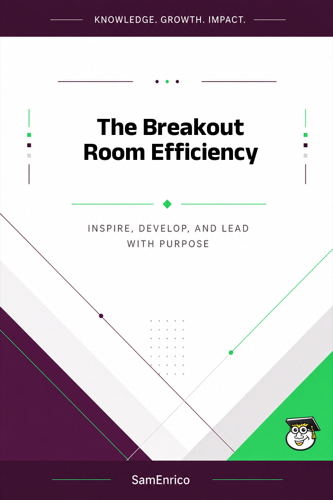
Non-FictionBusiness BriefFacilitation
The Breakout Room Efficiency
Uses small groups in large meetings for parallel d
Uses small groups in large meetings for parallel discussion.
Formats
About this book
Free sample
Chapter 1: The 36-Second Lie--–- The email arrived at 4:47 PM on a Tuesday. Sarah, a vice president of product at a mid-sized technology company, had just finished what she thought was a great meeting. Forty people in a conference room. A crisp 60-minute agenda. Three brilliant slides from her head of engineering.
She had even left ten minutes for Q&A, a practice she had started after last quarter's engagement survey said employees didn't feel heard.She opened the email. Two resignation letters. One from a senior designer who had been with the company for four years. One from a product manager who had joined only six months earlier.Neither person had spoken a single word in sixty minutes. They had sat silently, watched the slides, listened to the engineering presentation, nodded along, and decided—quietly, rationally, finally—that their voices did not matter here.Sarah forwarded the emails to her boss with a one-line note: "What did I miss?"Her boss forwarded back a one-line reply: "Count the speaking time."Sarah pulled the meeting recording.
The head of engineering spoke for 31 minutes. Sarah spoke for 12 minutes. Three directors asked questions totaling 9 minutes. Two senior managers made brief comments totaling 5 minutes. The remaining 32 people—including the designer and the product manager who resigned—spoke for zero minutes.Thirty-two people.
Sixty minutes. Zero words.Sarah's meeting was not an exception. It was the rule. And the math behind that rule is devastating.The Participation Bottleneck Every large meeting suffers from a fatal mathematical flaw. It does not matter how skilled the facilitator is, how brilliant the agenda is, or how charismatic the speaker is.
The flaw is arithmetic, not art.Consider a standard 60-minute plenary meeting with 100 attendees. In that hour, the maximum speaking time per person—assuming the facilitator speaks not at all, assuming every second is allocated perfectly, assuming no one speaks twice—is 36 seconds.Thirty-six seconds.That is not a meeting. That is a hostage situation with Power Point.Of course, no real meeting achieves that theoretical maximum. In practice, a handful of people speak. The CEO talks for 20 minutes.…
This is the end of the free sample. Get the eBook to keep going. Buy now
Contents
- Chapter 1
- Chapter 2
- Chapter 3
- Chapter 4
- Chapter 5
- Chapter 6
- Chapter 7
- Chapter 8
- Chapter 9
- Chapter 10
- Chapter 11
- Chapter 12
Details
- Author
- Schmitz Corinne
- Publisher
- SamEnrico
- Language
- English
- Genre
- Non-Fiction, Business Brief, Facilitation
- Released
- 2026-06-09
- Pages (approx.)
- 131
- Available as
- eBook, Audiobook

Read better in the ZLOADR app
Your eBooks on your phone or tablet. Sign in with your SamEnrico account and start reading.
More by Schmitz Corinne
 The Prostatitis Meditation GuideSchmitz Corinne$11.99
 Pinterest VA Google Analytics SetupSchmitz Corinne$11.99
 Night Shift Breast Cancer RiskSchmitz Corinne$11.99
 Small Talk for Tech ConferencesSchmitz Corinne$11.99
 The Tehran Tango: A Diplomat's Deadly DanceSchmitz Corinne$11.99
 The Vanishing Act: The Untold Story of the Lost Franklin ExpeditionSchmitz Corinne$11.99
 Understanding Coloboma of Optic NerveSchmitz Corinne$17.99
 Development TesterSchmitz Corinne$11.99
 Traction Metrics For Pre SeedSchmitz Corinne$12.99
 Sales Review Blocking GuideSchmitz Corinne$12.99
 How to Start a Brakes and Parts (excluding Linings for Motor Vehicles) Business (Beginners Guide)Schmitz Corinne$11.99
You may also like
 Hong Kong Handover 1997Dunn Johnnie$11.99
 Zumba For Postnatal Recovery CourseNeal Christian$11.99
 Zumba for BeginnersLadner Nikia$11.99
 YouTube Comment Mining GuideHumes Pandora$12.99
 Worry Box MeditationCarlin Rudy$11.99
 Workplace Stress MeditationNguyen Lynn$11.99
 Workplace Stress and Sleep RepairHawley Ivory$11.99
 Workplace Perfectionism CureDelaney Jeffry$11.99
 Workplace Injustice Anger GuideWallen Isabelle$11.99
 Work Addiction and Burnout LinkGreenwood Ester$11.99
 Women in Yoga and WellnessBeattie Galina$11.99
 Women in Stand Up ComedyChun Evangeline$11.99