
Non-FictionSelf-HelpCaregiving
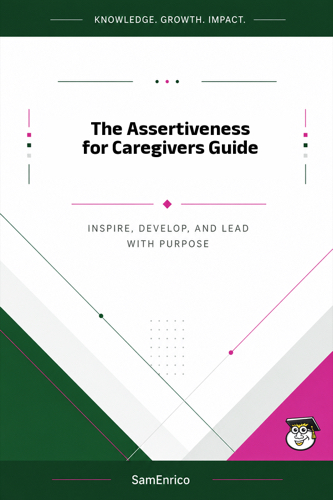
The Assertiveness for Caregivers Guide eBook
Set limits while caring for aging parents or ill f
Set limits while caring for aging parents or ill family members.
Formats
Free sample
Chapter 1: The Vaseline Lens...--The phone rings at 11:47 PM on a Tuesday. You are already in bed, having finally fallen asleep after two hours of tossing. The ringtone—the one you assigned to your parent—sends a bolt of adrenaline through your chest. You answer before the second ring finishes.“I fell,” your mother says. “I’m on the floor.
I’ve been here for an hour.”Your heart hammers. You throw on clothes, drive twenty minutes through empty streets, and find her on the bathroom floor, unhurt but terrified. You help her up, make tea, sit with her until 2 AM. You drive home, sleep four hours, and go to work.The next morning, you call a home care agency. You find an aide who can come three mornings a week to help with bathing and mobility.
You present the plan to your mother carefully, with brochures and reassurance.She looks at you and says, “I don’t need a stranger in my house. I have you.”And because you are a good daughter, a good son, a good person—you say yes. You cancel your plans. You absorb the extra work. You tell yourself it’s temporary.
You tell yourself you can handle it.This is how the guilt trap closes around you.The Core Problem: Why You Can’t Say No Let me name what you are feeling right now, probably while reading this in a waiting room, a parking lot, or at 2 AM when you cannot sleep.You feel guilty before you even set a limit. This is called anticipatory guilt—the imagination of your parent’s suffering, projected forward into a future where you have dared to say no. You imagine them lonely, scared, angry, or abandoned. You imagine the phone call where they say, “I needed you and you weren’t there.” You imagine their disappointment, their tears, their quiet silence that means more than any words.And because you imagine this suffering so vividly, you say yes. You say yes to the fourth phone call of the day.
You say yes to the 11 PM visit. You say yes to driving them to a doctor’s appointment when you have your own physical therapy. You say yes to cleaning their house when your own house is falling apart. You say yes to being the only sibling who shows up.You say yes until you cannot say yes anymore. And then you say yes anyway.This is not weakness.
This is the guilt trap, and it is the number one reason caregivers fail to set limits. It is also the number one reason caregivers burn out, end up in emergency rooms themselves, lose their marriages, or develop depression so severe they cannot function.The guilt trap has a specific mechanism. It works like this:When you anticipate setting a limit—for example, telling your mother you cannot come over tonight—your brain generates a vivid mental simulation of the worst possible outcome. This is an evolutionary survival mechanism. Your brain is designed to prioritize avoiding danger over seeking reward.
And in your brain, your parent’s emotional distress has been categorized as danger.So you feel a spike of anxiety. That anxiety feels urgent. It feels like an alarm telling you that if you set this limit, something terrible will happen.But here is the truth that the guilt trap hides from you: the alarm is lying.Your parent’s disappointment is not danger. Their loneliness is not a medical emergency. Their anger is not a heart attack.
These are feelings—uncomfortable, sad, real feelings—but they are not catastrophes. The guilt trap takes ordinary feelings and inflates them into disasters. It takes a preference (“I want you here”) and recasts it as a necessity (“You must be here or I will suffer irreparably”).The Vaseline on the Camera Lens I want to give you a mental image that will change how you see your situation.Imagine you are holding a camera. You want to take a clear photograph of your parent’s needs, your capacity, and the reality of your situation. But someone has smeared Vaseline on the lens.
Everything looks soft, blurry, and distorted. A small request looks like a crisis. A reasonable limit looks like cruelty. A night off looks like abandonment.That Vaseline is anticipatory guilt.When guilt smears the lens, you cannot see clearly. You mistake your parent’s preference for a medical necessity.
You mistake their habit of calling you first for an emergency. You mistake their unwillingness to accept outside help for your obligation to provide all help.Here is what clarity looks like without the Vaseline:A preference: “I want you to visit every day.” A necessity: “I need someone to check that I took my blood thinner, because missing it could cause a stroke.”A habit: “I call you first when I’m lonely.” An emergency: “I have fallen and cannot get up.”An unwillingness: “I don’t want an aide.” An obligation: “I am required to ensure you are safe, not to be the sole provider of that safety.”The Vaseline lens also distorts time. It makes every request feel urgent. It makes you feel that if you do not respond right now, something terrible will happen. But most caregiving requests are not urgent.
Most can wait an hour, a day, or even a week. The guilt trap collapses time so that everything feels like a 911 call.Your first job as an assertive caregiver is not to learn scripts or tactics. Your first job is to wipe the lens clean. You must learn to see the difference between a true emergency and a manufactured crisis. You must learn to feel the guilt and act anyway.The Five-Minute Rule Here is the single most practical tool in this entire book.
It is simple, it takes almost no time, and it will save your life.The Five-Minute Rule: Before saying yes to any non-emergency request from your parent, wait five minutes.That is it. Five minutes.Do not respond immediately. Do not text back. Do not agree on the phone. Say these words: “Let me think about that.
I will call you back in a few minutes.”Then set a timer for five minutes.During those five minutes, ask yourself four questions:Is this a true emergency? Does someone need an ambulance? Is there active bleeding, chest pain, shortness of breath, or a fall with a potential head injury? If yes, call 911 immediately. The Five-Minute Rule does not apply to true emergencies.Am I saying yes out of guilt or out of genuine capacity?
Check your body. Is your stomach tight? Is your heart racing? Are you already exhausted? That is guilt.
Genuine capacity feels calm, spacious, and free.What is the realistic worst consequence if I say no? Not the catastrophic fantasy. The realistic consequence. Will your parent be annoyed? Probably.
Will they be angry? Possibly. Will they die? Almost certainly not.What would I tell my best friend to do in this situation? This question bypasses your guilt and accesses your wisdom.
You would never tell your best friend to sacrifice their health for a non-emergency. You would tell them to set…
This is the end of the free sample. Get the eBook to keep going. Buy now
About this book
Details
- Author
- Pendergrass Rozanne
- Publisher
- SamEnrico
- Language
- English
- Genre
- Non-Fiction, Self-Help, Caregiving
- Released
- 2026-06-09
- Pages (approx.)
- 140
- Available as
- eBook, Audiobook

Read better in the ZLOADR app
Your eBooks on your phone or tablet. Sign in with your SamEnrico account and start reading.
More by Pendergrass Rozanne
 Teacher Emotion GuidePendergrass Rozanne$11.99
 Silicon Valley Immigrant Tech Founder GuidePendergrass Rozanne$11.99
 Partner Body Acceptance GuidePendergrass Rozanne$11.99
 PTSD Partner Relationship GuidePendergrass Rozanne$11.99
 Siege Artillery DeploymentPendergrass Rozanne$11.99
 The Angry Parent Legacy BreakerPendergrass Rozanne$11.99
 Assertiveness Training WorkbookPendergrass Rozanne$11.99
 The Alchemy of Genius: Florence’s Golden DawnPendergrass Rozanne$11.99
 Love and the Olympics: The Secret Romance of Leni Riefenstahl and Jesse OwensPendergrass Rozanne$11.99
 Echoes of Trinity: The Secret Tapes of Los AlamosPendergrass Rozanne$11.99
 The Mineral Guide to PolaritePendergrass Rozanne$11.99
 Long-Term Community SustainabilityPendergrass Rozanne$11.99
You may also like
 Hong Kong Handover 1997Dunn Johnnie$11.99
 Zumba For Postnatal Recovery CourseNeal Christian$11.99
 Zumba for BeginnersLadner Nikia$11.99
 YouTube Comment Mining GuideHumes Pandora$12.99
 Worry Box MeditationCarlin Rudy$11.99
 Workplace Stress MeditationNguyen Lynn$11.99
 Workplace Stress and Sleep RepairHawley Ivory$11.99
 Workplace Perfectionism CureDelaney Jeffry$11.99
 Workplace Injustice Anger GuideWallen Isabelle$11.99
 Work Addiction and Burnout LinkGreenwood Ester$11.99
 Women in Yoga and WellnessBeattie Galina$11.99
 Women in Stand Up ComedyChun Evangeline$11.99