
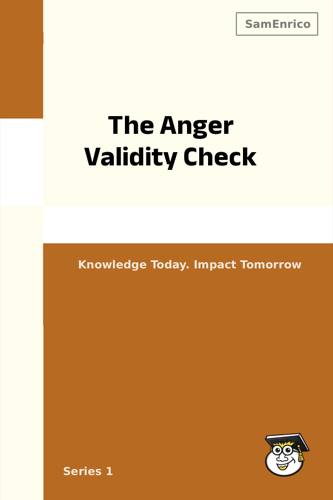
The Anger Validity Check eBook
Helps partners distinguish between justified anger
Helps partners distinguish between justified anger and disproportionate reactions using reality testing.
Formats
Free sample
Chapter 1: The Dashboard Warning Light--Anger is not your enemy. This is the single most important sentence you will read in this entire book, so I want you to pause and really let it land. Not your enemy. Not a sin. Not a character flaw.
Not evidence that you are “broken” or “too much” or “out of control.” Anger is a neurological signal, no different from the ache in your stomach that tells you to eat or the sharp pullback of your hand from a hot stove. It is data. Pure and simple. The problem is not that you feel anger. The problem is what you do with it—and, more specifically, whether you have ever learned to distinguish between anger that is warning you about a real threat and anger that is simply amplifying noise.I have worked with hundreds of couples and individuals who came to me convinced that their anger was the problem.
“I have an anger problem,” they say, shoulders slumped, shame heavy in their voice. And every time, I ask the same question: “Or do you have a validity problem?” Because here is what I have learned after years of clinical practice and research synthesis drawing from the work of John Gottman, Gary Chapman, and Ray Guarendi: most people who struggle with anger are not struggling with the feeling itself. They are struggling with an inability to check whether that feeling is proportional to the event that triggered it. They are fighting blind. They are reacting to a dashboard warning light as if the car were already on fire.This chapter exists to rewire your relationship with anger from the ground up.
Before we can talk about proportionality, before we can introduce the tools for reality testing, before we can teach you the communication protocols that will save your most important relationships—we have to establish a foundation. Anger is not the enemy. Anger is a messenger. And messengers, no matter how loud or inconvenient, deserve to be heard. But they also deserve to be questioned.The Warning Light That Saved My Marriage Let me tell you about the night I almost ended my own relationship over a burnt grilled cheese sandwich.It sounds ridiculous now, and that is precisely the point.
I was exhausted. I had worked twelve hours, come home to a messy kitchen, asked my partner to clean it while I put the kids to bed, and emerged forty-five minutes later to find the kitchen exactly as I had left it—plus a smoking pan on the stove and the acrid smell of burnt bread hanging in the air. Something inside me cracked. Not broke. Cracked.
That is the best word I have for it. A hairline fracture in the dam of my patience, and then the full flood.I did not yell. I am not a yeller. Instead, I went cold. Silent.
I cleaned the kitchen myself, scraping burnt cheese off the pan with more force than necessary, and then I went to bed without saying goodnight. The next morning, I was still cold. My partner asked what was wrong. “You know what you did,” I said. They did not know.
They genuinely did not know. And that made me angrier, because in my mind, the message was obvious: I asked for help. You ignored me. You made a mess instead of fixing one. You do not care about me.That last sentence—“You do not care about me”—was not a feeling.
It was a story. But in the moment, it felt like truth. I carried that story for three days. Three days of silence, of one-word answers, of sleeping on the far edge of the bed. On the fourth day, my partner sat me down and said something I have never forgotten: “I know you are angry.
But I do not know why, and at this point, I am starting to think the anger is not about the sandwich anymore.”They were right. The anger was not about the sandwich. It was about a pattern I had perceived but never articulated. It was about exhaustion. It was about feeling unseen.
And it was about a childhood wound I had never addressed—the feeling that my needs were always secondary to everyone else’s convenience. The sandwich was just the trigger. The anger was real. But my reaction—three days of silent punishment—was wildly disproportionate to the crime. A neutral observer would have said: “You have a valid point about wanting help.
But your reaction is a 9 out of 10, and the problem is a 3.”That night taught me the first and most important lesson of anger validity: The feeling of anger is automatic. The meaning you attach to it is a choice. And the story you tell yourself in the first ninety seconds after you feel angry will determine whether that anger becomes a tool for repair or a weapon of destruction.The Neurology of the First Ninety Seconds Let us talk about what actually happens inside your brain when you get angry. This is not abstract neuroscience for its own sake. Understanding the mechanics of anger is the first step toward unhooking yourself from its automatic grip.When you perceive a threat—and anger is always, at its core, a response to a perceived threat—your amygdala activates.
The amygdala is a small, almond-shaped cluster of neurons deep in your brain’s temporal lobe. Its job is to scan for danger and respond faster than your conscious mind can think. This is an ancient system, evolved millions of years ago to keep you alive in a world of predators and poisons. The problem is that your amygdala cannot tell the difference between a physical threat (a tiger) and a social threat (a partner’s dismissive comment). Both trigger the same cascade.Within milliseconds of perceiving a threat, your amygdala signals your hypothalamus to release adrenaline and cortisol.
Your heart rate increases. Your blood pressure rises. Your breathing quickens. Blood flows away from your digestive system and toward your large muscle groups, preparing you to fight or flee. Your prefrontal cortex—the part of your brain responsible for logical reasoning, impulse control, and empathy—begins to down-regulate.
This is not a malfunction. This is your brain prioritizing survival over social niceties. You cannot reason your way out of a tiger attack, so your brain stops wasting energy on reason.Here is the critical piece of information that most people never learn: this entire physiological cascade lasts approximately ninety seconds. That is not a metaphor. It is a biological fact.
When a wave of emotion passes through your body, the chemical surge lasts roughly ninety seconds. After that, the amygdala’s direct signal diminishes. What keeps the anger going after ninety seconds is not the original threat. It is the story you start telling yourself.I want you to read that sentence again: What keeps the anger going after ninety seconds is the story you start telling yourself.In the first ninety seconds, you are along for the ride. Your body is reacting automatically.
You did not choose to feel angry. You did not fail at emotional regulation. You are a human being with…
This is the end of the free sample. Get the eBook to keep going. Buy now
About this book
Details
- Author
- Bolduc Roseanne
- Publisher
- SamEnrico
- Language
- English
- Genre
- Non-Fiction, Self-Help, Reality Testing
- Released
- 2026-06-10
- Pages (approx.)
- 159
- Available as
- eBook, Audiobook

Read better in the ZLOADR app
Your eBooks on your phone or tablet. Sign in with your SamEnrico account and start reading.
More by Bolduc Roseanne
 Expert Pattern Recognition GuideBolduc Roseanne$11.99
 Self Hypnosis Fractionation CourseBolduc Roseanne$11.99
 Fitness After PregnancyBolduc Roseanne$11.99
 Phone Call Distraction TriageBolduc Roseanne$11.99
 The Comeback Kid: How a Broken Man Built a Billion-Dollar EmpireBolduc Roseanne$11.99
 Silk and Sabers: The Forgotten War of the Tea ClippersBolduc Roseanne$11.99
 Understanding Endocardial FibroelastosisBolduc Roseanne$17.99
 SAFe for Intel StartupsBolduc Roseanne$12.99
 Redbubble Store Setup GuideBolduc Roseanne$12.99
 Freon Recovery (Appliance)Bolduc Roseanne$11.99
 How to Start a Prefabricated Buildings Made of Metal Business (Beginners Guide)Bolduc Roseanne$11.99