
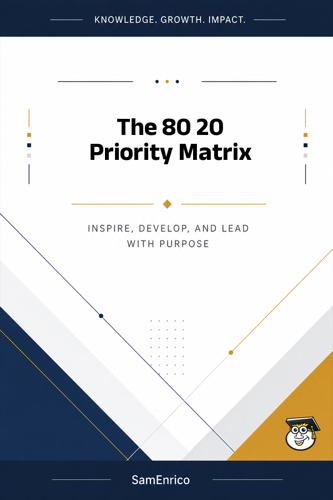
The 80 20 Priority Matrix eBook
Combine Pareto principle with Eisenhower to focus
Combine Pareto principle with Eisenhower to focus on highest leverage tasks.
Formats
Free sample
Chapter 1: The Exhausted Executive--–- Sarah had done everything right. She arrived at her downtown Chicago office at 7:45 AM, fifteen minutes before her first meeting. By 8:00 AM, she had cleared seventeen emails—mostly quick replies, a few "let's circle back," one "great question, I'll revert." By 9:30 AM, she had attended two back-to-back standing meetings, neither of which had a clear agenda. By 11:00 AM, she had extinguished a minor fire involving a misrouted shipment to a mid-tier client. By 1:00 PM, she had eaten a sad desk lunch while reviewing a fifty-slide deck that could have been five bullet points.
By 3:00 PM, she had been pulled into a "quick sync" that ran ninety minutes. By 5:30 PM, she had sent forty-two more emails, approved three expense reports, and updated a shared spreadsheet that no one would look at again.At 6:15 PM, Sarah leaned back in her chair, exhausted. Her eyes burned. Her neck ached. She had not taken a single uninterrupted breath for more than eleven minutes at any point in the day.
She had worked harder than anyone in her department. And yet, as she looked at her to-do list, the one item at the top—the one that would have moved her annual review from "meets expectations" to "promotion-ready"—remained untouched. It had been untouched for three weeks.Sarah is not lazy. She is not disorganized. She is not stupid.
Sarah is a victim of the most dangerous illusion in modern work: the belief that doing more is the same as achieving more. She is trapped in the Productivity Paradox.The Trap You Didn't Know You Were In Let us name this feeling. It is the feeling of ending a ten-hour workday with nothing truly accomplished. It is the feeling of your to-do list growing longer even as you work faster. It is the feeling of being busy—frantic, even—while your most important projects collect digital dust in a folder called "Q3 Priorities" that you haven't opened since last quarter.If you feel this way, you are not alone.
In fact, you are normal. And that is precisely the problem.Research from Microsoft's Work Trend Index, based on analysis of billions of Microsoft 365 actions across thousands of organizations, reveals a staggering truth: the average professional spends only two hours and forty-eight minutes per day on what could reasonably be called "productive work." The remaining five hours and twelve minutes are consumed by context switching, email, meetings with unclear outcomes, and what the researchers call "shallow work"—tasks that keep you busy but do not move meaningful metrics.Let that number land. Two hours and forty-eight minutes. That is less than a single movie. That is less than most people's morning commute in heavy traffic.
That is less time than the average person spends scrolling social media. And yet, this is the total daily output of your productive capacity.Worse, the data shows that this number has been declining for a decade, not improving. We have more productivity apps, more automation, more calendars, more AI, more everything—and we are accomplishing less of what matters. We have confused activity with progress, and we are paying for it with our time, our energy, and our sanity.The Neuroscience of Fake Productivity Why do we do this to ourselves? The answer lies not in your calendar or your email habits but deep within your brain.
Specifically, in a small cluster of neurons called the nucleus accumbens—the brain's reward center.Every time you complete a task, regardless of its importance, your brain releases a small burst of dopamine. This is the same neurotransmitter involved in pleasure, motivation, and learning. It feels good to check a box. It feels good to send an email. It feels good to clear a notification.
Your brain does not distinguish between "closing a $500,000 deal" and "deleting a spam email" when it comes to dopamine release. Both activities trigger the same chemical reward.This creates a dangerous feedback loop. You feel good when you complete tasks, so you seek out tasks that are easy to complete. Small tasks. Quick tasks.
Low-friction tasks. These tasks provide immediate gratification—a dopamine hit every few minutes. Large, difficult, high-value tasks, by contrast, provide delayed reward. They take hours, days, or weeks to complete. Your brain, which is wired for short-term survival, strongly prefers the small, quick, easy tasks.
This is not a character flaw. This is neurology.Psychologists call this phenomenon the Completion Bias. It is the systematic tendency to prioritize tasks that can be completed quickly over tasks that are actually important. The Completion Bias explains why your inbox is empty but your strategic plan is untouched. It explains why you have reorganized your desktop folders three times this month but have not touched the proposal that would double your department's budget.
It explains why you feel productive and unaccomplished at the same time.The Completion Bias is reinforced by a second neurological quirk: The Urgency Addiction. When you respond to an urgent request—an email marked "ASAP," a Slack message with a red exclamation, a "quick question" from your boss—your body releases cortisol and adrenaline. These are stress hormones, not pleasure hormones. But they are powerful. They create a feeling of importance, of being needed, of saving the day.
The urgency addiction tricks you into believing that responding to emergencies is the same as making progress. It is not. Most emergencies are not emergencies at all. They are other people's lack of planning, repackaged as your priority.Together, the Completion Bias and the Urgency Addiction form a perfect trap. You spend your day chasing small, easy, urgent tasks that provide dopamine hits and adrenaline rushes.
You feel busy. You feel important. You feel productive. And at the end of the day, you have moved exactly zero inches toward your most important long-term goals. You are Sisyphus with a smartphone, rolling the same boulder up the same hill every day and calling it "hard work."The Difference Between Busy and Effective We must draw a sharp distinction here, because this distinction is the entire foundation of this book.
The distinction is between being busy and being effective.Busy means high activity, zero or negative output. Busy people attend meetings that should have been emails. They respond to messages the moment they arrive. They say yes to every request. They feel overwhelmed and important at the same time.
They confuse motion with progress.Effective means lower activity, high leverage. Effective people work on fewer things, but those things matter more. They ignore most requests. They let emails sit. They say no to meetings without agendas.
They feel calm and slightly uncomfortable because they are not "doing enough" in the moment—but at the end of the quarter, they have moved every meaningful metric.Here is the painful truth: our society rewards the appearance of busyness. We praise the colleague who responds to emails at 11 PM. We celebrate the manager who attends twelve meetings in a single day. We promote the executive who never seems to stop working. But these rewards are for the performance of productivity, not the reality of it.
The most productive people in any organization are often the ones who seem to be doing the least—because they are…
This is the end of the free sample. Get the eBook to keep going. Buy now
About this book
Details
- Author
- Mccombs Londa
- Publisher
- SamEnrico
- Language
- English
- Genre
- Non-Fiction, Self-Help
- Released
- 2026-06-07
- Pages (approx.)
- 126
- Available as
- eBook, Audiobook

Read better in the ZLOADR app
Your eBooks on your phone or tablet. Sign in with your SamEnrico account and start reading.
More by Mccombs Londa
 Experiencing Mental ObjectsMccombs Londa$11.99
 DBT Emotion Regulation BasicsMccombs Londa$11.99
 Pelvic Floor Yoga SequenceMccombs Londa$11.99
 Emotion Regulation For Empty NestMccombs Londa$11.99
 Antwerp Heist Insurance PayoutMccombs Londa$11.99
 Statin Therapy GuideMccombs Londa$11.99
 Gregg Braden MatrixMccombs Londa$11.99
 The Lost Druids of Anglesey: Blood Moon RebellionMccombs Londa$11.99
 The Great Emoji Heist: How a Tiny Image Sparked a Global ScandalMccombs Londa$11.99
 How to Produce Hair Permanents and StraightenersMccombs Londa$11.99
 Retail and Sales Student HandbookMccombs Londa$12.99
 Reference List Formatting GuideMccombs Londa$12.99
You may also like
 Hong Kong Handover 1997Dunn Johnnie$11.99
 Zumba For Postnatal Recovery CourseNeal Christian$11.99
 Zumba for BeginnersLadner Nikia$11.99
 YouTube Comment Mining GuideHumes Pandora$12.99
 Worry Box MeditationCarlin Rudy$11.99
 Workplace Stress MeditationNguyen Lynn$11.99
 Workplace Stress and Sleep RepairHawley Ivory$11.99
 Workplace Perfectionism CureDelaney Jeffry$11.99
 Workplace Injustice Anger GuideWallen Isabelle$11.99
 Work Addiction and Burnout LinkGreenwood Ester$11.99
 Women in Yoga and WellnessBeattie Galina$11.99
 Women in Stand Up ComedyChun Evangeline$11.99