
Non-FictionInformativeEducational
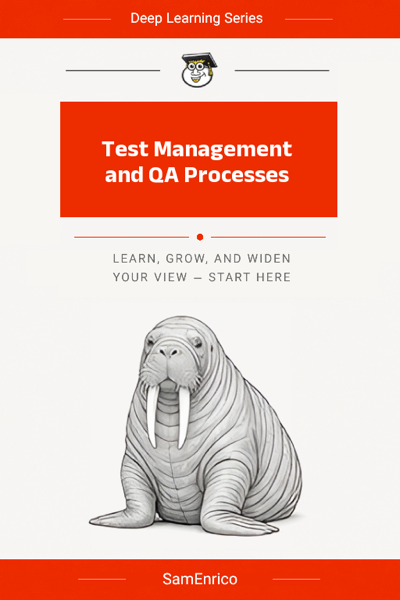
Test Management and QA Processes eBook
A Coursebook on Test Management and QA Processes
A Coursebook on Test Management and QA Processes
Formats
Free sample
Chapter 1: The Quality Lie--–- The first thing you need to understand about software testing is that almost everything you have been told is wrong. Not slightly exaggerated or generously simplified, but actively, demonstrably, and often catastrophically wrong. Testing is not a phase. It is not a gate. It is not something you do after development to catch mistakes before they reach customers.
And the most dangerous myth of all—the one that has quietly destroyed more software projects than any coding error or architecture flaw—is that quality costs money. That testing is a necessary evil. A tax on delivery. A box to check before the real work begins.This chapter exists to kill that myth.If you are a test manager, a quality assurance lead, a product owner who has inherited a broken testing process, or an engineering director wondering why your releases keep catching fire, this chapter is your new operating system. By the time you finish reading it, you will understand why the traditional approach to testing is structurally incapable of producing high-quality software.
You will learn a different model—the Cost of Quality—that has been hiding in plain sight for decades, ignored because it is inconvenient to the way most companies budget and plan. And you will walk away with a concrete, numbers-driven method for building a business case that even the most skeptical chief financial officer cannot dismiss.But first, a story. Not a hypothetical worked example, not a sanitized case study from a consultant’s slide deck, but a historical disaster that killed people. Because when we talk about software quality in the abstract, it is easy to nod along and then return to business as usual. When we talk about five people dead because of a race condition in a radiation therapy machine, the abstraction dissolves.The Machine That Killed Because No One Tested the Edge Case Between June 1985 and January 1987, the Therac-25 radiation therapy machine delivered massive overdoses of radiation to at least six patients.
Three died. Two others suffered permanent, life-altering injuries. The cause was not a hardware failure, not a manufacturing defect, not operator error. The cause was a software bug—specifically, a race condition that allowed the machine to enter an illegal state when an operator typed too quickly while correcting a data entry error.The Therac-25 was designed to operate in two modes: low-power (for X-ray imaging) and high-power (for radiation treatment). The software’s state transition logic assumed that mode changes would always complete before new inputs arrived.
But operators, trained to work efficiently, sometimes typed the next command before the previous one finished processing. When this happened, the software skipped critical safety checks and entered high-power mode without moving the beam attenuator into position. Patients received full therapeutic radiation without the intended shielding.Here is what makes the Therac-25 relevant to every test manager reading this book: the same software had passed all its tests. The development team had written test cases, executed them against requirements, and documented passing results. The problem was not that they failed to test.
The problem was that they tested the wrong things. They tested for correct behavior under expected conditions. They did not test for behavior under unexpected conditions—like a fast-typing operator. They did not test state transitions for invalid sequences. They did not test what happens when the software receives input before it is ready.In the language we will develop throughout this book: they tested for functionality but not for risk.
They tested happy paths but not edge cases. And six people died.The Therac-25 is not an outlier. It is an exclamation point on a pattern that repeats daily, in less lethal forms, across every software organization on the planet. A payment gateway processes a double charge because two requests arrived simultaneously. A flight booking system sells the same seat to two passengers because a cache invalidation race condition went untested.
A medical device fails because no one tested what happens when the battery drops to exactly three percent during a firmware update. These are not failures of effort. They are failures of imagination. And imagination, as we will see, can be systematized.The Cost of Quality: Your New Mental Model For most of software history, testing has been framed as a trade-off. More testing means higher quality but slower delivery and higher cost.
Less testing means faster delivery but lower quality and higher risk. This framing assumes that quality and speed are opposing forces, that you must choose one at the expense of the other.This framing is false.The truth, established by decades of data from industries far more mature than software, is captured in a model called the Cost of Quality (Co Q). The Co Q model was developed in manufacturing in the 1950s by quality pioneer Philip Crosby and later adapted for software by Capers Jones, Rex Black, and others. It breaks all quality-related expenditures into four categories, and once you understand these categories, you will never look at testing the same way again.Prevention Costs Prevention costs are the investments you make to stop defects from being created in the first place. These include:Training developers and testers on requirements analysis, test design, and quality practices Process improvement initiatives (root cause analysis, retrospective action items)Tooling for static analysis, type checking, and formal verification Requirements reviews and inspections before coding begins Design reviews and architecture evaluations Establishing coding standards and style guides Building reusable test harnesses and scaffolding Prevention costs are the most unpopular category because they produce no immediate, visible output.
When you spend money on training, no feature ships. When you conduct a design review, no bug is found (yet). Prevention feels like overhead, like bureaucracy, like something you will do "when we have time."But prevention is also the most leveraged investment you can make. Every dollar spent on prevention saves between ten and one hundred dollars in later categories. The defect amplification model, which we will explore in detail later in this chapter, explains why: a single requirements error, if not caught in prevention, amplifies into multiple design errors, which amplify into multiple coding errors, which amplify into multiple test failures, which finally emerge as customer-facing defects.
Catch the requirement early, and you kill the entire amplification chain at its root.Appraisal Costs Appraisal costs are the investments you make to detect defects before they reach customers. This is what most people mean when they say "testing." Appraisal includes:Unit testing (if performed after code is written)Integration testing System testing Acceptance testing Regression testing Code reviews and peer inspections Static analysis execution Performance and security testing Test automation development and maintenance Appraisal is necessary but expensive. It is also the category where most teams overspend because they underinvest in prevention. When you skip requirements reviews, you push defect detection to testing, where finding a requirements bug costs ten times as much as finding it in review. When you skip design reviews, you push structural problems to integration testing, where they cost even more.
Appraisal is the ambulance at the bottom of the cliff—heroic, essential, and tragically expensive compared to a fence at the top.Internal…
This is the end of the free sample. Get the eBook to keep going. Buy now
About this book
Details
- Author
- Bowlin Blanch
- Publisher
- SamEnrico
- Language
- English
- Genre
- Non-Fiction, Informative, Educational
- Released
- 2026-06-02
- Pages (approx.)
- 146
- Available as
- eBook, Audiobook

Read better in the ZLOADR app
Your eBooks on your phone or tablet. Sign in with your SamEnrico account and start reading.
More by Bowlin Blanch
 Holiday Grief Parent LossBowlin Blanch$11.99
 Napping for Chronic FatigueBowlin Blanch$11.99
 CrossFit Beginner GuideBowlin Blanch$11.99
 Bipolar Psychosis HandbookBowlin Blanch$11.99
 Alibaba White Label GuideBowlin Blanch$11.99
 Hypomania Diagnostic GuideBowlin Blanch$11.99
 Headache MeditationBowlin Blanch$11.99
 Grieving A Stillborn BabyBowlin Blanch$11.99
 Assertive Communication WorkbookBowlin Blanch$11.99
 The Oracle of Teotihuacán: How an Ancient Talk Show Host Shaped Mesoamerican CultureBowlin Blanch$11.99
 Shadows of the Kremlin: The Poisoned Umbrella That Changed HistoryBowlin Blanch$11.99
 The Gold Weavers of Axum: Merchants Who Built an EmpireBowlin Blanch$11.99
You may also like
 Hong Kong Handover 1997Dunn Johnnie$11.99
 Zumba For Postnatal Recovery CourseNeal Christian$11.99
 Zumba for BeginnersLadner Nikia$11.99
 YouTube Comment Mining GuideHumes Pandora$12.99
 Worry Box MeditationCarlin Rudy$11.99
 Workplace Stress MeditationNguyen Lynn$11.99
 Workplace Stress and Sleep RepairHawley Ivory$11.99
 Workplace Perfectionism CureDelaney Jeffry$11.99
 Workplace Injustice Anger GuideWallen Isabelle$11.99
 Work Addiction and Burnout LinkGreenwood Ester$11.99
 Women in Yoga and WellnessBeattie Galina$11.99
 Women in Stand Up ComedyChun Evangeline$11.99