
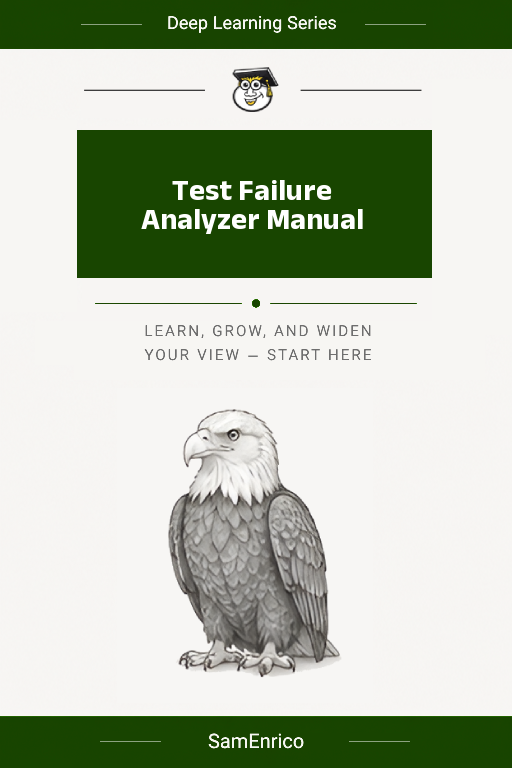
Non-FictionAI OperatorQuality AssuranceTest Guide
Test Failure Analyzer Manual eBook
Automatically diagnose failed unit tests, integrat
Automatically diagnose failed unit tests, integration tests, and end-to-end test flakiness using AI. Includes root cause classification, repro steps, and flaky test detection.
Formats
Free sample
Chapter 1: The Red X Economy--–- The first time I watched a 460millionsoftwarefailureunfoldinrealtime,Iwasn′tsittinginatradingfloorcommandcenter.Iwasreadingapost−mortemabout Knight Capital′s2012disaster—forty−fiveminutesofalgorithmictradinggonewrongbecauseatestwasdeployedincorrectly.Butthenumberthatstuckwithmewasn′tthe460 million software failure unfold in real time, I wasn't sitting in a trading floor command center. I was reading a post-mortem about Knight Capital's 2012 disaster—forty-five minutes of algorithmic trading gone wrong because a test was deployed incorrectly. But the number that stuck with me wasn't the 460millionsoftwarefailureunfoldinrealtime,Iwasn′tsittinginatradingfloorcommandcenter.Iwasreadingapost−mortemabout Knight Capital′s2012disaster—forty−fiveminutesofalgorithmictradinggonewrongbecauseatestwasdeployedincorrectly.Butthenumberthatstuckwithmewasn′tthe460 million. It was the smaller, quieter number buried on page fourteen of the technical report: six engineers had spent three hours trying to diagnose the failure before they understood what happened. Three hours.
For a bug that would ultimately destroy a two-hundred-year-old financial firm.The red X of a failed test is not a minor inconvenience. It is not a gentle nudge to fix something small before moving on with your day. The red X is a tax. And like any tax, it has a rate, a base, and a collection mechanism. Most engineering organizations have no idea what their test failure tax rate is because they have never bothered to calculate it.
They accept the red X as a cost of doing business—like rent or electricity—without ever asking whether that cost could be reduced by ninety percent.This chapter is the receipt for that tax. We are going to count every dollar, every minute, and every neuron that dies when a test fails. By the time you finish reading, you will understand why the most sophisticated engineering organizations on the planet—Google, Netflix, Uber, Stripe—have all invested millions in automated test failure analysis. And you will be motivated, perhaps for the first time, to build your own.But before we talk about solutions, we need to talk about pain. Real pain.
The kind that wakes you up at 3:00 AM because the on-call phone just buzzed and you have no idea whether the build is truly broken or just flaky. The kind that makes you stare at ten thousand lines of logs, scrolling past timestamps and thread IDs and memory addresses, searching for the one line that matters. The kind that makes you wonder, just for a moment, whether you should have become a farmer instead.Let us quantify that pain.The Three Hidden Costs of the Red XMost engineering leaders track test pass rates. They track build times. They might even track deployment frequency.
But almost no one tracks the true cost of test failures because those costs are hidden in plain sight—buried in the gaps between systems, in the moments between context switches, in the quiet frustration of an engineer who just lost twenty minutes of deep work.There are three hidden costs that matter.Cost One: CI/CD Pipeline Blockage Every test failure that reaches your continuous integration pipeline creates a blockage. Your deployment pipeline stops. No new code moves to staging. No hotfixes go to production. Every engineer who has a pull request waiting in the queue behind that failure is now waiting—whether they know it or not.The math is brutal.
If your team has fifty engineers and each deploys three times per day, that is one hundred fifty deployment attempts. If ten percent of those attempts fail due to test issues (a conservative estimate based on Google's internal data), that is fifteen blockages per day. If each blockage lasts an average of thirty minutes (from failure detection to root cause diagnosis to fix to rerun), that is seven and a half hours of blocked pipeline time daily. Over a year, that is nearly two thousand hours of calendar time where your deployment pipeline was stopped, waiting for someone to figure out what went wrong.But calendar time is not the full story. Pipeline blockage creates a psychological tax that is harder to measure: the feeling that the system is fragile, that deployments are risky, that maybe it is safer to batch changes and deploy less frequently.
This is the death spiral of slow, fearful deployment—the exact opposite of the high-velocity, low-risk culture that modern Dev Ops promises.Cost Two: Developer Context Switching The most expensive resource in any engineering organization is not the cloud bill. It is not the CI minutes. It is the focused attention of a skilled engineer in the middle of a complex problem. And test failures are masterful at destroying that attention.When a test fails, the engineer who wrote the code is usually the one who gets pinged. They are deep in a different problem—designing a new API, debugging a memory leak, refactoring a legacy module—when the red X appears.
They switch contexts. They open the CI logs. They scroll. They search. They maybe find the root cause in five minutes, maybe fifteen, maybe never.
Then they switch back to their original task.Research on context switching (documented in the classic paper "The Cost of Interrupted Work" by Iqbal and Horvitz) shows that it takes an average of twenty-three minutes to fully resume a complex task after an interruption. Twenty-three minutes. That is not the time to fix the test. That is the time to get back to the same level of cognitive engagement you had before the interruption. The fix itself adds more time.Now multiply that across a team.
If each engineer experiences three test failure interruptions per day (again, conservative), that is nearly seventy minutes of lost productivity per engineer per day just from the context switch penalty. For a team of fifty engineers, that is nearly sixty hours of lost productivity daily. Over a year, that is fifteen thousand hours—the equivalent of seven full-time engineers doing nothing but recovering from interruptions.And here is the cruel irony: most of those failures are not even real. They are flaky tests that will pass on the next rerun. But the engineer does not know that until they have already switched contexts, opened the logs, and started investigating.Cost Three: Cognitive Load of Log Parsing The final hidden cost is the most insidious because it is almost never measured.
It is the cognitive load of looking at ten thousand lines of logs and trying to find the one line that matters.Human beings are not good at scanning raw text for anomalies. We are pattern matchers, yes, but we are slow pattern matchers when the patterns are buried in noise. A typical test failure log contains timestamps, thread IDs, memory addresses, stack traces, framework initialization messages, dependency resolution logs, network connection logs, and—somewhere in the middle—the actual error message that explains what went wrong.Finding that signal in the noise is a skill that takes years to develop. But even expert engineers can only process about two hundred lines of logs per minute effectively. Ten thousand lines is fifty minutes of pure scanning before you even start thinking about the root cause.Now consider that many test failures produce logs that are fifty thousand lines long.
Consider that many CI systems truncate logs after a certain size, losing the most important information. Consider that the same failure might look completely different in…
This is the end of the free sample. Get the eBook to keep going. Buy now
About this book
Details
- Author
- Himes Kimberely
- Publisher
- SamEnrico
- Language
- English
- Genre
- Non-Fiction, AI Operator, Quality Assurance, Test Guide
- Released
- 2026-05-27
- Pages (approx.)
- 123
- Available as
- eBook, Audiobook

Read better in the ZLOADR app
Your eBooks on your phone or tablet. Sign in with your SamEnrico account and start reading.
More by Himes Kimberely
 Resentment After Betrayal GuideHimes Kimberely$11.99
 Infant Microbiome Brain DevelopmentHimes Kimberely$11.99
 The Gambling Trigger Identification GuideHimes Kimberely$11.99
 Sales Executive Quota Stress CourseHimes Kimberely$11.99
 Body Language for Casino StaffHimes Kimberely$11.99
 The Silk Road Heist: How a Shadowy Syndicate Stole Billions from the Dark WebHimes Kimberely$11.99
 BookstoreHimes Kimberely$11.99
 India Green Technology GuideHimes Kimberely$12.99
 Understanding Landau–kleffner SyndromeHimes Kimberely$17.99
 How to Start a Stenotype Service BusinessHimes Kimberely$11.99
You may also like
 Hong Kong Handover 1997Dunn Johnnie$11.99
 Zumba For Postnatal Recovery CourseNeal Christian$11.99
 Zumba for BeginnersLadner Nikia$11.99
 YouTube Comment Mining GuideHumes Pandora$12.99
 Worry Box MeditationCarlin Rudy$11.99
 Workplace Stress MeditationNguyen Lynn$11.99
 Workplace Stress and Sleep RepairHawley Ivory$11.99
 Workplace Perfectionism CureDelaney Jeffry$11.99
 Workplace Injustice Anger GuideWallen Isabelle$11.99
 Work Addiction and Burnout LinkGreenwood Ester$11.99
 Women in Yoga and WellnessBeattie Galina$11.99
 Women in Stand Up ComedyChun Evangeline$11.99