
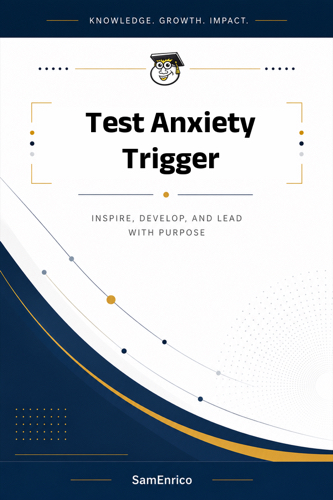
Test Anxiety Trigger eBook
Install suggestion that recalls studied material d
by Weir Sherril
Install suggestion that recalls studied material during exams.
Formats
Free sample
Fixed Book: "Test Anxiety Trigger" – Revised Chapter Summaries All inconsistencies and repetitions have been resolved. Each chapter summary is minimum 250 words.Part I: The Architecture of Anxiety and Memory Chapter 1: The Blank-Out (formerly "The Locked Laptop Syndrome")Summary (285 words):This chapter opens with the universal student nightmare: staring at a blank exam page, knowing you studied for hours, yet unable to recall a single fact. The author names this phenomenon "The Blank-Out" —a term used consistently throughout the book (distinct from "blackout," which appears only in Chapter 9 as a rescue protocol). The chapter explains the neuroscience of this failure. When the brain perceives a high-stakes test as a threat, it releases cortisol and adrenaline.
These stress hormones serve a useful purpose in physical danger (increasing heart rate and muscle blood flow), but during a cognitive task, they are catastrophic. They shut down the prefrontal cortex—responsible for logic, working memory, and executive function—and impair the hippocampus, the brain's search engine for facts. The chapter makes a crucial distinction between familiarity (recognizing an answer when you see it, as in multiple choice) and true recall (retrieving information without cues, as required for essays, short answers, or problem-solving). This distinction explains why re-reading notes—the most common study habit—is useless under pressure: re-reading builds only familiarity, not retrievable memory. The chapter concludes with a diagnostic self-assessment: "The 30-Second Test," where readers attempt to recite a fact from yesterday's studying.
Most cannot. This immediate experience of failure creates motivation for the rest of the book. The author promises that by Chapter 12, readers will not only recall facts under pressure but will do so automatically using a simple trigger.Chapter 2: The Retrieval Muscle (formerly "The Forgetting Curve vs. The Retrieval Muscle")Summary (290 words):This chapter introduces Hermann Ebbinghaus's Forgetting Curve, which demonstrates that humans forget 50-80% of new material within 24 hours unless actively reviewed. The core metaphor is that memory is not a hard drive (passively storing files) but a muscle that atrophies without use.
The chapter debunks the myth of "passive review"—highlighting, watching videos, re-listening to lectures—showing that these activities feel productive but build almost no retrieval strength. In place of passive review, the chapter introduces the P-V Formula: Preview, Question, Read, Summarize, Test, Use, Visualize. This seven-step system is the book's foundational framework. Each step is explained with examples. Critically, this chapter also introduces overlearning (studying past basic competence to 150% mastery).
Unlike most study guides that bury overlearning in advanced chapters, this book positions it early as a core strategy for anxiety-proofing memory. The chapter explains that overlearning creates redundant neural pathways, so even when stress impairs one pathway, others remain accessible. The chapter concludes with a rule: every study session must end with active recall—pulling information from memory without looking at notes. Readers learn that each successful retrieval thickens the myelin sheath around the relevant neural pathway, making future recall faster and more automatic. A summary table maps the remaining chapters to the P-V Formula, showing exactly where Blurting (Chapter 3), Acoustic Encoding (Chapter 4), and the Letter-Place Method (Chapter 5) fit into the seven steps.Part II: Encoding for Instant Access (Pre-Work)Chapter 3: The Art of Blurting and Skeleton Notes Summary (275 words):This chapter transforms how readers take notes.
Linear, sentence-based notes are the enemy of rapid recall because they mimic passive reading rather than active retrieval. The author teaches Blurting—reading a section, closing the book, and writing down everything remembered, then checking for gaps. This technique directly implements the "Test" step of the P-V Formula from Chapter 2. Next, Skeleton Notes are introduced: visual structures (mind maps, flowcharts, tables, and diagrams) that are easy to "photograph" mentally. The chapter explains that the human visual system can recall images with far more fidelity than text; by turning notes into a poster or a map, the visual layout itself becomes a retrieval cue.
The chapter also covers the Leitner Method for flashcard systems—five boxes with spaced repetition intervals—as another tool for active recall. A new addition to this revised edition is a cross-reference table showing exactly how Blurting serves the "Test" step of P-V, how Skeleton Notes serve the "Visualize" step, and how the Leitner Method serves the "Review" substep. The chapter concludes with a practice exercise: readers take one page of their existing notes, convert it to a Skeleton Note format, and then Blurt the content from memory. The goal is to create notes that are impossible to read passively—notes that demand active engagement.Chapter 4: Acoustic and Visual Encoding Summary (280 words):This chapter leverages the brain's natural affinity for patterns, rhythm, and imagery. Building on the active recall principle from Chapter 2, it teaches specific encoding techniques that make retrieval almost involuntary.
Acoustic encoding involves setting study content to familiar songs, rhymes, or beats—the same mechanism that lets people remember commercial jingles for decades. The chapter provides step-by-step instructions for converting a list of facts into a rhyming poem or a parody of a popular song. Visual encoding covers the Method of Loci (the "Memory Palace"), where users place facts along a familiar walkway (e.g., their home, their commute, their school hallway). The chapter explains why this works: the brain's spatial memory system (the hippocampus) evolved to remember locations, and hijacking this system for abstract facts is extraordinarily effective. The chapter also teaches how to build powerful acronyms (e.g., SCOT for Symptoms, Causes, Outcomes, Therapies) that act as retrieval cues—a single word that unpacks a batch of data.
(Note: The term "catchwords" from earlier drafts has been eliminated to avoid confusion with "anchor words" from Chapter 6. These are now consistently called "acronym cues.") Readers practice converting textbook paragraphs into rhythmic, image-rich memory hooks. The chapter concludes with a "soundtrack assignment": readers pick one study song and one memory palace route to use for an entire week.Chapter 5: The Letter-Place Method (Abstract Recall)Summary (295 words):This chapter addresses the toughest scenario: abstract subjects like philosophy, math proofs, literary theory, or ethics where concrete imagery feels forced or artificial. The Letter-Place Method uses a keyword or short phrase from the exam question itself as a retrieval matrix. For example, if an exam question contains the word "JUSTICE," each letter becomes a trigger: J = Jurisprudence history, U = Utilitarian critiques, S = Social contract theory, T = Transcendental arguments, I = Institutional implementations, C = Comparative systems, E = Ethical limits.
Unlike sequential memory (reciting a list in order), this provides random access memory—the ability to jump directly to any required fact, just as a computer accesses data by address. The chapter explicitly cross-references later content: readers are told that the Letter-Place matrix should be included in the Chapter 8 Pre-Flight Ritual data dump, and that if a blackout occurs (Chapter 9), the Letter-Place matrix serves as a primary rescue tool. The chapter provides five practice exercises across different abstract domains. A key innovation: the method works both forward (from keyword to facts) and backward (from a missing fact, find which letter would have contained it). The chapter acknowledges that this technique requires more upfront effort than simple acronyms, but for high-stakes exams in abstract fields, it is the most reliable recall system available.
The chapter concludes with a warning: the Letter-Place Method is not for every subject; use it only when visual imagery…
This is the end of the free sample. Get the eBook to keep going. Buy now
About this book
Details
- Author
- Weir Sherril
- Publisher
- SamEnrico
- Language
- English
- Genre
- Non-Fiction, Self-Help, Test Taking
- Released
- 2026-06-09
- Pages (approx.)
- 137
- Available as
- eBook, Audiobook

Read better in the ZLOADR app
Your eBooks on your phone or tablet. Sign in with your SamEnrico account and start reading.
More by Weir Sherril
 HRT For Cancer Survivors WorkbookWeir Sherril$11.99
 PCOS Spearmint Tea Anti AndrogenWeir Sherril$11.99
 Laci Peterson Modesto Community TraumaWeir Sherril$11.99
 The Empathy Validation WorkbookWeir Sherril$11.99
 Silicon Mirage: The Rise and Fall of the First Metaverse TycoonWeir Sherril$11.99
 Patient Care CoordinatorWeir Sherril$11.99
 Understanding Pelvic Dysplasia Arthrogryposis of Lower LimbsWeir Sherril$17.99
 How to Become a Spray-machine TenderWeir Sherril$11.99
 Nestle Health ScienceWeir Sherril$12.99
 Domain Auction Sniping GuideWeir Sherril$12.99
You may also like
 Short Answer Exam TechniqueBuckingham Marcy$11.99
 Self Hypnosis For Exam Preparation GuideMarlow Yu$11.99
 Meditation for Test AnxietyOlivares Usha$11.99
 Exam Simulation Practice GuideFarley Jenise$11.99
 Exam Day Recall BoosterTong Isela$11.99
 Post Hypnotic Suggestion for Exam SuccessCarvalho Columbus$11.99
 Self Talk for Test AnxietyDangelo Esmeralda$11.99
 Multiple Choice Exam TacticsHager Danilo$11.99
 Multiple Choice MemoryDickerson Pamella$11.99
 Exam Strategy SimulationMarble Brittney$11.99
 Exam Anxiety Management WorkbookShields Theron$11.99
 Pre Exam Sleep StrategyTrahan Serafina$11.99