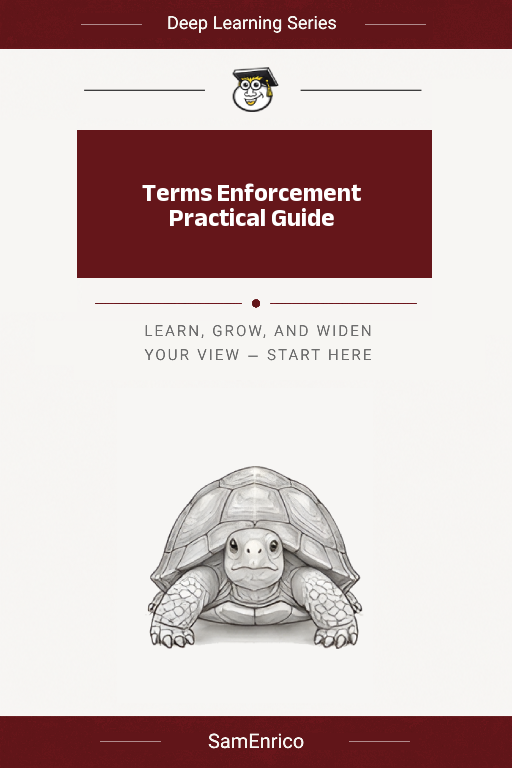
Terms Enforcement Practical Guide eBook
Enforce your Terms of Service through account susp
Enforce your Terms of Service through account suspension, legal demands, or automated checks. Build systems to detect violations without manual review.
Formats
Free sample
Chapter 1: The $3 Million Mistake...--The doctor’s name was Michael, though in the court filings he was simply “Plaintiff.” He was a pediatric surgeon in Chicago who, on a Tuesday afternoon, tried to send $8,400 to a medical supply company in Germany. He had done this exact transfer eleven times before without incident. On the twelfth time, an automated fraud detection system—let’s call it “Shield”—flagged the transaction.The reason? Michael had logged in from a new i Phone. That was it.
A device change. No unusual velocity, no mismatched geolocation, no blacklisted counterparty. Just a new phone.Shield’s machine learning model had been trained on millions of transactions, and it had learned that device changes preceding large wire transfers were correlated with account takeover fraud. The correlation was real. The confidence score was 94 percent.
The system froze Michael’s account instantly, without human review, and sent an automated email: “Suspicious activity detected. Your account has been temporarily restricted. Contact support.”Michael called support. He waited forty-seven minutes. He explained the situation.
The support agent, reading from a script, said she could see the flag but could not override it without “further verification.” She asked for a notarized affidavit confirming his identity. Michael, who was in the middle of a twelve-hour shift and whose daughter’s surgery was scheduled for the following Monday, asked to speak to a manager. The manager said the same thing.Three weeks later, Michael sued. His legal theory was not that the freeze was incorrect—he acknowledged that automated systems make mistakes. His theory was that the platform had no reasonable basis for the freeze because its Terms of Service did not explicitly authorize suspicion-based freezes without evidence.
The platform’s To S said it could terminate accounts for “any reason or no reason,” which its lawyers had assured them was bulletproof.It was not bulletproof. The court found that the “any reason” clause applied to termination, not to temporary freezes of funds. More critically, the court held that freezing funds—unlike terminating an account—implicated state-level consumer protection statutes that required “reasonable cause” before deprivation. The platform had no reasonable cause. It had a 94 percent confidence score from a black-box model whose training data it refused to disclose.
The jury awarded Michael $3.2 million.The platform shut down its consumer division eight months later. Not because it couldn’t afford the verdict, but because the discovery process revealed that its enforcement system had no audit trails, no documented decision chain, and no appeals process that anyone had ever successfully used. The plaintiff’s attorneys had a field day. The platform’s general counsel resigned.This book exists so that is not you.The Three-Layer Defense Framework Before we dive into cases, clauses, and code, you need to understand the mental model that will guide every decision in this book. Let’s call it the Three-Layer Defense Framework.
Every enforcement action you take—whether automated or manual, financial or content-based, temporary or permanent—must satisfy all three layers simultaneously. Miss one layer, and you are exposed.Layer 1: Legal Fortification. Your Terms of Service must explicitly authorize the specific enforcement action you are taking. “Any reason” is not enough. You need clauses for suspicion-based freezes, for temporary restrictions, for data preservation, for appeals exhaustion.
You need to know which clauses courts have actually upheld—and which they have pierced.Layer 2: Procedural Enforcement. Your product workflows must provide due process. That means graduated sanctions (warning before ban, restriction before deletion), a visible appeal mechanism, and human review for subjective decisions. Procedural failures are how class actions are born.Layer 3: Automated Detection. Your ML systems must be auditable.
You must know, for every enforcement action, the specific clause violated, the confidence score, the input features that drove the decision, and the version of the model that made the call. If you cannot produce this chain in discovery, you will lose—even if you were right.Most platforms nail one layer and ignore the other two. The fintech that froze Michael’s account had decent detection (Layer 3) but terrible legal (Layer 1) and procedural (Layer 2) foundations. The social network that bans trolls with human moderators has good process but no scale. The startup that writes a beautiful To S but never implements automated detection catches nothing.The goal of this book is to help you build all three layers, in the right order, with the right trade-offs.
And it starts with understanding the single most dangerous misconception in platform enforcement.The Myth of the Absolute Termination Right Here is what your boilerplate To S probably says right now:“We reserve the right to terminate or suspend your account at any time, for any reason or no reason, with or without notice.”Every lawyer has written this clause. Every platform has it. And it is not entirely wrong—courts do generally uphold broad termination rights. But the nuance is everything. Let’s look at what courts actually do, not what lawyers hope they will do.The General Rule: Deferential but Not Deified In the United States, the dominant precedent comes from the Ninth Circuit’s decision in Zango, Inc.
v. Kaspersky Lab, Inc. (2009). Kaspersky’s antivirus software flagged Zango’s software as adware and blocked it. Zango sued.
The court held that Kaspersky’s To S gave it “broad discretion” to determine what constituted a threat, and that discretion was enforceable. The key language: “A contractual grant of discretion is not a license to act in bad faith, but it does foreclose liability for reasonable exercises of that discretion.”This is the two-part test that matters. Courts will not second-guess your enforcement decisions if:The To S explicitly grants you discretion, and You exercised that discretion in good faith (not fraudulently, not grossly negligently).The problem is that platforms constantly fail the second pring. Not because they are malicious, but because they cannot prove good faith when challenged. A black-box model with no audit trail looks like arbitrary enforcement.
A suspension with no documented reason looks like bad faith. An ignored appeal looks like negligence.When Courts Pierce the Veil Let’s look at the cases where platforms lost—not because their enforcement was wrong, but because their documentation was absent.Case 1: The Bank That Froze Without Cause (US, 2018)A regional bank froze a small business’s account after the business deposited several large checks. The bank’s fraud algorithm flagged the deposits as “structuring” (a money laundering technique). The bank had no evidence of structuring—just a pattern that its model associated with structuring. The To S said the bank could freeze accounts for “suspected fraud.” The court held that “suspected” required specific articulable facts, not a model score.
The bank could not produce those facts because its model was a black box. Verdict: $1.1 million.Case 2: The Nigerian Bank That Won (Nigeria, 2020)A customer tried to withdraw a large sum immediately after changing his password and registered phone number. The bank froze the account. The customer sued. The bank’s To S contained an explicit clause: “The bank may freeze any account where there has been a material change in access credentials followed by a withdrawal request exceeding 50%…
This is the end of the free sample. Get the eBook to keep going. Buy now
About this book
Details
- Author
- Hartley Yuriko
- Publisher
- SamEnrico
- Language
- English
- Genre
- Non-Fiction, First 30 Days, Enforcement
- Released
- 2026-06-01
- Pages (approx.)
- 151
- Available as
- eBook, Audiobook

Read better in the ZLOADR app
Your eBooks on your phone or tablet. Sign in with your SamEnrico account and start reading.
More by Hartley Yuriko
 Elizabeth I Court Survival GuideHartley Yuriko$11.99
 Schema Therapy Emotions GuideHartley Yuriko$11.99
 The Endowment Effect GuideHartley Yuriko$11.99
 Stress Management for Real Estate AgentsHartley Yuriko$11.99
 How to Produce Art and Craft KitsHartley Yuriko$11.99
 Alabaster (Variety of Gypsum) MiningHartley Yuriko$11.99
 How to Become a Papier Mache MolderHartley Yuriko$11.99