
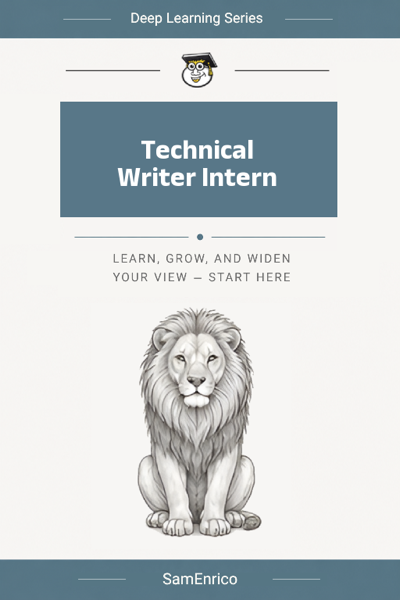
Non-FictionInformativeEducational
Technical Writer Intern eBook
A Coursebook on Technical Writer Intern
A Coursebook on Technical Writer Intern
Formats
Free sample
Chapter 1: Jargon Monsters & Basement Myths...--You’ve been told that technical writing is a quiet, solitary profession. You imagine a fluorescent-lit basement, a dusty style guide, a writer sipping cold coffee while perfecting comma placement in a 400-page manual that no one will ever read. Maybe you’ve heard the rumors: technical writers are failed novelists, grammar cops, or introverts hiding from human interaction.That image is not only wrong—it’s dangerous.Because if you walk into your first day as a technical writer intern believing that myth, you will fail. Not because you can’t write. But because you won’t understand what you’ve actually signed up for.The reality is starkly different.
Modern technical writing is high-velocity, intensely collaborative, and deeply integrated with product development. You’ll sit in sprint planning meetings where engineers debate API changes. You’ll tag along to usability tests where real users struggle with words you wrote. You’ll be pulled into Slack channels at 4 PM on a Friday because a release is going out and the documentation needs to go with it.You are not a basement dweller. You are a bridge—between engineers who know too much and users who know too little, between product managers who want to ship and support agents who have to clean up the mess.
Your job is not to write beautiful sentences. Your job is to reduce suffering.That’s the thesis of this book, and it’s the thesis of this chapter: an internship in technical writing is not about proving you can follow a style guide. It’s about learning how to add value quickly in an environment that moves faster than you’re comfortable with.But before you can add value, you need to understand what you’re walking into. And that means confronting three things: the modern technical communication landscape, the three pillars that will support your entire career, and the impostor syndrome that will try to crush you in your first week.The Modern Technical Communication Landscape: Agile, Docs-as-Code, and AILet’s start with a timeline.Fifteen years ago, technical writing looked like this: a writer received a finished product, spent six weeks writing a manual, sent it to a printer, and then went home. The doc was static.
The product was frozen. The user had no choice but to read the PDF or call support.That world is gone.Today, software ships in continuous delivery cycles—sometimes multiple times per day. Hardware products get firmware updates over the air. Medical devices sync with cloud platforms. The documentation cannot lag behind the product.
It must evolve in lockstep, sometimes leading the product to warn users about known issues before the fix is released.This shift has given rise to three major forces shaping every technical writing internship today: Agile development, Docs-as-Code, and AI-assisted authoring.Agile Development: The Cadence That Will Define Your Days Agile is a project management methodology that breaks work into short cycles called sprints, usually one or two weeks long. At the end of each sprint, the team delivers something usable—a working feature, a bug fix, a documentation update.For you, the intern, this means no six-week writing marathons. You’ll work in small chunks. You’ll ship often. You’ll get feedback constantly.Here are the key agile ceremonies you’ll encounter, with a plain-English translation of each:Sprint Planning (usually Monday morning, 60-90 minutes): The team decides what to accomplish in the upcoming sprint.
The product manager brings a list of priorities; engineers estimate how much work each task requires; the team commits to a set of deliverables. Your role as an intern? Listen. Take notes. When someone mentions a doc task, volunteer.
But don’t overcommit—you’re still learning.Daily Standup (every morning, 15 minutes): Each team member answers three questions: What did I do yesterday? What will I do today? What’s blocking me? Your answers should be honest and short. “Yesterday I finished the installation guide.
Today I’m starting the troubleshooting section. No blockers.” That’s perfect.Sprint Review (end of sprint, 30-60 minutes): The team shows what they built. Engineers demo code; you should demo documentation. Show a before-and-after slide. Celebrate improvements.Sprint Retrospective (after the review, 30-60 minutes): The team discusses what went well and what could improve.
This is where you can suggest process changes—but only after you’ve earned trust.If this sounds overwhelming, good. It is, at first. But within two weeks, the rhythm becomes second nature. You’ll learn to plan your writing in two-day chunks, not two-week marathons. And you’ll discover something surprising: the pressure of shipping constantly makes you better.
You can’t obsess over perfection when the sprint ends on Friday. You learn to ship “good enough” and iterate.Docs-as-Code: Treating Documentation Like Software The second force reshaping technical writing is Docs-as-Code. This is exactly what it sounds like: you write documentation using the same tools and workflows that engineers use to write code.Instead of writing in Microsoft Word or Google Docs, you write in plain text using Markdown (a simple formatting syntax that you’ll learn in Chapter 7 and Appendix C). Instead of emailing drafts back and forth, you store your documentation in Git, a version control system that tracks every change, who made it, and why. Instead of begging for approvals, you open pull requests where reviewers can comment on your work line by line.Why does this matter?
Because Docs-as-Code enables five things that traditional documentation workflows cannot:Parallel work: Multiple writers can edit the same document simultaneously without overwriting each other’s changes.Versioning: You can see exactly what changed between the last release and this one, down to the individual comma.Automation: When the engineer merges code, your documentation can automatically update—no manual sync required.Code review culture: Documentation gets the same rigorous review as code, which means higher quality and fewer errors.Single source of truth: You write once and publish everywhere (web, PDF, mobile) using static site generators.But Docs-as-Code also has a downside: it’s terrifying for beginners. Git has a reputation for being complex and unforgiving. The command line looks like a hacker movie. Merge conflicts (when two people edit the same line) cause grown adults to cry.Here’s the truth: Git is not that hard. The basic workflow—clone, branch, edit, commit, push, pull request—takes about an hour to learn and a week to internalize.
Everything beyond that is optional. You don’t need to be a command-line wizard. You need to know six commands. That’s it.Note for hardware and medical device interns: Not every company uses Docs-as-Code. If you’re interning at a hardware company or a regulated medical device manufacturer, you’re more likely to use a component content management system (CCMS) like Mad Cap Flare or Paligo.
Those tools are different but share the same core concepts: structured writing, single-sourcing, and version control. We cover those differences in Chapter 8. For now, understand that Docs-as-Code is the standard for software and developer tools. If that’s not your world, don’t panic. The principles transfer.AI-Assisted Authoring: Your New Junior Assistant…
This is the end of the free sample. Get the eBook to keep going. Buy now
About this book
Details
- Author
- Heflin Sharilyn
- Publisher
- SamEnrico
- Language
- English
- Genre
- Non-Fiction, Informative, Educational
- Released
- 2026-05-11
- Pages (approx.)
- 157
- Available as
- eBook, Audiobook

Read better in the ZLOADR app
Your eBooks on your phone or tablet. Sign in with your SamEnrico account and start reading.
More by Heflin Sharilyn
 Ylang Ylang Stress ReliefHeflin Sharilyn$11.99
 Region of Value Content GuideHeflin Sharilyn$11.99
 Senator Filibuster Reform GuideHeflin Sharilyn$11.99
 Kidnap Crisis Non-Ransom Resolution GuideHeflin Sharilyn$11.99
 Self Hypnosis Morning PainHeflin Sharilyn$11.99
 Frozen Echoes: The Day the Music Died in the ArcticHeflin Sharilyn$11.99
 The Last Whale Song: How Deep-Sea Vents Changed the Ocean’s FutureHeflin Sharilyn$11.99
 How to Become a Die CutterHeflin Sharilyn$11.99
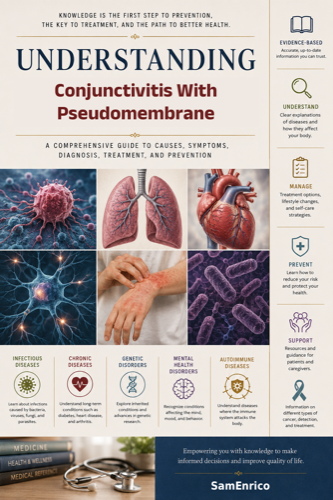 Understanding Conjunctivitis With PseudomembraneHeflin Sharilyn$17.99
 Google Ads Policy Tracker 2026Heflin Sharilyn$12.99
 Dubai Student Rights GuideHeflin Sharilyn$12.99
You may also like
 Hong Kong Handover 1997Dunn Johnnie$11.99
 Zumba For Postnatal Recovery CourseNeal Christian$11.99
 Zumba for BeginnersLadner Nikia$11.99
 YouTube Comment Mining GuideHumes Pandora$12.99
 Worry Box MeditationCarlin Rudy$11.99
 Workplace Stress MeditationNguyen Lynn$11.99
 Workplace Stress and Sleep RepairHawley Ivory$11.99
 Workplace Perfectionism CureDelaney Jeffry$11.99
 Workplace Injustice Anger GuideWallen Isabelle$11.99
 Work Addiction and Burnout LinkGreenwood Ester$11.99
 Women in Yoga and WellnessBeattie Galina$11.99
 Women in Stand Up ComedyChun Evangeline$11.99