
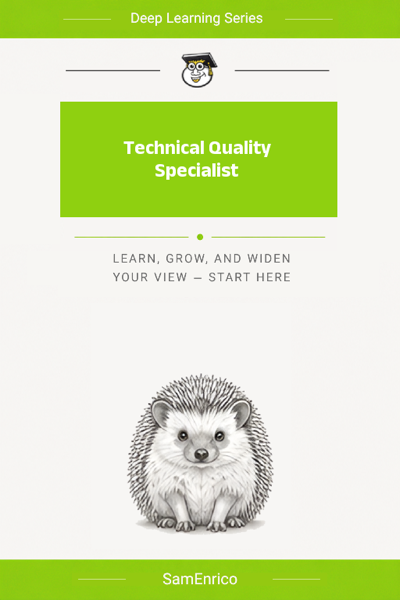
Non-FictionInformativeEducational
Technical Quality Specialist eBook
A Coursebook on Technical Quality Specialist
A Coursebook on Technical Quality Specialist
Formats
Free sample
Chapter 1: The $12 Billion Typo...--The conference room on the 14th floor had floor-to-ceiling windows overlooking the Pacific Ocean, a mahogany table that seated twenty-four, and a silence so heavy it felt like the air had been replaced with concrete. On one side of the table sat three lawyers from a prestigious firm that billed $2,500 per hour. On the other side sat James, a technical quality specialist with fourteen years of experience, a worn ASQ certification card in his wallet, and a knot in his stomach that had been growing for seventy-two hours.The document in front of him was seventy-three pages long. The error was on page forty-one, line twelve, third column. A single digit.
A "5" that should have been a "6." The difference between 0.005 inches and 0.0005 inches. Ten times smaller. Ten times more precise. Ten times more expensive to produce.Three months earlier, James had flagged this discrepancy. He had walked the engineering change order down to the lead engineer's cubicle, placed it on the desk, and said, "I think there's a typo in the tolerance callout for the actuator housing." The lead engineer had glanced at it, shrugged, and said, "It's been through design review.
It's fine." James had escalated to the quality manager, who had taken the document, promised to look into it, and never returned the email. James had documented his concern in the QMS—a non-conformance report with a single line: "Potential specification error in ECO-2024-089, tolerance for dimension 12.4. Recommend review."The NCR had been closed three days later with a disposition of "No Action Required. Signature: R. Chen, Engineering Manager."Now, seventy-three pages sat on a mahogany table.
The actuator housing had been manufactured to the incorrect tolerance. The parts had been shipped. They had failed in the field. Not catastrophically—no one had died, thank God—but the failure had caused a cascade of events that shut down a customer's entire production line for eleven days. The customer was suing for $12 billion in lost revenue, plus punitive damages.The lead engineer who had dismissed James's concern was no longer with the company.
The quality manager who had closed the NCR was on medical leave for stress-related hypertension. James was the only person in the room who had seen the error before it became a disaster. He was also the only person in the room without a law degree.The senior partner from the law firm tapped the document with a manicured finger. "Mr. James," he said, "can you walk us through what you saw, when you saw it, and what you did about it?"James opened his mouth.
The knot in his stomach tightened. And then he began to talk.This is not a book about paperwork. This is not a book about checklists, though checklists will appear in these pages. This is not a book about ISO standards, though the standards will be discussed in detail. This is a book about the space between what is designed and what is made, the space between what is required and what is delivered, the space between a product that works and a product that fails.
You live in that space. You are the Technical Quality Specialist.The Silent Profession Quality is the only profession whose success is measured by the absence of failure. When a quality specialist does their job perfectly, nothing happens. Planes do not crash. Pacemakers do not malfunction.
Bridges do not collapse. Cars do not explode. Food does not poison children. And because nothing happens, no one notices. No one gives a medal to the quality specialist who prevented a recall.
No one puts the inspector who caught a critical defect on the cover of a magazine. The only time quality professionals become visible is when something goes wrong. Then, suddenly, everyone wants to know: Where was quality? Who signed off on this? Why didn't someone stop this?This is the paradox of your profession.
You are invisible in success and visible only in failure. You are the last line of defense between a product and the public, yet you are often treated as a bureaucratic nuisance by engineers who see you as a roadblock, by production managers who see you as a cost center, and by executives who see you as a necessary evil required by some regulation they have never read.And yet: every product recall, every catastrophic failure, every lawsuit that bankrupts a company can be traced back, through a chain of decisions and oversights, to a moment where someone ignored a warning, signed a document without reading it, or assumed that because nothing had gone wrong before, nothing would go wrong this time. The technical quality specialist is the person who does not ignore the warning. Who reads the document. Who assumes that because something could go wrong, it eventually will.This chapter is about who you are, what you do, and why it matters.
But more than that, this chapter is about redefining your role from a reactive gatekeeper—someone who inspects and rejects—to a proactive strategic partner who prevents problems before they ever reach the production line.The Three Faces of Quality: QA, QC, and TQSBefore we go any further, we need to clear up a confusion that has plagued the quality profession for decades. Quality Assurance. Quality Control. Technical Quality Specialist. These terms are often used interchangeably, but they describe three distinct functions.
Understanding the difference is the first step to understanding your unique value.Quality Assurance (QA) is process-oriented and preventive. QA asks: "Do we have the right systems in place to produce quality products?" QA develops procedures, conducts audits, manages documentation, and ensures compliance with standards like ISO 9001. QA is about building quality into the process before production begins. QA professionals think in terms of systems, procedures, and continuous improvement. They are concerned with the question: "Are we doing things the right way?"Quality Control (QC) is product-oriented and detective.
QC asks: "Does this specific product meet specifications?" QC inspects incoming materials, monitors production output, tests finished goods, and identifies defects. QC is about catching problems after they occur. QC professionals think in terms of samples, measurements, and acceptance criteria. They are concerned with the question: "Is this product good enough to ship?"The Technical Quality Specialist (TQS) is analytical and cross-functional. The TQS asks: "Why did this failure happen, and how do we prevent it from happening again?" The TQS does not simply inspect or audit.
The TQS investigates root causes, analyzes data, evaluates risk, validates processes, manages supplier quality, and bridges the gap between engineering, production, and management. The TQS thinks in terms of physics, statistics, and human factors. The TQS is concerned with the question: "What could go wrong, and how do we stop it before it does?"Here is a clarifying note for readers who work in smaller organizations: In companies with fewer than 100 employees, you may wear all three hats. You may write the QA procedures, perform the QC inspections, and conduct the TQS investigations. That is normal.
That is practical. This book does not require you to work in a siloed role. However, understanding the distinctions helps you recognize which hat you are wearing at…
This is the end of the free sample. Get the eBook to keep going. Buy now
About this book
Details
- Author
- Cerda Bertram
- Publisher
- SamEnrico
- Language
- English
- Genre
- Non-Fiction, Informative, Educational
- Released
- 2026-06-02
- Pages (approx.)
- 158
- Available as
- eBook, Audiobook

Read better in the ZLOADR app
Your eBooks on your phone or tablet. Sign in with your SamEnrico account and start reading.
More by Cerda Bertram
 Prioritization for Government WorkCerda Bertram$11.99
 Cocaine Psychosis Recovery ManualCerda Bertram$11.99
 Preparation Rituals for PresentersCerda Bertram$11.99
 Murdoch Labor Union WarsCerda Bertram$11.99
 Relapse Prevention in Twelve StepsCerda Bertram$11.99
 The Silent Reaper: How a Hospital's Secret Killed 100+ PatientsCerda Bertram$11.99
 The Ballad of the Iron Lady: How Florence Nightingale Revolutionized War MedicineCerda Bertram$11.99
 Polish B2B Contract Remote GuideCerda Bertram$12.99
 Amazon Listing Hijacker RemovalCerda Bertram$12.99
 Understanding Blethen–wenick–hawkins SyndromeCerda Bertram$17.99
 How to Become a Intelligence Research SpecialistCerda Bertram$11.99
You may also like
 Hong Kong Handover 1997Dunn Johnnie$11.99
 Zumba For Postnatal Recovery CourseNeal Christian$11.99
 Zumba for BeginnersLadner Nikia$11.99
 YouTube Comment Mining GuideHumes Pandora$12.99
 Worry Box MeditationCarlin Rudy$11.99
 Workplace Stress MeditationNguyen Lynn$11.99
 Workplace Stress and Sleep RepairHawley Ivory$11.99
 Workplace Perfectionism CureDelaney Jeffry$11.99
 Workplace Injustice Anger GuideWallen Isabelle$11.99
 Work Addiction and Burnout LinkGreenwood Ester$11.99
 Women in Yoga and WellnessBeattie Galina$11.99
 Women in Stand Up ComedyChun Evangeline$11.99