
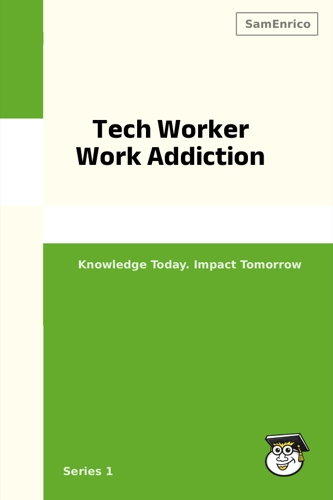
Non-FictionSelf-HelpTech Industry
Tech Worker Work Addiction eBook
Breaks startup hustle and coding marathon culture.
by Eaves Kiara
Breaks startup hustle and coding marathon culture.
Formats
Free sample
Chapter 1: The Broken Rung--–- The notification buzzed at 11:47 PM. Another Slack message. Another "quick question." Another expectation that someone, somewhere, believed required an immediate answer. The developer stared at the screen, fingers hovering over the keyboard, already knowing they would respond. Not because the question was urgent.
Not because the company would fail without them. But because something deeper had taken hold—something that felt like dedication but functioned like addiction.This book opens with a question that most tech workers never ask out loud: Why do so many talented, passionate developers burn out despite loving the work? The answer, as we will discover across these chapters, lies not in individual weakness or lack of discipline. It lies in a culture that has systematically weaponized passion into exploitation, transforming the joy of creation into the compulsion of endurance.Before we can solve the problem of work addiction, we must first understand its origins. And those origins are not found in the psychology of dopamine loops or the biology of cortisol spikes—those come later.
The origins are found in the stories we have been told about what it means to be a good engineer, a dedicated founder, or a successful tech worker. They are found in the myths that Silicon Valley built and then exported to the rest of the world.The Myth of the Natural Hustle Every industry has its origin stories. In tech, the stories are unusually potent and unusually misleading. Consider the archetypal narrative: a handful of brilliant programmers, fueled by pizza and caffeine, work through the night to launch a product that changes the world. The garage startup.
The all-nighter before the demo. The founder who sleeps under their desk. These images have become so embedded in tech culture that they feel inevitable—as if the only path to success is through exhaustion.But as Celeste Headlee argues in Do Nothing, the hustle culture that defines modern tech is not an eternal virtue. It is a relatively recent invention, emerging in the 1980s and accelerating dramatically with the dot-com boom of the 1990s. Before that, the relationship between work and identity looked very different.
Industrial workers fought for the eight-hour day. Post-war corporate employees expected pensions and predictable schedules. The idea that one should love their work enough to sacrifice sleep, health, and relationships for it would have struck most people as strange, even pathological.The shift came with the rise of the "knowledge worker" and the corresponding belief that creative labor cannot be measured in hours. If you are solving a complex engineering problem, the thinking goes, you cannot simply clock out at 5 PM and resume at 9 AM. The problem follows you home.
It sits in the back of your mind during dinner. It wakes you at 3 AM with a solution. This is true, to some extent. Creative work does not fit neatly into timecards. But the tech industry took this reality and stretched it into a justification for total availability.The result is a culture that treats boundaries as weaknesses and exhaustion as a status symbol.
The developer who works 80 hours is celebrated. The developer who works 40 hours is suspected of lack of commitment. The founder who sleeps four hours per night is featured in a Linked In post. The founder who sleeps eight hours is never mentioned. This is not a natural condition.
It is a constructed one. And like any construction, it can be deconstructed.The 10x Developer Delusion Perhaps no myth has caused more damage to tech workers than the myth of the 10x developer. The idea is seductive: a small number of programmers are so extraordinarily productive that they can outperform ten average developers combined. Companies chase these unicorns. Developers compare themselves to an impossible standard.
And everyone ends up exhausted.The 10x myth did not emerge from rigorous research. It emerged from anecdotal observations in the 1960s and 1970s, when computing was new and the range of skill levels was genuinely vast. A novice programmer might take days to write code that an expert could write in hours. The ratio of productivity was real. But over time, this observation was weaponized.
It became a justification for expecting superhuman output from every developer. If you are not 10x, the logic goes, you are not trying hard enough.Andy Dunn's memoir Burn Rate offers a devastating case study of how this plays out in startup environments. Dunn, the founder of the menswear brand Bonobos, describes a culture where workaholism was modeled from the top down. Founders worked 80-hour weeks and expected their teams to do the same. The result was not just burnout but a kind of collective delusion—everyone performing exhaustion as proof of dedication, while the quality of work and quality of life both declined.The 10x myth also creates a perverse incentive structure.
If productivity is treated as an innate, fixed trait (you either are a 10x developer or you are not), then any failure to perform becomes a personal failing rather than a systemic one. The developer who burns out is not seen as a victim of an unsustainable workload. They are seen as someone who simply could not handle the pace. This is not just cruel. It is also wrong.
The research on developer productivity consistently shows that environmental factors—clear requirements, manageable workloads, psychological safety—far outweigh individual aptitude in determining output.The Ownership Trap Big tech companies have their own version of the hustle myth, dressed in more sophisticated language. At Amazon, the leadership principle of "Ownership" sounds noble: act on behalf of the entire company, beyond your own team. Do not sacrifice long-term value for short-term results. But in practice, ownership has become a justification for 24/7 availability. If you own something, the reasoning goes, you are responsible for it at all times.
The pager goes off at 3 AM? You own it. The build breaks on Saturday? You own it. The customer has a problem on Christmas Day?
You own it.This blurring of responsibility and availability is not accidental. It is a structural feature of how big tech organizes work. On-call rotations, once reserved for critical infrastructure roles, have expanded to cover almost every engineering position. The tools of constant connectivity—Slack, email, mobile notifications—have erased the boundaries between work and life. And the financial incentives (equity, bonuses, promotions tied to perceived commitment) have made it nearly impossible to say no.The consequences are visible in the data.
A 2022 study of technology workers found that those in on-call roles reported significantly higher rates of burnout, anxiety, and sleep disorders than those in comparable roles without on-call requirements. The same study found that the expectation of after-hours availability—even when no actual work was performed—was strongly correlated with work addiction symptoms. Simply knowing that you might be contacted is enough to keep your nervous system in a state of low-grade activation.This is the ownership trap: you are rewarded for acting like the business depends on you, and then the business actually begins to depend on you, and then you cannot leave without guilt. The cycle is self-reinforcing. The more you give, the more is expected.
The more that is expected, the more you must give to meet expectations. And somewhere along the way, the joy…
This is the end of the free sample. Get the eBook to keep going. Buy now
About this book
Details
- Author
- Eaves Kiara
- Publisher
- SamEnrico
- Language
- English
- Genre
- Non-Fiction, Self-Help, Tech Industry
- Released
- 2026-06-09
- Pages (approx.)
- 129
- Available as
- eBook, Audiobook

Read better in the ZLOADR app
Your eBooks on your phone or tablet. Sign in with your SamEnrico account and start reading.
More by Eaves Kiara
 Lighthouse Sanctuary JourneyEaves Kiara$11.99
 Park Walking MeditationEaves Kiara$11.99
 Crucial Confrontation FrameworkEaves Kiara$11.99
 GAD And Parenting WorryEaves Kiara$11.99
 Post Scramble Border ConflictsEaves Kiara$11.99
 Magnesium For AnxietyEaves Kiara$11.99
 Velvet & Vengeance: The Lost Heiress of the Silk RoadEaves Kiara$11.99
 Silk and Scandal: The First Fashion Wars of Colonial AustraliaEaves Kiara$11.99
 How to Start a Mental Hospital (public Sector) Business (Beginners Guide)Eaves Kiara$11.99
 How to Produce Hedge Trimmer AccessoriesEaves Kiara$11.99
 Ubongo Kids Media ExitEaves Kiara$12.99
 Vendor Site Visit ChecklistEaves Kiara$12.99
You may also like
 Hong Kong Handover 1997Dunn Johnnie$11.99
 Zumba For Postnatal Recovery CourseNeal Christian$11.99
 Zumba for BeginnersLadner Nikia$11.99
 YouTube Comment Mining GuideHumes Pandora$12.99
 Worry Box MeditationCarlin Rudy$11.99
 Workplace Stress MeditationNguyen Lynn$11.99
 Workplace Stress and Sleep RepairHawley Ivory$11.99
 Workplace Perfectionism CureDelaney Jeffry$11.99
 Workplace Injustice Anger GuideWallen Isabelle$11.99
 Work Addiction and Burnout LinkGreenwood Ester$11.99
 Women in Yoga and WellnessBeattie Galina$11.99
 Women in Stand Up ComedyChun Evangeline$11.99