
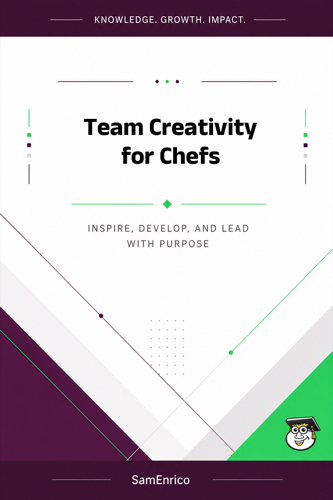
Team Creativity for Chefs eBook
Kitchen team collaborative menu planning.
Kitchen team collaborative menu planning.
Formats
Free sample
Chapter 1: The Silent Bottleneck--The first sign that a kitchen is dying is not a bad review on Yelp or a health inspection failure. It is the sound of silence during the pre-shift meeting. The chef speaks. The team nods. The menu repeats.
And somewhere in the back, a dishwasher who has been pureeing squash scraps into a surprisingly delicious soup for his own family meal says nothing, because no one ever asked.This book begins with a simple provocation: the “lone genius” chef is a myth. Not a harmless myth, but an expensive, exhausting, and creativity-killing one. The image of the chef as a solitary artist—head bowed over a notebook at 4:00 AM, sketching plates in the dark, emerging at service with a fully formed vision—has ruined more restaurants than rising food costs ever will. It has produced burnt-out chefs, disengaged line cooks, and menus that taste like they were written by committee in the worst sense: not because too many people contributed, but because only one person did, and that person ran out of ideas two years ago.The problem is not that chefs lack creativity. The problem is that most kitchens are structured to suppress the creativity of everyone except the chef.
The command-and-control brigade system, borrowed from military hierarchy, is designed for consistency and speed, not innovation. It rewards silence, obedience, and execution. It punishes questioning, experimentation, and divergence. And then, paradoxically, the same chefs who built that system complain that their teams lack passion or that they themselves are “blocked.”The truth is that every kitchen is already full of creative potential. The twenty-two-year-old line cook from Oaxaca knows how to toast chiles in a way no cookbook teaches.
The pastry cook who spends her days piping perfect rosettes has been sketching a smoked chocolate tart in her notebook for six months. The dishwasher, who sees exactly which dishes come back with food left on the plate, has a more accurate read on the menu than any comment card. But unless the chef builds a structure to harvest those ideas, they will remain dormant. The chef becomes a bottleneck—not because they are controlling, but because they have inadvertently designed a system where only their ideas can flow.This chapter dismantles the lone genius myth, replaces it with a more accurate and more useful model of kitchen creativity, and establishes the foundational rules that will govern every subsequent chapter. By the end of this chapter, you will understand why the most innovative restaurants in the world are not run by the loudest chefs, but by the best conductors.
And you will have a clear framework for who decides what, so that collaboration never becomes chaos.The Anatomy of the Bottleneck Every kitchen has a bottleneck. In most restaurants, the bottleneck is not the oven, the pass, or the dishwasher. It is the chef’s brain. Consider the typical menu planning process. The chef sits alone or with one trusted sous chef and generates ideas.
Those ideas are filtered through the chef’s personal taste, training, fatigue, and biases. Then the chef presents a draft menu to the team, often with the implicit message that feedback is tolerated but not truly welcome. The team nods. The menu prints. And six weeks later, when the chef is already bored with dishes they designed, the cycle repeats.This process has three hidden costs that are rarely discussed.
First, the chef burns out. Generating every idea, solving every problem, and carrying the full weight of the menu’s success or failure is unsustainable. Second, the team disengages. When cooks are treated as execution machines rather than creative contributors, they stop caring about anything beyond their station. They do exactly what they are told and nothing more.
And third, the menu stagnates. No single person has an infinite well of ideas. Eventually, the chef starts repeating themselves—the same flavor combinations, the same plating techniques, the same seasonal crutches.The data on this is surprisingly clear, even if it comes from outside the culinary world. In a famous study of brainstorming at a Fortune 500 company, researchers found that groups generated 40% more ideas when the manager was removed from the room entirely. In another study, teams that were told “your manager will evaluate your ideas” produced half as many novel concepts as teams that were told “your peers will evaluate your ideas anonymously.” Hierarchy suppresses creativity.
Not because managers are malicious, but because the mere presence of an authority figure shifts the brain from exploration mode to execution mode.The same dynamic plays out in kitchens every day. A line cook has an idea for a sauce, but they hesitate. Will the chef think it’s stupid? Will they get mocked? Will it slow down prep?
So they say nothing. The idea dies. The chef never knows it existed. And the restaurant loses a potential signature dish.The Conductor, Not the Soloist If the lone genius model is broken, what replaces it? The answer is a fundamental shift in the chef’s role from Soloist to Conductor.
A symphony conductor does not play every instrument. In fact, most conductors are not the best instrumentalists in the orchestra. What a conductor does is shape timing, balance, dynamics, and emotional expression. They decide when the violins enter, how loudly the brass plays, and where the tempo breathes. The musicians bring their technical mastery and interpretive ideas.
The conductor molds those into a cohesive whole.In a kitchen, this means the chef stops being the sole source of ideas and starts being the editor, the facilitator, and the guardian of constraints. The chef’s job is not to have all the answers but to ask the right questions, to create the conditions under which the team’s creativity can flourish, and to ensure that the resulting menu is financially viable, executable during a rush, and true to the restaurant’s identity.This is not abdication. It is not a free-for-all where every half-baked idea makes it onto the menu. The chef still holds final authority on business-critical decisions: food cost margins, cook time feasibility, allergen safety, and brand consistency. But the chef does not hold a monopoly on ideas.
In fact, the chef’s most important creative act is stepping aside to let others step forward.Consider a case study from outside the culinary world, but one that translates directly. The Bradshaw Family Cookbook, a multi-generational collection of recipes, became a bestseller not because it had a single brilliant author, but because it blended voices. Grandmother’s intuition about when pie dough is “just right,” the teenage grandson’s Tik Tok-inspired ramen hacks, the uncle’s practical shortcuts for weeknight dinners—together, these created something richer than any solo cookbook author could produce. The same principle applies in the kitchen. The nineteen-year-old line cook who spends four hours a night on their phone between tickets may spot a food trend before the chef ever hears about it.
The prep cook from El Salvador knows how to use every part of a plantain because that knowledge was survival, not culinary school theory. These are not novelties. They are competitive advantages.The “Yes, And…” Rule Changing the…
This is the end of the free sample. Get the eBook to keep going. Buy now
About this book
Details
- Author
- Barrows Marshall
- Publisher
- SamEnrico
- Language
- English
- Genre
- Non-Fiction, Self-Help, Culinary
- Released
- 2026-06-06
- Pages (approx.)
- 109
- Available as
- eBook, Audiobook

Read better in the ZLOADR app
Your eBooks on your phone or tablet. Sign in with your SamEnrico account and start reading.
More by Barrows Marshall
 Stress and Memory ImpairmentBarrows Marshall$11.99
 Persuasion for PilotsBarrows Marshall$11.99
 Postpartum Abdominal BindingBarrows Marshall$11.99
 Forgiveness Night MeditationBarrows Marshall$11.99
 Senior Self Esteem GuideBarrows Marshall$11.99
 First Job Loss RecoveryBarrows Marshall$11.99
 The Growth Mindset for CoachesBarrows Marshall$11.99
 The 19th Amendment: A Century of Suffrage StrugglesBarrows Marshall$11.99
 Elephant Seals: Facts, Size, Breeding Battles & DivingBarrows Marshall$11.99
 How to Produce Paintball GunsBarrows Marshall$11.99
 How to Become a Barley SteeperBarrows Marshall$11.99
 Payment Tracking for Small African ExportersBarrows Marshall$12.99
You may also like
 Hong Kong Handover 1997Dunn Johnnie$11.99
 Zumba For Postnatal Recovery CourseNeal Christian$11.99
 Zumba for BeginnersLadner Nikia$11.99
 YouTube Comment Mining GuideHumes Pandora$12.99
 Worry Box MeditationCarlin Rudy$11.99
 Workplace Stress MeditationNguyen Lynn$11.99
 Workplace Stress and Sleep RepairHawley Ivory$11.99
 Workplace Perfectionism CureDelaney Jeffry$11.99
 Workplace Injustice Anger GuideWallen Isabelle$11.99
 Work Addiction and Burnout LinkGreenwood Ester$11.99
 Women in Yoga and WellnessBeattie Galina$11.99
 Women in Stand Up ComedyChun Evangeline$11.99