
Non-FictionSelf-HelpPeer Teaching
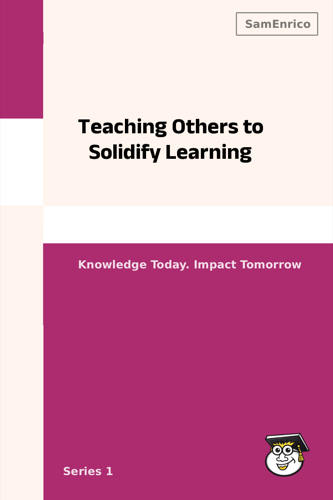
Teaching Others to Solidify Learning eBook
Explains the protégé effect and how tutoring other
Explains the protégé effect and how tutoring others boosts your own recall.
Formats
Free sample
Chapter 1: The 30% Betrayal--–- The first time I heard about the protégé effect, I thought it was a lie. Not an exaggeration. Not a marketing gimmick. A flat-out lie. A graduate student at Stanford had just told me that students who study to teach remember thirty percent more than students who study to take a test.
Thirty percent. In the world of learning science, that number is obscene. Most educational interventions—highlighting, rereading, summarizing, even taking notes—produce single-digit improvements, if they produce any improvement at all. Some actually make things worse. But thirty percent?
That would mean a student who scores a C (70 percent) on a test could jump to an A (100 percent) simply by changing their intention before they opened the book. No extra hours. No expensive tutoring. No fancy apps. Just a different mindset.I didn't believe it either.So I did what any skeptical researcher would do.
I went looking for the original study. I found it in the journal Science from 2007, one of the most prestigious scientific publications in the world. The experiment was elegant in its simplicity. Researchers took two groups of students and gave them the exact same material to study. The first group was told, "You will be tested on this material." The second group was told, "You will teach this material to another student." Here's the kicker: the second group never actually taught anyone.
They simply expected to teach. After studying, both groups took the same test. The results were unmistakable. The students who studied with the expectation of teaching outperformed the test-expectation group by a wide margin. They didn't study longer.
They didn't have better resources. They just studied differently because their brain knew someone else would depend on them.That was the moment I realized that everything I thought I knew about learning was wrong.For most of my life, I had been a professional student. I took notes in elaborate color-coded systems. I highlighted textbooks until the pages were neon. I reread chapters before exams.
I made flashcards. I summarized paragraphs in the margins. I did everything the educational system told me to do. And like most people, I forgot most of what I learned within a few weeks. The periodic table?
Gone. The causes of World War I? A vague blur. Calculus? Not a chance.
I assumed this was normal. I assumed memory was leaky bucket, and the best I could do was fill it quickly before an exam and accept the inevitable loss.But the protégé effect suggests something entirely different. It suggests that memory is not a passive storage system. It is an active construction process. And the act of teaching—or even preparing to teach—forces your brain to build stronger, more durable memories than any amount of passive review ever could.This chapter will do three things.
First, it will establish the scientific foundation of the protégé effect, tracing it from ancient philosophy to modern neuroscience. Second, it will introduce the key studies that prove the effect is real, including the "first-born IQ advantage" and Stanford's famous "Betty's Brain" experiment. Third, it will begin to explain why the effect works, setting the stage for the practical protocols in later chapters. By the end of this chapter, you will understand why studying to teach is the single most underutilized learning strategy in the world—and why you are about to adopt it as your own.The Ancient Discovery That Modern Science Proved True Long before there were f MRI machines, randomized controlled trials, or peer-reviewed journals, the Roman philosopher Seneca made an observation that should have changed education forever. "While we teach," he wrote, "we learn." It was a simple sentence, almost aphoristic.
But Seneca wasn't just being poetic. He was describing something he had witnessed in his own life. When he taught his students, he found that his own understanding deepened. His ideas became clearer. His arguments became sharper.
His memory became more reliable.For nearly two thousand years, this observation floated around the edges of educational philosophy, occasionally referenced but never systematically studied. Teachers knew that teaching helped them learn. They just didn't know why. And because they didn't know why, they couldn't systematize it. They couldn't turn it into a protocol that anyone could use, regardless of their natural talent or teaching experience.That changed in the late twentieth century, when cognitive psychologists began to take Seneca seriously.The term "protégé effect" was coined by researchers studying peer tutoring in the 1980s.
They noticed something strange. In peer tutoring programs, the tutors often improved more than the tutees. This was backwards. Normally, you would expect the person receiving instruction to learn the most. But again and again, the tutors showed larger gains.
They didn't just learn the material better. They retained it longer. They could apply it to novel situations more flexibly. They developed deeper conceptual understanding.At first, researchers thought this was a fluke. Maybe the tutors were simply more motivated.
Maybe they had higher baseline ability. Maybe the studies were flawed. But as the evidence accumulated, a pattern emerged. The tutor advantage was real. It was consistent.
And it was large.The breakthrough came when researchers realized that the expectation of teaching—not the act itself—was the active ingredient. In study after study, students who expected to teach outperformed students who expected to be tested, even when neither group actually taught anyone. This meant the effect was cognitive, not social. It wasn't about the interaction with another person. It was about how the brain prepared for that interaction.This is the first and most important thing you need to understand about the protégé effect: you do not need a real student to benefit from it.
You just need to study as if one is waiting for you.The First-Born IQ Advantage: A Natural Experiment One of the most compelling pieces of evidence for the protégé effect comes from an unexpected source: birth order research. For decades, psychologists have known that first-born children tend to have higher IQs than their younger siblings. The effect is small but reliable—about one to three IQ points per sibling. For years, researchers assumed this was about parental attention. First-borns get more time and resources from parents before siblings arrive.
That made intuitive sense.But then a clever study came along and blew that explanation apart.Researchers compared first-borns who had younger siblings to first-borns who did not. If parental attention was the driver, then only children (first-borns with no siblings) should have the highest IQs. They have the most parental attention, after all. But that's not what the data showed. First-borns with younger siblings had higher IQs than first-borns without siblings.
Something about having a younger sibling made you smarter.The researchers proposed a radical explanation: first-borns teach their younger siblings. They explain how to tie shoes, how to spell words, how to count, how to resolve conflicts, how to navigate the social world. In doing so, they strengthen their own cognitive abilities. They retrieve knowledge, reorganize it into simpler forms, and elaborate with examples—exactly the three cognitive processes that the protégé effect activates. Younger siblings, by…
This is the end of the free sample. Get the eBook to keep going. Buy now
About this book
Details
- Author
- Jacks Houston
- Publisher
- SamEnrico
- Language
- English
- Genre
- Non-Fiction, Self-Help, Peer Teaching
- Released
- 2026-06-06
- Pages (approx.)
- 148
- Available as
- eBook, Audiobook

Read better in the ZLOADR app
Your eBooks on your phone or tablet. Sign in with your SamEnrico account and start reading.
More by Jacks Houston
 MLK Oratory Mastery GuideJacks Houston$11.99
 The Study Motivation GuideJacks Houston$11.99
 Sam Sheppard Retrial AnalysisJacks Houston$11.99
 Infidelity ConversationJacks Houston$11.99
 Writing Goal Action SystemJacks Houston$11.99
 Pet Loss and RelationshipsJacks Houston$11.99
 CEO Morning Routine GuideJacks Houston$11.99
 The Silk Road Merchants of the Swahili Coast: Africa's Forgotten Trade TycoonsJacks Houston$11.99
 The Great Bombay Diamond Heist: How a Victorian-Era Forensic Breakthrough Cracked the CaseJacks Houston$11.99
 Service Providers Guide to WeldingJacks Houston$11.99
 Two Week Product Launch ReviewJacks Houston$12.99
 Sanctions Compliance GuideJacks Houston$12.99
You may also like
 Hong Kong Handover 1997Dunn Johnnie$11.99
 Zumba For Postnatal Recovery CourseNeal Christian$11.99
 Zumba for BeginnersLadner Nikia$11.99
 YouTube Comment Mining GuideHumes Pandora$12.99
 Worry Box MeditationCarlin Rudy$11.99
 Workplace Stress MeditationNguyen Lynn$11.99
 Workplace Stress and Sleep RepairHawley Ivory$11.99
 Workplace Perfectionism CureDelaney Jeffry$11.99
 Workplace Injustice Anger GuideWallen Isabelle$11.99
 Work Addiction and Burnout LinkGreenwood Ester$11.99
 Women in Yoga and WellnessBeattie Galina$11.99
 Women in Stand Up ComedyChun Evangeline$11.99