
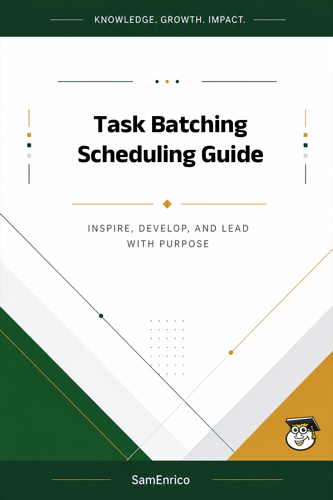
Task Batching Scheduling Guide Audiobook
Groups similar activities together to reduce conte
Groups similar activities together to reduce context switching and save time.
Formats
Free sample
Chapter 1: The Twenty-Three Minute Ghost--–- Sarah’s Tuesday morning began like any other. At 8:47 AM, she opened her email to find fourteen new messages. She replied to the most urgent three, then a Slack notification popped up: “Quick question?” She answered. Then her phone buzzed with a calendar reminder for a 9:30 meeting. She spent seven minutes preparing for it.
At 9:30, she joined the Zoom call. At 9:47, while someone else was talking, she opened her email again. At 9:52, she started drafting a response. At 9:58, her boss messaged: “Can you look at this?” She did. At 10:15, the meeting ended.
Sarah sat back, rubbed her eyes, and realized she had no idea what she had accomplished in the last ninety minutes. She felt busy. She felt tired. But when she looked at her to-do list, the one thing that actually mattered—the quarterly report due Friday—was still untouched.Sarah is not lazy. She is not disorganized.
And she is certainly not alone.Sarah is a victim of what this book will call the Twenty-Three Minute Ghost. It is the invisible cost that follows every interruption, every context switch, every tiny decision to stop one task and start another. And it is the single largest drain on your productivity that you have never measured.The Science You Were Never Told For decades, productivity advice has focused on willpower, motivation, and the mythical virtues of “discipline.” Work harder, they said. Wake up earlier. Make a better to-do list.
But none of that advice addressed the fundamental structure of how the human brain actually processes tasks.The research tells a different story.In a landmark series of studies on task switching, psychologist Robert Rogers demonstrated that the human brain does not transition smoothly between activities. Instead, each switch imposes a “residual cost”—a period during which cognitive performance remains degraded. A comprehensive meta-analysis by Monsell (2003) found that even simple task switches (e.g., sorting numbers by one rule then another) cost an average of 0.5 to 1 second per switch. That sounds small. But those were laboratory tasks with predictable rules.Real-world knowledge work is far worse.In a study conducted at the University of California, Irvine, researchers Gloria Mark and her team followed knowledge workers in their natural environments.
They discovered that the average worker switches tasks every three minutes and five seconds. And here is the devastating part: when interrupted, it takes an average…
This is the end of the free sample. Get the Audiobook to keep going. Buy now
About this book
Details
- Author
- Kurtz Herschel
- Publisher
- SamEnrico
- Language
- English
- Genre
- Non-Fiction, Self-Help, Task Batching
- Released
- 2026-06-09
- Pages (approx.)
- 153
- Available as
- eBook, Audiobook

Listen in the VoxFlicks app
Audiobooks and audio dramas wherever you go. Sign in with your SamEnrico account and press play.
More by Kurtz Herschel
 Menopause Partner CommunicationKurtz Herschel$11.99
 Self Worth HypnosisKurtz Herschel$11.99
 Overcoming Addiction After FiftyKurtz Herschel$11.99
 Household Chore Stress GuideKurtz Herschel$11.99
 The Personal Brand Testimonial GuideKurtz Herschel$11.99
 Meeting Rhythm StandardizationKurtz Herschel$11.99
 Virgil's Aeneid: The Epic That Shaped Rome's SoulKurtz Herschel$11.99
 Buffer Time Scheduling GuideKurtz Herschel$11.99
 The Last Empress: The Fall of Empress Eugénie and the Exile of a DynastyKurtz Herschel$11.99
 Mastering Tithe: Religious Agricultural TaxKurtz Herschel$11.99
 Feedback Collection SheetKurtz Herschel$12.99
 Ghana Customer Service WorkbookKurtz Herschel$12.99
You may also like
 The Batching Morning MethodMccaskill Micah$11.99
 Task Switching Recovery Protocol HandbookGriswold Christian$11.99
 Task Batching for EfficiencyGibson Jody$11.99
 Task Batching Strategy GuideMccloud Zulema$11.99
 The Interruption Batching MethodFisher Leon$11.99
 The Themed Day Scheduling MethodMays Mayra$11.99
 The Task Batching Efficiency GuideHandy Bibi$11.99