
Non-FictionBusiness Brief / European Union
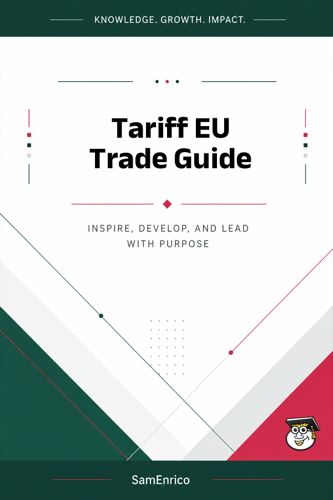
Tariff EU Trade Guide
Decodes EU's common external tariff, VAT on import
Decodes EU's common external tariff, VAT on imports, and union transit procedures.
Formats
About this book
Free sample
Chapter 1: The Tariff Lie--–- Every year, thousands of businesses importing into the European Union overpay their customs duties by an average of 15 percent. That is not a rounding error. That is not an occasional mistake. That is a systemic bleed of cash that most finance directors never notice and fewer than one in ten ever recover. The most common reason is not fraud, not incompetence, and not bad luck.
It is a fundamental misunderstanding of what the EU's tariff system actually is.Most people believe the EU's Common External Tariff is simply a long list of products with percentage rates attached. Import a pair of leather shoes from Vietnam: 8 percent. Import a diesel engine from Japan: 3.7 percent. Import frozen orange juice from Brazil: 15.2 percent plus an additional agricultural component. Simple enough.
But this belief is the tariff lie – the dangerous oversimplification that costs importers millions every year.The truth is far more complex and, for those who understand it, far more profitable. The EU's tariff system is not a list. It is a living, breathing database of trade policy, commercial defence measures, embargoes, suspensions, quotas, and preferential arrangements. What you see in a basic duty rate search is rarely what you actually pay. And what you think you know about classification is almost certainly wrong.This chapter demolishes the tariff lie and replaces it with a working understanding of the Union Customs Code, the Integrated Tariff of the European Union, and the practical tools that separate profitable importers from those who merely survive.The Old Code Versus the Union Customs Code Before 2016, EU customs operated under the Community Customs Code (CCC), a legal framework designed in the early 1990s when trade meant shipping containers on paper forms and digital declarations were a futuristic fantasy.
The CCC worked reasonably well for its time, but by 2015 it had become a bureaucratic nightmare. There were over 500 separate implementing regulations, conflicting national interpretations, and a dispute resolution process that took longer than most product lifecycles.The Union Customs Code (UCC) entered into force on May 1, 2016, with full implementation staggered through…
This is the end of the free sample. Get the eBook to keep going. Buy now
Contents
- Chapter 1
- Chapter 2
- Chapter 3
- Chapter 4
- Chapter 5
- Chapter 6
- Chapter 7
- Chapter 8
- Chapter 9
- Chapter 10
- Chapter 11
- Chapter 12
Details
- Author
- Hyland Rosalva
- Publisher
- SamEnrico
- Language
- English
- Genre
- Non-Fiction, Business Brief / European Union
- Released
- 2026-06-06
- Pages (approx.)
- 160
- Available as
- eBook, Audiobook

Read better in the ZLOADR app
Your eBooks on your phone or tablet. Sign in with your SamEnrico account and start reading.
More by Hyland Rosalva
 Smoking Cessation For COPD PatientsHyland Rosalva$11.99
 Caregiver Sleep Recovery PlanHyland Rosalva$11.99
 Stress Management for LawyersHyland Rosalva$11.99
 The Arsenic Widows of Toronto: Poison, Profit, and the Birth of Forensic ToxicologyHyland Rosalva$11.99
 Ecommerce Terms ManualHyland Rosalva$12.99
 Wayleave CoordinatorHyland Rosalva$11.99
 How to Produce Aquarium SealantHyland Rosalva$11.99
 How to Become a Paper-novelty MakerHyland Rosalva$11.99
You may also like
 Hong Kong Handover 1997Dunn Johnnie$11.99
 Zumba For Postnatal Recovery CourseNeal Christian$11.99
 Zumba for BeginnersLadner Nikia$11.99
 YouTube Comment Mining GuideHumes Pandora$12.99
 Worry Box MeditationCarlin Rudy$11.99
 Workplace Stress MeditationNguyen Lynn$11.99
 Workplace Stress and Sleep RepairHawley Ivory$11.99
 Workplace Perfectionism CureDelaney Jeffry$11.99
 Workplace Injustice Anger GuideWallen Isabelle$11.99
 Work Addiction and Burnout LinkGreenwood Ester$11.99
 Women in Yoga and WellnessBeattie Galina$11.99
 Women in Stand Up ComedyChun Evangeline$11.99