
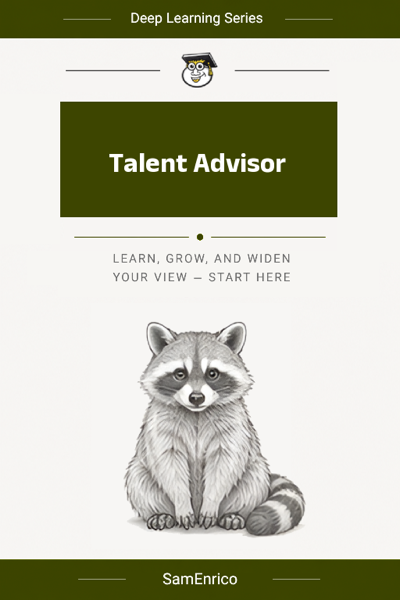
Non-FictionInformativeEducational
Talent Advisor eBook
A Coursebook on Talent Advisor
by Wilt Arianne
A Coursebook on Talent Advisor
Formats
Free sample
Chapter 1: The Order-Taker’s Funeral...--You arrive at work on a Monday morning like any other. Your coffee is hot. Your inbox is full. Your requisition load sits at fifteen open roles, which feels heavy but manageable. You have been doing this job for years—sourcing, screening, scheduling, closing.
You are good at it. Your hiring managers like you because you respond quickly. Your candidates like you because you are kind. Your boss likes you because your time-to-fill is consistently below average.You should feel secure. You should feel proud.But something has been nagging at you for months.
A quiet, uncomfortable voice you have been trying to ignore. It whispers that the game has changed. It whispers that the rules you mastered no longer apply. It whispers that your job—as you know it, as you have practiced it, as thousands of recruiters across the country practice it every single day—is already dying.You shake off the feeling and open your first requisition of the day. A senior engineering role.
Two weeks old. The hiring manager has already asked for an update three times. You run a Boolean search. You scan Linked In. You find four candidates who match the keywords.
You send them to the hiring manager. He rejects two immediately—"not enough experience"—and ignores the other two entirely. You schedule a call to "align on expectations," which is what you have learned to call it when a hiring manager refuses to accept market reality.This is your life. This is recruitment.And this is exactly what is about to become obsolete.The Great Unraveling Let us name the thing that no one in talent acquisition wants to say out loud: the traditional, high-volume, "post-and-pray" recruiting model is not just inefficient. It is not just outdated.
It is dying. And the funeral is happening faster than almost anyone realizes.Three forces are driving this extinction. Each one alone would be enough to reshape the profession. Together, they are creating a perfect storm that will separate the recruiters who evolve from the recruiters who become irrelevant.Force One: The Machine That Never Sleeps Artificial intelligence is not coming for recruiting jobs. It is already here.Today, AI tools can source candidates across dozens of platforms simultaneously, learning from each search to become more accurate over time.
They can screen resumes against job descriptions with greater consistency than any human reviewer, unaffected by fatigue, bias, or distraction. They can schedule interviews across multiple time zones, sending reminders and rescheduling as needed without a single human keystroke. They can answer candidate questions about benefits, timelines, and next steps through conversational chatbots that improve with every interaction.None of this is science fiction. All of it is available today, often for less than the monthly cost of a single recruiting license.The question is not whether AI will replace recruiting tasks. The question is which tasks remain after AI takes everything that can be automated.
And the answer is sobering: the transactional core of recruiting—sourcing, screening, scheduling, status updates, basic candidate communication—is almost entirely automatable.Consider the math. A typical recruiter spends approximately forty to sixty percent of their week on tasks that follow predictable, repeatable patterns: running Boolean searches, reviewing resumes against checklists, sending calendar invitations, updating applicant tracking system statuses, replying to "any updates?" emails. These tasks do not require strategic judgment. They do not require relationship nuance. They do not require human creativity.
They require pattern recognition, rule following, and execution speed—precisely what AI does best.The AI does not get tired. The AI does not take lunch breaks. The AI does not have off days. The AI does not ask for a raise.And here is the truth that keeps talent leaders awake at night: a junior recruiter with AI tools can now do the work that required a team of three five years ago. The efficiency gains are not incremental.
They are exponential. And they are just beginning.Force Two: The Invisible Market The second force is more subtle but equally devastating to traditional recruiting: the explosion of the hidden job market.Twenty years ago, if you wanted a new job, you looked at newspaper classifieds or online job boards. That was it. Your options were limited, so you participated. You uploaded your resume.
You applied. You waited.Today, the best candidates rarely apply to job postings at all.High-performing professionals are not scanning Linked In jobs sections during their lunch breaks. They are not uploading their resumes to company career sites. They are not filling out work history forms for roles they saw on Indeed. They are busy.
They are successful. They are being recruited constantly by their networks, by previous managers, by former colleagues. They do not need to apply because opportunities find them.This is the hidden job market: the vast, invisible ecosystem of talent that never appears in your applicant tracking system unless someone actively reaches out to them.The implications are brutal for the order-taker recruiter. If your primary strategy is posting jobs and waiting for applications, you are fishing in a pond that the best candidates have already left. You are competing for the sliver of talent that is actively looking—which, research consistently shows, is disproportionately composed of candidates who are unhappy, underqualified, or desperate.The hidden job market does not care about your job posting.
It does not care about your employer brand page. It does not care about your "apply now" button. The hidden job market requires something that transactional recruiters have never been trained to do: proactive, relationship-based, intelligence-driven outreach.Force Three: The Million-Dollar Mistake The third force is the simplest to understand and the most painful to experience: the cost of a bad hire is no longer a tolerable business risk.For decades, organizations treated hiring mistakes as an acceptable cost of doing business. "Sometimes you hire the wrong person," the thinking went. "You fire them and try again." This attitude persisted because the true cost of a bad hire was hidden.
It was not a line item on the P&L. It was not tracked in quarterly reports. It was a soft cost—low productivity, cultural friction, management distraction—that could be rationalized and ignored.Not anymore.Today, the cost of a bad hire is quantified and visible. Depending on the role and industry, a single hiring mistake costs between thirty thousand and one hundred fifty thousand dollars. For executive and specialized technical roles, the cost can exceed five hundred thousand dollars when you factor in recruiting expenses, onboarding time, lost productivity, management hours, severance, and replacement costs.The C-suite has noticed.Chief Financial Officers are no longer content to approve recruiting budgets without understanding the return on investment.
Chief Operating Officers are no longer willing to accept vague assurances about "cultural fit." Chief Executive Officers are asking their talent leaders a question that would have been unthinkable a decade ago: "How do you know this hire will succeed before we make the offer?"The order-taker recruiter cannot answer this question. They cannot answer it because they have never been asked to think in terms of outcomes. They have been measured…
This is the end of the free sample. Get the eBook to keep going. Buy now
About this book
Details
- Author
- Wilt Arianne
- Publisher
- SamEnrico
- Language
- English
- Genre
- Non-Fiction, Informative, Educational
- Released
- 2026-05-08
- Pages (approx.)
- 138
- Available as
- eBook, Audiobook

Read better in the ZLOADR app
Your eBooks on your phone or tablet. Sign in with your SamEnrico account and start reading.
More by Wilt Arianne
 Alcoholism and Schizophrenia Dual RecoveryWilt Arianne$11.99
 Parenting After Divorce StressWilt Arianne$11.99
 Work Addiction for VeterinariansWilt Arianne$11.99
 Private to Private LBOWilt Arianne$11.99
 The Fox at Bay: Hannibal's Masterstroke Against RomeWilt Arianne$11.99
 How to Produce AnalyzersWilt Arianne$11.99
 Customer Tracking Portal GuideWilt Arianne$12.99
 How to Become a Gluing-machine OffbearerWilt Arianne$11.99
You may also like
 Hong Kong Handover 1997Dunn Johnnie$11.99
 Zumba For Postnatal Recovery CourseNeal Christian$11.99
 Zumba for BeginnersLadner Nikia$11.99
 YouTube Comment Mining GuideHumes Pandora$12.99
 Worry Box MeditationCarlin Rudy$11.99
 Workplace Stress MeditationNguyen Lynn$11.99
 Workplace Stress and Sleep RepairHawley Ivory$11.99
 Workplace Perfectionism CureDelaney Jeffry$11.99
 Workplace Injustice Anger GuideWallen Isabelle$11.99
 Work Addiction and Burnout LinkGreenwood Ester$11.99
 Women in Yoga and WellnessBeattie Galina$11.99
 Women in Stand Up ComedyChun Evangeline$11.99