
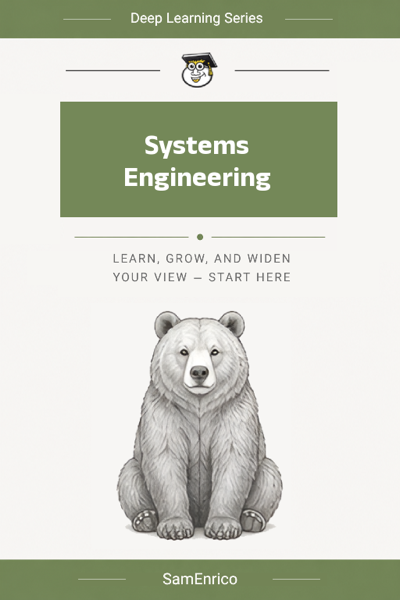
Systems Engineering eBook
A Coursebook on Systems Engineering
A Coursebook on Systems Engineering
Formats
Free sample
Chapter 1: The Edges of Order--–- In the summer of 1994, a gleaming new terminal opened at Denver International Airport. It was a monument to human ambition—glass spires rising from the Colorado prairie like frozen mountains, automated baggage carts humming through miles of underground tunnels, a computerized sorting system that promised to route luggage from check-in to any aircraft in less than fifteen minutes. The airport cost five billion dollars. It opened sixteen months late. And on its first day of operation, the baggage system ate suitcases.Not metaphorically.
Bags jammed in conveyor chutes. Luggage carts collided in tunnels. The system's 4,000 independent vehicles, controlled by more than 1,000 computers running 2.5 million lines of custom code, could not reliably tell a duffel bag from a child's car seat. In one notorious incident, a bag destined for a United Airlines flight ended up at a Continental gate, then back to check-in, then underground, then lost entirely—never to be seen again by its owner. The airport eventually ripped out the automated system and hired hundreds of baggage handlers to do by hand what machines could not.
The total cost of the failure, including lawsuits, redesigns, and permanent manual labor, exceeded three hundred million dollars.What went wrong? Not the conveyors. Not the software in isolation. Not the individual vehicles. What failed was the integration of these pieces into a whole.
The baggage system worked perfectly in component tests. The software passed unit tests. The carts moved correctly on empty tracks. But when you connected the check-in counters to the conveyors to the sorting algorithms to the carts to the aircraft loading docks—when you closed the loop and let real passengers with oddly shaped bags and late arrivals and misprinted tags enter the system—the emergent behavior was chaos. The whole was not the sum of its parts.
The whole was dysfunctional.That dysfunction has a name in engineering. It is called system failure, and it is almost never caused by a single broken component. It is caused by broken relationships between components. The Denver baggage system is not an exception. It is a monument to a universal truth that every engineer eventually learns the hard way: you cannot build complex things by assembling perfect pieces and hoping they will work together.
You must design the between—the interfaces, the flows, the feedback loops, the unintended consequences. You must design the system.This book is about how to do that. It is about the discipline that emerges when the complexity of a problem exceeds the capacity of any single person to hold it in their head. That discipline is called systems engineering, and it is the difference between Apollo 13 (a failure that was rescued) and the Denver baggage system (a failure that was not).What This Chapter Covers Before we dive into methods and models, before we draw a single functional flow diagram or write a single requirement, we need to understand what systems engineering is—not as a dictionary definition, but as a lived practice. This chapter will give you three things.
First, a working definition of a "system" that goes beyond obvious examples like airplanes and power grids to include messy human-technical hybrids like hospitals and supply chains. Second, a clear distinction between systems engineering as a process and systems thinking as a mindset—because the former without the latter is just paperwork. Third, an honest look at what happens when systems engineering fails, so that by the end of this chapter, you will be able to spot the warning signs of failure in any project, whether it is a Mars rover or a mobile app.The Trouble with "System"Let us begin with a deceptively simple question: what is a system? Most people, when asked, will point to examples. A car is a system.
A computer is a system. The New York subway is a system. But these examples, while true, do not tell us what makes a collection of things systematic rather than merely aggregated. A pile of sand is not a system. A crowd of people waiting for a bus is not a system.
A drawer full of unrelated tools is not a system. So what distinguishes these cases?The standard definition, drawn from the INCOSE Handbook and from foundational texts like Blanchard and Fabrycky's Systems Engineering and Analysis (-6), runs something like this: a system is an integrated set of elements that accomplishes a defined objective through emergent behavior. Let us unpack each clause.First, "an integrated set of elements." A system has parts. Those parts can be physical (a sensor, a wheel, a radio transmitter), informational (a database, an algorithm, a control law), or human (an operator, a maintainer, a manager). But integration means that the parts are connected.
They exchange matter, energy, or information. If you can separate a part without affecting the rest, it was never truly part of the system in the first place.Second, "accomplish a defined objective." Systems exist for a purpose. That purpose might be explicit, as in a missile guidance system designed to hit a target. Or it might be implicit, as in an ecosystem that sustains life without conscious intention. But in engineered systems—the focus of this book—the objective is defined by stakeholders: people who have a stake in whether the system succeeds or fails.Third, "through emergent behavior." This is the crucial clause, and the one most often misunderstood.
Emergence is the phenomenon whereby a whole exhibits properties that none of its parts possess individually. A single water molecule is not wet. Wetness emerges when you have trillions of them. A single neuron does not feel fear. Fear emerges from a network of billions.
A single baggage cart, tested alone, does not cause chaos. The chaos emerges when thousands of them interact.If you remember nothing else from this chapter, remember this: systems engineering is the discipline of managing emergence. You cannot predict emergent behavior by studying components in isolation. You can only predict it by studying interactions.Boundaries, Functions, and Interfaces If we accept that a system is an integrated set of elements that accomplishes an objective through emergent behavior, then the natural question becomes: how do we describe a system? The answer, which will recur throughout this book, is that every system can be understood through three fundamental descriptors: boundaries, functions, and interfaces.The boundary is the line between what is inside the system and what is outside.
This sounds obvious, but boundary decisions are among the most consequential in systems engineering. If you draw the boundary too narrowly, you exclude something critical—say, the human operator—and your model will be wrong. If you draw it too broadly, you include irrelevant complexity and your model becomes unmanageable. Consider a traffic intersection. Is the traffic light a system?
Or is the system the light plus the sensor loops embedded in the pavement? Or the light, sensors, and the central control computer two miles away? Or all of those plus the drivers? There is no single correct boundary. The boundary depends on what question you are asking.
For optimizing signal timing, you need the sensors and the computer. For predicting accident rates, you need the drivers. Systems…
This is the end of the free sample. Get the eBook to keep going. Buy now
About this book
Details
- Author
- Quintanilla Hilde
- Publisher
- SamEnrico
- Language
- English
- Genre
- Non-Fiction, Informative, Educational
- Released
- 2026-05-11
- Pages (approx.)
- 147
- Available as
- eBook, Audiobook

Read better in the ZLOADR app
Your eBooks on your phone or tablet. Sign in with your SamEnrico account and start reading.
More by Quintanilla Hilde
 Alcoholism and Loneliness Recovery HandbookQuintanilla Hilde$11.99
 TVPI Database GuideQuintanilla Hilde$11.99
 Parenting Resentment ReleaseQuintanilla Hilde$11.99
 Work Addiction for Construction WorkersQuintanilla Hilde$11.99
 The Druids of the Mist: Keepers of Celtic WisdomQuintanilla Hilde$11.99
 How to Produce Ammonia CleanerQuintanilla Hilde$11.99
 Cross Border Returns Policy HandbookQuintanilla Hilde$12.99
 How to Become a Glue-spreading-machine OperatorQuintanilla Hilde$11.99