
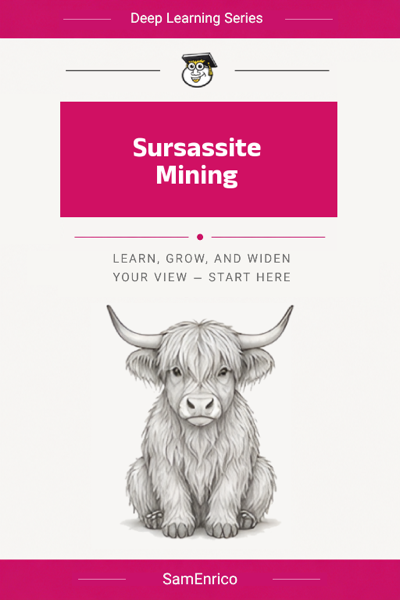
Non-FictionInformativeEducational
Sursassite Mining eBook
A Coursebook on Sursassite Mining
A Coursebook on Sursassite Mining
Formats
Free sample
Chapter 1: The Stone That Shouldn’t Exist--–- The first thing you need to understand about Sursassite is that it has no business being here at all. Not on this mountain. Not in this book. Not anywhere within a thousand kilometers of the earth’s surface. By every law of physics and every rule of metamorphic geology, this mineral should be crushed, reabsorbed, or transformed into something else long before any human could ever lay a hand on it.
And yet, here it is. Hidden in the crumpled folds of the world’s most tortured mountain ranges, waiting in narrow veins and forgotten talus slopes for someone patient enough to find it. That paradox—the mineral that should not exist—is exactly what makes Sursassite worth more per carat than most people earn in a month.This chapter is not an introduction in the conventional sense. You will find no dry recitation of chemical formulas here, no academic throat-clearing. Instead, this is the story of how a rare and improbable mineral came to be known, why it has remained almost invisible to the mining world, and why that invisibility is your greatest advantage.
By the end of this chapter, you will understand not just what Sursassite is, but why hunting for it is fundamentally different from chasing gold, silver, or any other conventional ore.The Accidental Discovery In the summer of 1982, a part-time prospector named Enzo Ferraro was doing what he always did when the alpine snows melted enough to expose the high screes above the Val Sursassa in northwestern Italy. He was walking slowly, eyes on the ground, hammer in hand, looking for anything that did not belong. Ferraro was not a geologist. He had never set foot inside a university. What he had was a lifetime of familiarity with the Ligurian Alps and a nose for stones that looked different from the ordinary gray-green schists that dominated the landscape.What he found that day was a fragment of rock no larger than his thumb.
It was brownish-red, fibrous in texture, and strangely heavy for its size. It was embedded in a piece of quartzite shot through with black manganese oxides. Ferraro almost threw it back down the slope. He had seen similar stones before—piemontite, mostly, which was common in the region and not particularly valuable. But something about this one made him slip it into his pocket instead of tossing it aside.That single act of pocketing a curious rock set in motion a chain of events that would take nearly a decade to resolve.
Ferraro showed the specimen to a local mineral dealer, who passed it to a collector in Milan, who eventually sent a fragment to the Natural History Museum in Paris. There, a crystallographer named Dr. Hélène Bouchard recognized that the stone did not match any known mineral in the museum’s reference collection. The X-ray diffraction pattern was wrong for piemontite. The optical properties were wrong for andalusite.
The chemistry—manganese, aluminum, silicon, oxygen, and hydrogen in a specific ratio—did not fit any existing entry in the mineralogical catalog.In 1991, after nine years of scattered analysis and bureaucratic delay, the International Mineralogical Association formally approved Sursassite as a new mineral species. It was named for the valley where Ferraro had found it: Val Sursassa. The type specimen was deposited in the museum in Paris, where it still resides. Ferraro, by then in his late sixties, reportedly sold his find for what would today be roughly $18,000—more money than he had earned in the previous five years of sporadic prospecting.The story might have ended there, as so many mineral discoveries do, with a footnote in a technical journal and a few hundred grams of material scattered across museum drawers. But Sursassite had two things working in its favor.
First, it was genuinely rare. Second, it was beautiful. Not beautiful in the flashy way of a faceted diamond or the deep glow of a ruby, but beautiful in the way that speaks to serious mineral collectors: subtle color shifts from brownish-red to deep green depending on the angle of light, a fibrous texture that catches the eye, and a heft that feels substantial in the hand.Today, the global supply of Sursassite suitable for cutting into gemstones is measured not in tons or even kilograms, but in the low hundreds of kilograms. The total amount of Sursassite ever extracted, from every source combined, would likely fill no more than two or three wheelbarrows. By that measure, it is rarer than emerald, rarer than alexandrite, rarer even than painite—once considered the rarest gem mineral on earth.What This Book Is and What It Is Not Before we go any further, let us be clear about what you are holding.
This book is not a theoretical mineralogy text. There will be no derivations of crystal field theory, no exhaustive literature reviews, no exercises in calculating unit cell parameters. Those books exist, and they serve an important purpose for academic mineralogists. But they will not help you find Sursassite, extract it, or sell it.This book is a field guide, a business plan, and a safety manual wrapped into one. It is written for the person who is willing to get their boots dirty, who understands that finding rare minerals requires equal parts science, intuition, and stubborn persistence.
It is for the solo prospector working a remote mountainside with nothing but a hammer and a hand lens. It is for the small-scale operator willing to invest in a portable XRF analyzer and a few months of prospecting in exchange for the chance at a six-figure payday. It is for the collector who wants to understand where their specimens come from and how to evaluate them.What this book assumes is that you already know how to read a topographic map, swing a rock hammer without hurting yourself, and recognize the basic rock types of metamorphic terranes. If those skills are new to you, you will learn them as you go, but you will learn them faster by spending time in the field than by reading any book. This book is designed to be read with a highlighter in one hand and a field notebook in the other.A word about scale: Throughout this book, we will focus exclusively on small-scale operations.
That means mines that process less than 500 metric tons of ore per year, employ fewer than fifty people, and generate less than one million dollars in annual revenue. This is not because larger operations are impossible—though Sursassite’s rarity makes them unlikely—but because the strategies that work for a solo prospector or a small team are fundamentally different from those that work for a multinational mining corporation. We will talk about hand tools, backpackable equipment, and techniques that do not require heavy machinery. We will talk about the legal pathways that exist for individuals and small businesses to stake claims and obtain permits. We will talk about the economics of selling to collectors and jewelers, not to industrial buyers.If you are looking for information on how to build a processing plant that can handle ten thousand tons of ore per day, you…
This is the end of the free sample. Get the eBook to keep going. Buy now
About this book
Details
- Author
- Gatewood Hortense
- Publisher
- SamEnrico
- Language
- English
- Genre
- Non-Fiction, Informative, Educational
- Released
- 2026-06-02
- Pages (approx.)
- 142
- Available as
- eBook, Audiobook

Read better in the ZLOADR app
Your eBooks on your phone or tablet. Sign in with your SamEnrico account and start reading.
More by Gatewood Hortense
 ABC Please Skills ManualGatewood Hortense$11.99
 Power Posing for Presentation NervesGatewood Hortense$11.99
 News Corp Global TakeoverGatewood Hortense$11.99
 Prioritization for Project ManagersGatewood Hortense$11.99
 Service Positions in Twelve StepsGatewood Hortense$11.99
 The Serpent’s Crown: The Lost Dynasty of the AmazonGatewood Hortense$11.99
 Frozen Frontiers: The Unseen Expeditions of Antarctica's Indigenous GuardiansGatewood Hortense$11.99
 Ten Year Career OutcomesGatewood Hortense$12.99
 Alibaba Supplier Red Flags GuideGatewood Hortense$12.99
 Understanding Blepharophimosis Ptosis Esotropia Syndactyly ShortGatewood Hortense$17.99
 How to Start a Powder Compact Made of Plastic Business (Beginners Guide)Gatewood Hortense$11.99
You may also like
 Hong Kong Handover 1997Dunn Johnnie$11.99
 Zumba For Postnatal Recovery CourseNeal Christian$11.99
 Zumba for BeginnersLadner Nikia$11.99
 YouTube Comment Mining GuideHumes Pandora$12.99
 Worry Box MeditationCarlin Rudy$11.99
 Workplace Stress MeditationNguyen Lynn$11.99
 Workplace Stress and Sleep RepairHawley Ivory$11.99
 Workplace Perfectionism CureDelaney Jeffry$11.99
 Workplace Injustice Anger GuideWallen Isabelle$11.99
 Work Addiction and Burnout LinkGreenwood Ester$11.99
 Women in Yoga and WellnessBeattie Galina$11.99
 Women in Stand Up ComedyChun Evangeline$11.99