
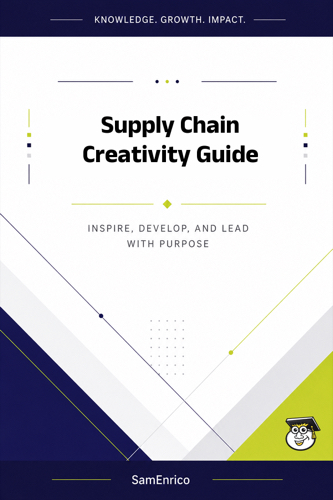
Non-FictionSelf-HelpSupply Chain
Supply Chain Creativity Guide eBook
Redesign logistics networks using unconventional r
by Ison Nilda
Redesign logistics networks using unconventional routing and partnerships.
Formats
Free sample
Chapter 1: The Brittleness Trap--–- Maya Chen’s screen had turned into a war zone. Three red alerts blinked in rapid succession. Her largest regional distribution center in Zhengzhou had just lost power—not from a storm, not from a grid failure, but from a routine maintenance shutdown that someone had forgotten to schedule around the holiday surge. Forty miles away, a tanker truck had jackknifed on the G4 Expressway, closing the main artery that fed 60 percent of her northern routes. And her CFO was already on the phone, demanding to know why air freight costs had tripled in the past six hours.Maya had been a logistics director for eleven years.
She had survived port strikes, typhoon seasons, and the great toilet paper panic of 2020. But this was different. This was a Tuesday. Nothing exceptional had happened. And yet her network—which she had spent three years optimizing down to the decimal point—was unraveling like a cheap sweater.She pulled up her dashboard.
The numbers were brutal. On-time delivery had dropped from 98.2 percent to 71 percent in less than twenty-four hours. Safety stock, which she had calculated using the most sophisticated formulas, was already exhausted at three of her seven warehouses. The automated rerouting system, the one that cost half a million dollars to implement, kept suggesting the same three alternate roads—all of which were now clogged with the very trucks it had sent there.Her phone buzzed. A text from her head dispatcher: “We have 14 drivers sitting idle because they can’t get back to the depot.
Fuel burn is up 22% from yesterday. When do we start canceling orders?”Maya didn’t have an answer. She had done everything right. She had followed the playbook that every logistics conference, every industry publication, every software vendor had preached for two decades: minimize cost per mile, reduce inventory carrying costs, centralize distribution, and run your trucks at 95 percent utilization. She had the Lean Six Sigma black belts to prove it.
She had the cost-per-pallet charts that made her CFO smile.But none of that mattered now. Because Maya had fallen into the brittleness trap.The Seduction of Linear Efficiency The brittleness trap is invisible when conditions are perfect. That is what makes it so dangerous. Every logistics professional has been trained to worship at the altar of linear efficiency: find the shortest path, carry the least inventory, run the fewest trucks, and measure everything by cost per unit. This is not malice.
This is mathematics. The algorithms that power every major Transportation Management System (TMS) are built on optimization models that assume the world is predictable, routes are stable, and disruptions are rare events to be managed by adding safety stock or insurance.But here is the uncomfortable truth that Maya learned on that Tuesday: efficient systems are not the same as resilient systems. In fact, they are often opposites.Consider the humble drinking glass. A glass is highly efficient at holding water. It uses precisely the amount of material needed for its function, no more.
Drop it on a tile floor, and it shatters. Now consider a rubber camping cup. It is less efficient—thicker walls, less elegant shape, more material per ounce of water held. But you can throw it against a wall, stomp on it, stuff it in a backpack, and it still holds water. The rubber cup is less efficient but vastly more resilient.Modern logistics has been optimized for the glass.
We have shaved grams of material, minutes of transit time, pennies per mile. We have built networks that hum with the precision of a Swiss watch—until a single gear jams, and the whole mechanism seizes.A Brief History of How We Got Here To understand why logistics became so brittle, we need to rewind to the 1980s. That decade saw two revolutions that fundamentally reshaped how goods move. The first was the deregulation of transportation in the United States (the Motor Carrier Act of 1980 and the Staggers Rail Act of 1980), which unleashed price competition and created the modern freight brokerage industry. The second was the rise of Just-In-Time (JIT) manufacturing, pioneered by Toyota and rapidly adopted across every industry.JIT was a beautiful idea: instead of holding months of inventory, you schedule deliveries to arrive exactly when needed.
This reduced warehousing costs, freed up working capital, and exposed quality problems immediately because there were no buffer stocks to hide defects. For two decades, JIT was the undisputed king of logistics philosophy.But JIT came with a hidden assumption: that the supply chain was reliable. That trucks would arrive on schedule. That borders would stay open. That a container ship could transit the Suez Canal in twelve hours, every time.The assumption was never true, but for a while, it was close enough.
The post-Cold War era saw falling trade barriers, expanding infrastructure, and a long period of geopolitical stability. Disruptions happened, but they were local and temporary—a strike in one port, a snowstorm in one region.Then came 2020. COVID-19 did not just disrupt supply chains; it revealed their brittleness. When factories in China shut down, the entire world felt it. When borders closed, trucks sat for days.
When consumers panic-bought toilet paper and flour, the algorithms that had optimized for steady-state demand simply broke. They had no instruction set for a 500 percent demand spike on a product that cost almost nothing to make but took up enormous truck space.The pandemic was not an anomaly. It was a warning shot. Since 2020, we have seen the Suez Canal blockage (2021), the Ever Given incident that held up $9 billion in goods per day; the Russian invasion of Ukraine (2022), which disrupted wheat, energy, and neon gas (critical for semiconductors); rail strikes across Europe (2022–2023); drought in the Panama Canal (2023–2024); and cyberattacks on major freight brokers (ongoing). Each event exposed new vulnerabilities.And yet, most logistics networks today are still designed using the same linear optimization models that failed during COVID.
Why? Because brittleness is not a bug in those models; it is a feature of how they define efficiency.The Anatomy of a Brittle Network A brittle network has five telltale signs. The first is single-threaded arteries. This means that a disproportionate share of volume flows through a small number of routes, warehouses, or carriers. In Maya’s case, 60 percent of her northern routes depended on a single highway.
When that highway closed, she had no meaningful alternative. The second sign is high utilization without slack. A network running at 95 percent capacity has no room to absorb shocks. When a truck breaks down, there is no backup. When demand spikes, there is no surge capacity.
The third sign is static safety stock formulas. Most companies calculate safety stock based on historical demand variability, assuming the future will resemble the past. But black swan events—by definition—do not resemble the past. A formula designed for 2 percent demand variability fails catastrophically when variability hits 200 percent. The fourth sign is contractual rigidity.
Long-term contracts with dedicated carriers often prohibit deviation. If your contract says you must ship 100 loads per week on a specific lane, you cannot redirect that capacity to a disrupted lane even if doing so…
This is the end of the free sample. Get the eBook to keep going. Buy now
About this book
Details
- Author
- Ison Nilda
- Publisher
- SamEnrico
- Language
- English
- Genre
- Non-Fiction, Self-Help, Supply Chain
- Released
- 2026-06-10
- Pages (approx.)
- 158
- Available as
- eBook, Audiobook

Read better in the ZLOADR app
Your eBooks on your phone or tablet. Sign in with your SamEnrico account and start reading.
More by Ison Nilda
 Blue Zone Lunch GuideIson Nilda$11.99
 CRPS Pain ManagementIson Nilda$11.99
 Memorializing Lost BabyIson Nilda$11.99
 Bandit Signs for WholesalingIson Nilda$11.99
 Values Based Anger RestructuringIson Nilda$11.99
 Quiet Freelancing EthicsIson Nilda$11.99
 Gambling and MarriageIson Nilda$11.99
 The Resounding Legacy: Chevalier de Saint-Georges and the Birth of Black Classical MusicIson Nilda$11.99
 Whispers from the Iron Curtain: The Lost Broadcasts of Radio Free EuropeIson Nilda$11.99
 The Essential Guide to CaribbeanIson Nilda$11.99
 How to Produce RepositionableIson Nilda$11.99
 A Collector's Handbook to the Alfa Romeo Alfasud SprintIson Nilda$11.99
You may also like
 Hong Kong Handover 1997Dunn Johnnie$11.99
 Zumba For Postnatal Recovery CourseNeal Christian$11.99
 Zumba for BeginnersLadner Nikia$11.99
 YouTube Comment Mining GuideHumes Pandora$12.99
 Worry Box MeditationCarlin Rudy$11.99
 Workplace Stress MeditationNguyen Lynn$11.99
 Workplace Stress and Sleep RepairHawley Ivory$11.99
 Workplace Perfectionism CureDelaney Jeffry$11.99
 Workplace Injustice Anger GuideWallen Isabelle$11.99
 Work Addiction and Burnout LinkGreenwood Ester$11.99
 Women in Yoga and WellnessBeattie Galina$11.99
 Women in Stand Up ComedyChun Evangeline$11.99