
Non-FictionSelf-HelpSuicide Prevention
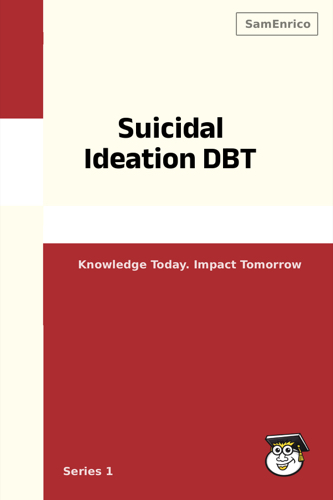
Suicidal Ideation DBT eBook
Emotion regulation for crisis moments and building
Emotion regulation for crisis moments and building reasons to live.
Formats
Free sample
Chapter 1: The Miscalculated Solution--The first time your brain offered you suicide as an answer to your pain, it was not trying to kill you. It was trying to save you.That sentence sounds like a contradiction, and in many ways it is. But understanding that contradiction is the single most important step you will take in this entire book. Your suicidal thoughts are not proof that you are broken, evil, weak, or beyond help. They are proof that your brain has learned a dangerous miscalculation—a faulty equation that says when pain exceeds coping resources, death is the only remaining solution.
Your brain is trying to solve a problem. It simply does not have the right tools.This chapter will teach you why that miscalculation happens, how to recognize it in real time, and the first concrete skill—Chain Analysis—that begins to rewrite the equation. You will learn the crucial difference between wanting to die and wanting the pain to stop. You will see why most suicidal crises are not about death at all, but about escape from unbearable suffering. And you will begin to build the foundation for every skill that follows in this book.Let us begin with a story.
Not a fictional one designed to inspire you. A real one, from a real person who once sat exactly where you are sitting now.The Woman Who Built a Life Worth Living In 1961, a nineteen-year-old girl was admitted to a psychiatric hospital in Connecticut. She had been suicidal for years. She cut her arms, her legs, her stomach. She burned herself with cigarettes.
She was tormented by a constant, crushing sense that she was fundamentally wrong—that her suffering was both unbearable and deserved. The staff at the hospital considered her one of the most difficult patients they had ever treated.Her name was Marsha Linehan.She would spend more than two years in that hospital, much of it in seclusion. The treatments of the day—heavy sedatives, restraint, isolation—did not help. She was strapped to a bed. She was locked in a room with nothing but a concrete floor.
The staff, she later recalled, seemed to have given up on her. They did not know what else to do.But something happened in that room. Lying on that concrete floor, she had what she would later describe as an experience of radical acceptance. Not resignation—not giving up on herself—but a profound letting go of the fight against her own pain. She stopped trying to argue with her suffering.
She stopped telling herself she should not feel the way she felt. She simply lay there and allowed the pain to exist without fighting it.She later wrote: "I had to learn to accept that I was the way I was, and that was okay. And then I had to change."That woman went on to earn a Ph D in psychology, to develop one of the most effective treatments ever created for suicidal behavior, and to train thousands of therapists worldwide. Her treatment is called Dialectical Behavior Therapy—DBT. And every single skill in this book traces its lineage back to that young woman on a hospital floor, who realized that her suicidal thoughts were not the enemy.
The enemy was the belief that she had no other way to stop the pain.I am telling you this story not because you need to become Marsha Linehan. You do not. You need to become you—but a version of you who has more tools than you have right now. I am telling you this story because it proves something crucial: the person who creates the map does not have to be someone who was never lost. The best guides are the ones who have walked the terrain themselves.
The people who write books like this one are not standing on dry ground pointing at the water. They are standing in the water with you. Many of them have been underwater.You are not broken. You have learned a miscalculation. And miscalculations can be corrected.The Problem-Solving Brain: Why Suicide Makes a Terrible Kind of Sense To understand why your brain offers suicide as a solution, you have to understand what the human brain is designed to do.
Above all else, the brain is a problem-solving organ. It is not primarily a feeling organ or a thinking organ or a connecting organ—though it does all those things. Its most fundamental job is to scan your internal and external environment for threats, discomforts, and pains, and then generate solutions to eliminate them.When you are hungry, your brain generates the thought "eat." When you are cold, it generates "find warmth." When you are lonely, it generates "reach out to someone." These are automatic, often unconscious processes. You do not decide to feel hungry; you simply feel it, and your brain offers solutions without you having to deliberate.Now consider emotional pain. Here is something most people do not know: the human brain does not distinguish between physical pain and social-emotional pain in the way you might expect.
Neuroimaging studies have shown that the same brain regions—the anterior cingulate cortex, the insula, the periaqueductal gray—activate whether you are experiencing a burn on your skin or a rejection from someone you love. Pain is pain, as far as your nervous system is concerned. And the brain's job is to make pain stop.So when you experience overwhelming emotional pain—shame, grief, terror, despair, rage, emptiness—your brain does what it always does. It searches for a solution that will eliminate the pain completely and permanently. If you have tried other solutions (crying, talking, sleeping, distracting, self-harming, drinking, using drugs, eating, not eating) and the pain remains, your brain may arrive at a stark conclusion: the only way to guarantee the pain stops is to stop everything.
To stop your heart. To stop your breath. To stop being.That is the problem-solving miscalculation. The brain has confused ending consciousness with ending suffering. It has failed to consider that pain can change, that suffering can decrease, that new solutions can appear tomorrow that do not exist today, that the absence of pain is not the same as the absence of life.
But in the moment of crisis, the brain is not considering tomorrow. It is trying to solve the unbearable present with the limited information it has right now.This is not a character flaw. It is not a sin. It is not evidence that you are "too sensitive" or "dramatic" or "broken" or "attention-seeking." It is a miscalculation. And like all miscalculations, it can be corrected with better information and better tools.The Critical Distinction That Will Save Your Life Here is the most important distinction you will learn in this entire book.
I want you to write it down somewhere. Put it on your phone. Put it on a sticky note on your bathroom mirror. Tattoo it on the inside of your eyelids if you have to.Wanting to die and wanting the pain to stop are not the same thing.They feel the same in the moment. The urge to end your life often arrives as…
This is the end of the free sample. Get the eBook to keep going. Buy now
About this book
Details
- Author
- Welker Darius
- Publisher
- SamEnrico
- Language
- English
- Genre
- Non-Fiction, Self-Help, Suicide Prevention
- Released
- 2026-06-11
- Pages (approx.)
- 149
- Available as
- eBook, Audiobook

Read better in the ZLOADR app
Your eBooks on your phone or tablet. Sign in with your SamEnrico account and start reading.
More by Welker Darius
 Pharmacist Burnout PreventionWelker Darius$11.99
 Mindful Breathing For VeteransWelker Darius$11.99
 Restaurant Manager Stress GuideWelker Darius$11.99
 Color Breathing VisualizationWelker Darius$11.99
 Self Talk For Empty NestWelker Darius$11.99
 Egyptian Clothing GuideWelker Darius$11.99
 Deep Sea Saturation LogWelker Darius$11.99
 Church Basement SecretsWelker Darius$11.99
 The Ghosts of Marj Dabiq: The Mamluks' Last Stand Against the OttomansWelker Darius$11.99
 K2: The Savage Mountain's Unyielding ChallengeWelker Darius$11.99
 Echoes of the Pioneer: The Forgotten Signals of Voyager 1's Cosmic JourneyWelker Darius$11.99
 Procurement and Strategic SourcingWelker Darius$11.99
You may also like
 Hong Kong Handover 1997Dunn Johnnie$11.99
 Zumba For Postnatal Recovery CourseNeal Christian$11.99
 Zumba for BeginnersLadner Nikia$11.99
 YouTube Comment Mining GuideHumes Pandora$12.99
 Worry Box MeditationCarlin Rudy$11.99
 Workplace Stress MeditationNguyen Lynn$11.99
 Workplace Stress and Sleep RepairHawley Ivory$11.99
 Workplace Perfectionism CureDelaney Jeffry$11.99
 Workplace Injustice Anger GuideWallen Isabelle$11.99
 Work Addiction and Burnout LinkGreenwood Ester$11.99
 Women in Yoga and WellnessBeattie Galina$11.99
 Women in Stand Up ComedyChun Evangeline$11.99