
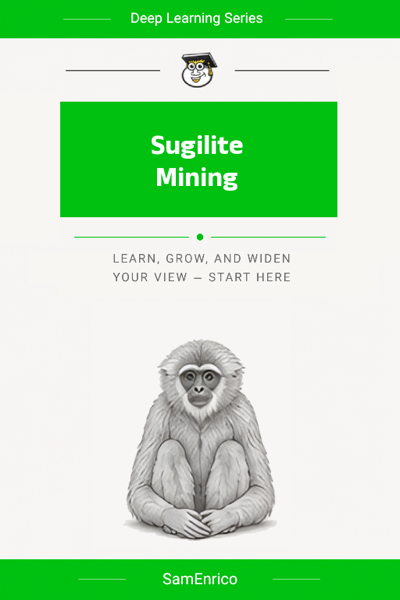
Sugilite Mining eBook
A Coursebook on Sugilite Mining
by Mckay Rosia
A Coursebook on Sugilite Mining
Formats
Free sample
Chapter 1: The Purple Discovery--On a remote outcrop of Iwagi Island in the Seto Inland Sea of Japan, during the final years of World War II, a petrologist named Ken-ichi Sugi cracked open a piece of manganese-bearing rock and saw something that should not have been there. Among the familiar black and brown oxides, a flash of translucent purple glinted back at him – a color utterly out of place in the drab mineralogy of the region. He rubbed the spot with his thumb, expecting the purple to be a stain or an optical illusion. It was not. It was a new mineral, unknown to science, and it would eventually carry his name.That moment in 1944 was the beginning of the sugilite story.
But it was not the moment that changed the world. For thirty-five years, sugilite remained a mineralogical curiosity – a footnote in academic papers, a specimen in museum drawers, a chemical formula on a page. Then, in 1979, a manganese miner in South Africa's Kalahari Desert tossed a purple rock onto the waste pile. He had seen thousands of purple rocks before. They were worthless, he had been told, just a strange mineral that got in the way of the real ore.
That rock was sugilite. But this time was different. This time, someone recognized it.What happened next transformed sugilite from an obscure academic specimen into one of the rarest and most valuable gemstones on Earth. A single deposit in the Northern Cape Province of South Africa – the Wessels Mine – began producing gem-quality sugilite in quantities that no one had imagined possible. The purple rock that miners had been discarding for years suddenly became worth more than the manganese they were mining.
A new chapter in mineralogy had begun.This chapter tells the story of that journey – from a wartime discovery in Japan to a gemstone revolution in South Africa to the complex global trade of today. You will learn who discovered sugilite, how it got its name, why it remained obscure for decades, and how a chance find in a manganese mine created a new category of rare gem. You will also understand the cultural and commercial forces that have shaped sugilite's reputation – from the metaphysical "Millennium Stone" to the unofficial "national gemstone" of South Africa to the controversial designation as a February birthstone. By the end of this chapter, you will understand not just what sugilite is, but why it matters – and why you should care about a purple mineral that most people have never heard of.The Man Behind the Mineral: Ken-ichi Sugi Ken-ichi Sugi was not a treasure hunter or a gem dealer. He was a meticulous academic, a professor of petrology at the University of Tokyo, who spent his career studying the alkaline rocks of Japan's many islands.
In 1944, with Japan in the grip of war, Sugi was conducting fieldwork on Iwagi Island – a small, rocky island in the Inland Sea, known more for its fishing villages than its geology.Iwagi Island is part of a region of alkaline igneous rocks, formed millions of years ago when magmas rich in sodium and potassium erupted or intruded into older sedimentary sequences. These alkaline rocks are mineralogically diverse, often containing rare minerals that form nowhere else. Sugi knew this. He was systematically cataloging the mineralogy of the island, collecting samples from the small manganese workings that dotted the landscape.It was in one such manganese prospect that Sugi found his purple mineral. The specimen was not spectacular – small crystals embedded in black manganese ore, translucent but not transparent, a deep violet-purple that caught the light.
Under the microscope, he saw a hexagonal crystal structure unfamiliar to him. Chemical analysis revealed a complex formula containing potassium, sodium, iron, manganese, aluminum, lithium, and silicon – an unusual combination that did not match any known mineral species.Sugi spent the next several years characterizing the mineral. He measured its physical properties, determined its crystal structure, and published his findings in Japanese academic journals. In his 1945 paper, he proposed the name "sugilite" in honor of himself – a common practice at the time for discoverers of new minerals. The International Mineralogical Association (IMA) officially accepted the name in 1962, retroactively recognizing Sugi's 1944 discovery as the type locality (the place where a new mineral is first identified).For the next three decades, sugilite remained an academic curiosity.
Specimens from Iwagi Island circulated among museums and mineral collectors, but they were small, poorly crystallized, and pale in color – interesting to specialists but worthless to jewelers. Most mineralogists assumed that was all sugilite could be: a minor, obscure mineral with no economic potential.They were wrong.The Wessels Mine Revolution The Kalahari Manganese Field in South Africa's Northern Cape Province is one of the largest manganese deposits on Earth. The ore body is Precambrian in age – over two billion years old – and has been mined continuously since the 1950s. The Wessels Mine, one of the principal operations in the field, extracts manganese from depths of 300 to 800 meters underground using room-and-pillar mining methods.Manganese miners are trained to look for black and brown ores – braunite, hausmannite, bixbyite. Anything else is waste.
For decades, miners at Wessels regularly encountered purple chunks of rock in the manganese ore. They called it "purple jasper" or "strange quartz" and tossed it onto the waste piles. No one knew it was sugilite. No one had ever seen sugilite from South Africa, and the Japanese type material looked nothing like these vivid purple masses.That changed in 1979, when a mining geologist with knowledge of rare minerals recognized the purple material for what it was. He sent samples to mineralogists, who confirmed the identification: the Wessels Mine was producing sugilite, and unlike the pale Japanese crystals, this material was gem-quality – deep purple, translucent, and massive enough to cut into cabochons.The discovery electrified the mineral and gem communities.
For the first time, sugilite was available in quantities sufficient for commercial use. And because the Wessels Mine was a manganese operation, sugilite was technically a by-product – recovered during manganese processing rather than mined directly. This made its extraction economically efficient (the manganese mining covered the costs) and its supply somewhat unpredictable (it depended on manganese production schedules).The "gem-quality revolution" had begun. Within a few years, sugilite from the Wessels Mine was being cut and polished in South African lapidary shops, sold to collectors and jewelers, and marketed under commercial names like "Royal Lavulite" (trademarked by South African dealers to distinguish their material from lower-grade Japanese specimens) and "Wessels Mine Sugilite" (a provenance label that still commands a premium today).As of 2024, the Wessels Mine has produced approximately 12-15 tons of sugilite of varying quality – from industrial-grade (opaque, heavily included) to the fabled "PP-grade" (intense purple, translucent, near-flawless). Approximately 60-70% of this resource has been mined to date, leaving an estimated 4-6 tons remaining.
The deposit is not infinite, and many analysts predict that the highest-grade material will be exhausted within the next decade. This scarcity is the primary driver of sugilite's high value.What's in a Name? Sugilite, Lavulite, and the Problem of Identity One mineral, many names. This is a source of confusion for buyers and a challenge for this book. Let me clarify.Sugilite is…
This is the end of the free sample. Get the eBook to keep going. Buy now
About this book
Details
- Author
- Mckay Rosia
- Publisher
- SamEnrico
- Language
- English
- Genre
- Non-Fiction, Informative, Educational
- Released
- 2026-06-02
- Pages (approx.)
- 149
- Available as
- eBook, Audiobook

Read better in the ZLOADR app
Your eBooks on your phone or tablet. Sign in with your SamEnrico account and start reading.
More by Mckay Rosia
 Opioid MAT Medication GuideMckay Rosia$11.99
 Yellow Journalism RevolutionMckay Rosia$11.99
 Stage Fright Emergency ProtocolMckay Rosia$11.99
 Prioritization for Customer SupportMckay Rosia$11.99
 Teenage Defiance Parental Anger FixMckay Rosia$11.99
 The First Atomic Dreamers: Aboriginal Fire and the Secrets of the OutbackMckay Rosia$11.99
 Love, Lies, and a Billion-Dollar Divorce: The Untold Story of Oprah and StedmanMckay Rosia$11.99
 How to Start a Powder Made of Aluminium Business (Beginners Guide)Mckay Rosia$11.99
 Understanding Blepharophimosis Nasal Groove Growth RetardationMckay Rosia$17.99
 Bootcamp Student Loan OptionsMckay Rosia$12.99
 Amazon Small And Light ProgramMckay Rosia$12.99