
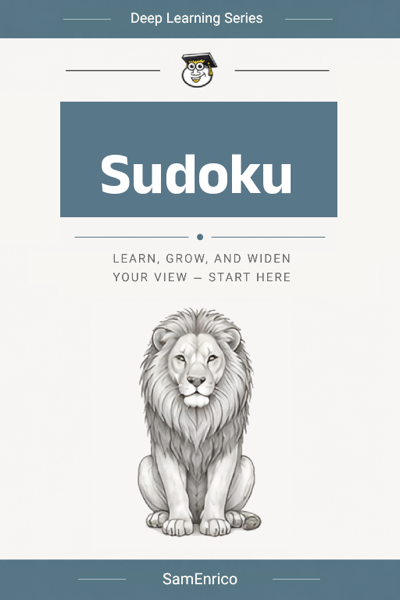
Non-FictionInformativeEducational
Sudoku Audiobook
A Coursebook on Sudoku
A Coursebook on Sudoku
Formats
Free sample
Chapter 1: The Cell That Changed Everything...--–- Every Sudoku puzzle ever published—from the cheap disposable books at airport newsstands to the handcrafted diabolical grids in championship finals—is built from exactly eighty-one cells arranged in a perfect nine-by-nine square. That is the universe of the game. Within that small grid, however, lives an infinite possibility space that has consumed millions of hours of human attention, launched international competitions, and inspired doctoral dissertations in combinatorics. But before you solve your first puzzle, before you learn a single technique, before you ever pencil a candidate into a corner of a cell, you must understand one thing: Sudoku is not mathematics. It is not arithmetic.
You will never add two numbers, subtract one from another, or calculate a sum. Sudoku is pure logic—a dance of constraints, a puzzle of mutual exclusion, a game where every number you place announces, "Because of me, nine other cells cannot hold this digit."This chapter establishes the absolute ground floor of Sudoku literacy. By the time you finish these pages, you will not yet have solved a difficult puzzle—that work begins in Chapter 2. Instead, you will understand the anatomy of the grid, the three overlapping constraints that define every valid puzzle, the notation that experts use to communicate, and the unbreakable rules that separate a legitimate Sudoku from an unsolvable mess. You will learn why a puzzle with two solutions is considered broken, why some unique puzzles still require guessing, and how to look at a grid the way a master does: as a web of relationships, not a collection of empty squares.Let us begin at the very beginning.
Let us build your Sudoku literacy from the cell upward.1.1 The Anatomy of the Grid Take any Sudoku puzzle. You will see a large square subdivided into nine rows, nine columns, and nine smaller three-by-three boxes. The large square contains exactly eighty-one smaller squares. Each of those small squares is called a cell. In published puzzles, some cells contain printed numbers—these are the givens or clues.
The remaining cells are empty, waiting for you to fill them.Here is the first rule, stated simply and memorably: Every row must contain each of the digits 1 through 9 exactly once. Every column must contain each of the digits 1 through 9 exactly once. Every three-by-three box must contain each of the digits 1 through…
This is the end of the free sample. Get the Audiobook to keep going. Buy now
About this book
Details
- Author
- Merrill Stephenie
- Publisher
- SamEnrico
- Language
- English
- Genre
- Non-Fiction, Informative, Educational
- Released
- 2026-05-18
- Pages (approx.)
- 159
- Available as
- eBook, Audiobook

Listen in the VoxFlicks app
Audiobooks and audio dramas wherever you go. Sign in with your SamEnrico account and press play.
More by Merrill Stephenie
 HRT Non Oral Routes Benefits GuideMerrill Stephenie$11.99
 Highway Hostility HandbookMerrill Stephenie$11.99
 The Sleeping Position Back GuideMerrill Stephenie$11.99
 Long Duration Storage GuideMerrill Stephenie$11.99
 Bloodline of the Sun King: The Forgotten HeirMerrill Stephenie$11.99
 How to Become a Tumbler TenderMerrill Stephenie$11.99
 NYC Pop Up TikTok StrategyMerrill Stephenie$12.99
 Paystack Transaction Dashboard GuideMerrill Stephenie$12.99
 Understanding Periventricular Laminar HeterotopiaMerrill Stephenie$17.99
You may also like
 Hong Kong Handover 1997Dunn Johnnie$11.99
 Zumba For Postnatal Recovery CourseNeal Christian$11.99
 Zumba for BeginnersLadner Nikia$11.99
 YouTube Comment Mining GuideHumes Pandora$12.99
 Worry Box MeditationCarlin Rudy$11.99
 Workplace Stress MeditationNguyen Lynn$11.99
 Workplace Stress and Sleep RepairHawley Ivory$11.99
 Workplace Perfectionism CureDelaney Jeffry$11.99
 Workplace Injustice Anger GuideWallen Isabelle$11.99
 Work Addiction and Burnout LinkGreenwood Ester$11.99
 Women in Yoga and WellnessBeattie Galina$11.99
 Women in Stand Up ComedyChun Evangeline$11.99