
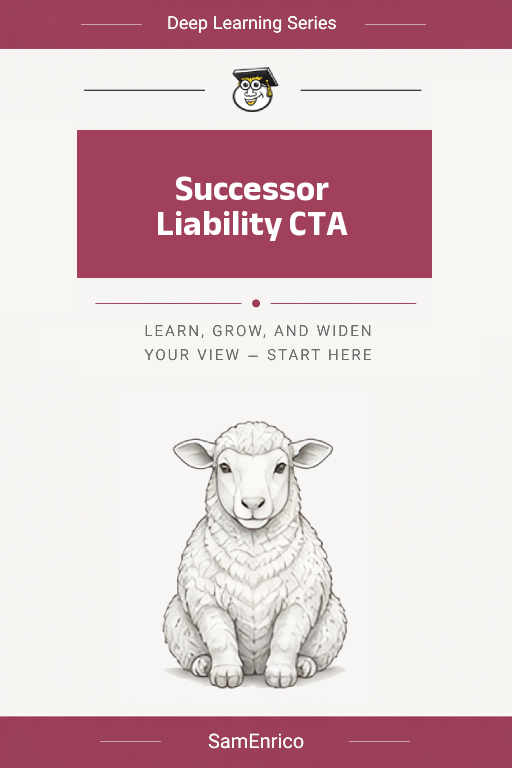
Successor Liability CTA eBook
Handles BOI reporting in mergers, acquisitions, an
Handles BOI reporting in mergers, acquisitions, and asset purchases including successor liability for predecessor CTA violations.
Formats
Free sample
Chapter 1: The Buyer’s New Nightmare...--–- On a Tuesday morning in late 2024, a mid‑sized private equity firm closed a seemingly straightforward acquisition. The target was a regional distribution company with clean financials, a loyal customer base, and no outstanding litigation. The buyer conducted standard due diligence: reviewed tax returns, audited accounts receivable, inspected environmental reports, and obtained representations and warranties on everything from intellectual property to employee benefits. Two weeks after closing, the buyer’s general counsel received a letter from Fin CEN. The target had never filed its Beneficial Ownership Information report.
By the time the buyer discovered the violation, 187 days had passed since the original deadline. The penalty calculation was simple: 187 days multiplied by 500perday,totaling500 per day, totaling 500perday,totaling93,500. But the letter did not stop there. Fin CEN also noted that the buyer, as successor to the target’s assets and operations, was equally liable for the violation. The buyer had unknowingly purchased not just a distribution company but also a ticking penalty clock.
That Tuesday morning, the general counsel learned a painful lesson: under the Corporate Transparency Act, buyer beware had become buyer liable.This is the new nightmare of M&A. And it is only the beginning.The Quiet Revolution in Corporate Transparency For more than a century, American business law operated on a foundational assumption: what you own privately, you may keep privately. States like Delaware, Nevada, and Wyoming built thriving economies by offering entrepreneurs the ability to form LLCs and corporations without disclosing the human beings behind them. An anonymous shell company could buy real estate, open bank accounts, sign contracts, and own subsidiaries—all while the true owner remained hidden behind a nominee director or a trust structure. This was not a loophole.
It was a feature.The Corporate Transparency Act, enacted in 2021 as part of the Anti‑Money Laundering Act, ended that era. Effective January 1, 2024, the CTA requires most entities formed or registered to do business in the United States to report their Beneficial Ownership Information to Fin CEN. For the first time, the federal government created a centralized, non‑public database of who actually owns and controls America’s business entities. The stated purpose was straightforward: combat shell companies used for money laundering, tax evasion, terrorist financing, and other illicit activities.But for M&A professionals, the CTA created something far more personal: successor liability risk.Why This Chapter Matters to You If you are reading this book, you are likely an M&A attorney, private equity professional, corporate development officer, or in‑house counsel. You have structured dozens or hundreds of transactions.
You know how to allocate risk through representations, warranties, indemnities, and escrows. You have seen environmental liability, product liability, and employment liability transfer to buyers. But you have never seen anything quite like the CTA.Here is what makes the CTA uniquely dangerous in M&A:First, the penalties are strict liability in practice. Unlike many regulatory regimes that require a showing of scienter or willfulness, the CTA imposes 500perdaycivilpenaltiesforsimplyfailingtofileorupdate BOI.Criminalpenalties—upto500 per day civil penalties for simply failing to file or update BOI. Criminal penalties—up to 500perdaycivilpenaltiesforsimplyfailingtofileorupdate BOI.Criminalpenalties—upto10,000 and two years imprisonment—attach to willful violations, but the civil penalty requires no proof of intent.
A missed deadline is a missed deadline.Second, the duty to file is continuous. Under the CTA, a reporting company must file an initial BOI report within 30 days of formation or registration. Thereafter, whenever there is a change in beneficial ownership or control, the company has only 30 days to file an updated report. This is not a one‑time compliance event. It is a perpetual obligation.Third, the CTA imposes successor liability.
As detailed in Chapter 7, the legal core of this book, a buyer that acquires a reporting company—whether by equity purchase, statutory merger, or even certain asset purchases—inherits all past CTA violations of the predecessor. The buyer cannot wipe the slate clean. The buyer cannot argue that it was not the reporting company at the time of the violation. The law looks to the entity, and the entity’s history travels with it.Fourth, Fin CEN does not provide public access to BOI data. Unlike a UCC lien search or a litigation docket search, a buyer cannot simply log into a database and check a target’s compliance status.
The only way to obtain a target’s BOI filings is to ask the target directly—and trust the response.Fifth, many targets do not even know they are reporting companies. As of early 2025, compliance rates among small to mid‑sized entities remain shockingly low. A 2024 survey by the American Bar Association found that fewer than 40% of newly formed LLCs had filed their initial BOI reports within the required 30 days. Among pre‑2024 entities, which had until January 1, 2025 to file their initial reports, the compliance rate was even lower. This means that when you buy a company, the odds are uncomfortably high that you are buying a violation.The Scope of the Problem: Numbers You Cannot Ignore To understand the magnitude of this new risk, consider the following data points.As of 2024, Fin CEN estimated that more than 30 million entities would be subject to BOI reporting requirements.
This includes nearly every privately held LLC, corporation, limited partnership, and similar entity formed or registered in the United States. The exemptions—23 in total—carve out only a narrow slice of the business landscape. Publicly traded companies are exempt. Banks and credit unions are exempt. Large operating companies with more than 20 full‑time U.S.
employees, a physical office, and more than $5 million in gross revenue are exempt. But the vast majority of middle‑market and lower‑middle‑market targets do not meet the large operating company threshold. They are reporting companies.Now consider the penalty math. If a target failed to file its initial BOI report on January 1, 2024, and you close the acquisition on December 31, 2024, the violation has been accruing for 365 days. That is 182,500incivilpenalties.Ifthetargetalsofailedtofileupdatesforthreechangesinbeneficialownershipduringthatyear,eachmissedupdateaddsanother182,500 in civil penalties.
If the target also failed to file updates for three changes in beneficial ownership during that year, each missed update adds another 182,500incivilpenalties.Ifthetargetalsofailedtofileupdatesforthreechangesinbeneficialownershipduringthatyear,eachmissedupdateaddsanother500 per day until filed. The total penalty can easily exceed $500,000 for a single year of non‑compliance. And because successor liability attaches to the entity, that penalty becomes your penalty the moment you sign the closing statement.Criminal exposure adds another layer. If the target’s prior owners willfully failed to file—perhaps they intentionally avoided learning about the CTA, or they actively concealed ownership information—the successor buyer could inherit not only civil penalties but also the risk of criminal investigation. While it is unlikely that Fin CEN would pursue criminal charges against an innocent buyer, the mere existence of criminal exposure changes the calculus of settlement negotiations and indemnity claims.The Fundamental Shift: From Caveat Emptor to Caveat Successor The Latin phrase caveat emptor—let the buyer beware—has governed Anglo‑American property law for centuries.
In the context of M&A, it has traditionally meant that a buyer must conduct due diligence because the seller is under no general duty to disclose latent defects. The CTA upends…
This is the end of the free sample. Get the eBook to keep going. Buy now
About this book
Details
- Author
- Withers Lesia
- Publisher
- SamEnrico
- Language
- English
- Genre
- Non-Fiction, Annual Checkup, M&A
- Released
- 2026-05-27
- Pages (approx.)
- 149
- Available as
- eBook, Audiobook

Read better in the ZLOADR app
Your eBooks on your phone or tablet. Sign in with your SamEnrico account and start reading.
More by Withers Lesia
 Sports Nutrition for GolfWithers Lesia$11.99
 International Franchise Sanctions ComplianceWithers Lesia$11.99
 Vocational Rehab Dual DiagnosisWithers Lesia$11.99
 The Self Hypnosis for Smell SensitivityWithers Lesia$11.99
 Anger Management for FreelancersWithers Lesia$11.99
 The Lioness of the Serengeti: Dr. Margaret D. Lowman’s Canopy ChroniclesWithers Lesia$11.99
 Understanding Ruzicka Goerz Anton SyndromeWithers Lesia$17.99
 How to Become a Plumber ApprenticeWithers Lesia$11.99
 Factoring for Agriculture GuideWithers Lesia$12.99
 Olivine (a Group of Silicate Minerals) MiningWithers Lesia$11.99
You may also like
 Hong Kong Handover 1997Dunn Johnnie$11.99
 Zumba For Postnatal Recovery CourseNeal Christian$11.99
 Zumba for BeginnersLadner Nikia$11.99
 YouTube Comment Mining GuideHumes Pandora$12.99
 Worry Box MeditationCarlin Rudy$11.99
 Workplace Stress MeditationNguyen Lynn$11.99
 Workplace Stress and Sleep RepairHawley Ivory$11.99
 Workplace Perfectionism CureDelaney Jeffry$11.99
 Workplace Injustice Anger GuideWallen Isabelle$11.99
 Work Addiction and Burnout LinkGreenwood Ester$11.99
 Women in Yoga and WellnessBeattie Galina$11.99
 Women in Stand Up ComedyChun Evangeline$11.99