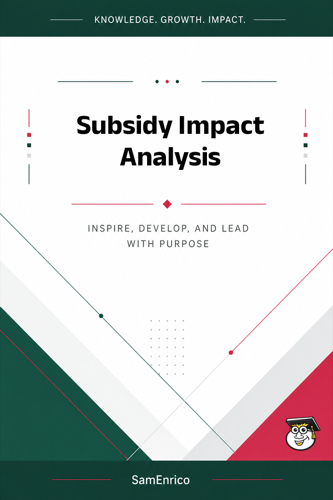
Subsidy Impact Analysis
Measure how government payments shift supply curve
Measure how government payments shift supply curves and affect market outcomes.
Formats
About this book
Free sample
Chapter 1: The $7 Trillion Blind Spot--–- Every year, governments around the world transfer roughly $7 trillion to businesses and households through subsidies. That figure—calculated by the International Monetary Fund and the World Bank using the price-gap method you will learn in Chapter 6—exceeds the total GDP of every country except the United States and China. It is larger than global military spending, larger than total annual investment in renewable energy, and roughly equivalent to the combined health care budgets of every nation on Earth. Yet most citizens, and even many policymakers, have no idea that this staggering sum is being moved through their economies. Even more troubling, most of these subsidies are not carefully analyzed before they are implemented, rarely evaluated after they are in place, and almost never reformed despite overwhelming evidence that they often fail to achieve their stated goals.This blind spot is not accidental.
Subsidies feel different from taxes. A tax is visible, painful, and resented. A subsidy is a gift, a helping hand, a government doing something nice for its people. But this intuitive framing is precisely backwards. Every subsidy must be paid for—either by current taxes, future taxes (debt), or forgotten public investments.
As you will see in Chapter 7, the true social cost of a subsidy is almost always larger than the amount of money the government spends, because raising that money through taxes itself destroys economic value. A subsidy is not a gift; it is a transfer with a tax attached to its back.This book is about how to see through that blind spot. It is a practical guide to subsidy impact analysis—the systematic measurement of how government payments shift supply curves and affect market outcomes. It draws on the best textbooks in economics, the most rigorous policy frameworks from the World Bank, and decades of real-world reform experience from countries that have successfully (and unsuccessfully) tried to clean up their subsidy programs. By the end of this book, you will be able to answer three questions that most policymakers never even ask: Who actually benefits from a subsidy?
How much does it truly cost? And could the same social goal be achieved with less waste?The Paradox of the…
This is the end of the free sample. Get the eBook to keep going. Buy now
Contents
- Chapter 1
- Chapter 2
- Chapter 3
- Chapter 4
- Chapter 5
- Chapter 6
- Chapter 7
- Chapter 8
- Chapter 9
- Chapter 10
- Chapter 11
- Chapter 12
Details
- Author
- Stephen Arron
- Publisher
- SamEnrico
- Language
- English
- Genre
- Non-Fiction, Business Brief, Public Economics
- Released
- 2026-06-08
- Pages (approx.)
- 151
- Available as
- eBook, Audiobook

Read better in the ZLOADR app
Your eBooks on your phone or tablet. Sign in with your SamEnrico account and start reading.
More by Stephen Arron
 The Hearing Loss Confidence GuideStephen Arron$11.99
 Mirror Fear CatoptrophobiaStephen Arron$11.99
 Networking by SectorStephen Arron$11.99
 Cannabis and Driving GuideStephen Arron$11.99
 Basketball Free Throw HypnosisStephen Arron$11.99
 NikkieTutorials CoverStephen Arron$11.99
 When the Sky Split Open: The Song of the First FireStephen Arron$11.99
 The Codebreakers' War: How Alan Turing's Secret Blueprint Built the Modern WorldStephen Arron$11.99
 How to Become a Budget ClerkStephen Arron$11.99
 The Mineral Guide to BrochantiteStephen Arron$11.99
 UK Company Credit Report FixStephen Arron$12.99
 Cooperative Merger and RestructuringStephen Arron$12.99