
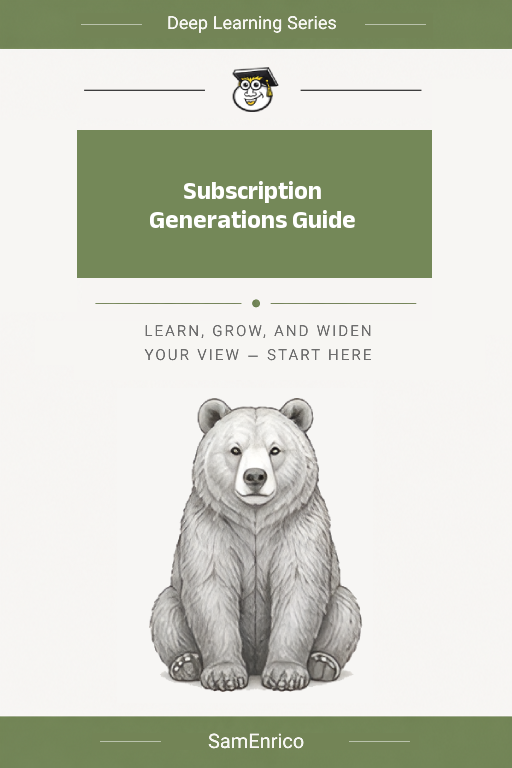
Non-FictionConsumer Mind ReportSubscription Economy
Subscription Generations Guide eBook
Contrast streaming, meal kit, beauty box, and soft
by Harp Miles
Contrast streaming, meal kit, beauty box, and software subscription adoption rates and churn drivers.
Formats
Free sample
Chapter 1: The Ownership Recession--–- Your grandmother saved for six months to buy a mahogany dining table that her grandchildren would one day fight over. You pay $12.99 per month for access to 80 million songs you will never listen to, streamed from a server farm in a state you have never visited, using a device that will be obsolete in 18 months. You do not own the table, the songs, or the device. And you have never been happier.This is the great paradox of modern commerce. For the first time in human history, a generation has voluntarily surrendered ownership.
Not out of poverty or coercion, but out of preference. The shift from possession to access is not a recession-era compromise. It is a fundamental rewiring of the human relationship with goods, services, and value itself. Call it the Ownership Recession—a quiet, accelerating collapse of the old model where buying meant keeping, and keeping meant owning until death or disrepair.The numbers are staggering. Between 2012 and 2022, the subscription economy grew 5.6 times faster than the S&P 500 and 6.2 times faster than traditional retail.
By 2026, seventy-five percent of direct-to-consumer brands are expected to offer a subscription option. A consumer born after 1995 is three times more likely to subscribe to a product than to buy it outright, compared to someone born before 1965. The eighteen-to-thirty-four demographic now holds an average of 4.6 active subscriptions at any given time, excluding utilities and rent. And here is the detail that keeps legacy executives awake at night: they are not subscribing to digital services alone. They are subscribing to razor blades, meal kits, pet food, beauty products, cars, furniture, and software that used to come in a box with a perpetual license.This book is about those subscriptions.
But more than that, it is about the generation that buys them, the generation that builds them, and the generation that will inherit an economy where ownership is no longer the default endpoint of aspiration.The Unbundling Cascade To understand where subscriptions are going, you must first understand how they won. The victory was not sudden. It was a cascade of unbundling that began with media and is now colonizing every corner of physical and digital life.The first domino fell in 2007, though few recognized it at the time. Netflix, a company that had built its business mailing red envelopes of DVDs, announced that it would begin streaming video directly to computers. The quality was terrible.
The selection was thin. The business model was incomprehensible to Wall Street analysts who had spent decades measuring success by per-unit sales. How could unlimited access for a flat monthly fee possibly compete with selling individual movies for $19.99?What the analysts missed was the psychology. Ownership of physical media came with hidden costs that consumers had learned to tolerate but never loved. DVDs scratched.
Cases cluttered. Box sets gathered dust. Every purchase required a decision, and every decision risked regret. The streaming subscription offered something radically different: permission to stop deciding. Pay once.
Watch anything. If you hate it, watch something else. The cost of a bad choice dropped from twenty dollars to zero.The second domino was software. For decades, companies like Microsoft and Adobe sold software on CDs or as one-time downloads. You paid a large sum—hundreds or thousands of dollars—and you owned that version forever.
The problem was that "forever" quickly became obsolete. Updates required new purchases. Security patches were grudging. And the upfront cost locked out millions of potential customers who could afford twenty dollars per month but not five hundred dollars all at once.The Software-as-a-Service model solved both problems. Salesforce proved that companies would pay recurring fees for access to cloud-based tools.
Adobe proved that customers would accept the transition even when it meant paying more over time. The psychological trade was simple: surrender perpetual ownership in exchange for perpetual updates, lower upfront costs, and the freedom to cancel at any time. By 2020, the vast majority of business software had shifted to subscription models. The holdouts looked like relics.The third domino was physical goods. Once consumers accepted subscriptions for digital content and software, the resistance to physical subscriptions crumbled.
Dollar Shave Club demonstrated that men would pay five dollars per month for razor blades delivered automatically, eliminating the annoying mid-week trip to the drugstore. Blue Apron showed that households would pay for pre-portioned meal kits, trading grocery shopping and meal planning for the convenience of a box. Birchbox proved that women would pay for surprise beauty samples, turning the department store cosmetic counter into a monthly ritual of discovery.Each of these physical subscriptions succeeded by solving a different problem. Razors solved the friction of replenishment. Meal kits solved the burden of planning.
Beauty boxes solved the paralysis of choice. But they all shared a common insight: ownership was never the goal. The goal was the outcome—smooth skin, dinner on the table, discovery without commitment. Subscriptions simply unbundled the outcome from the asset.The unbundling cascade continues today. Cars are available by subscription through Volvo and Porsche.
Furniture is rented through Feather and Fernish. Even housing itself is being unbundled through platforms like Airbnb and Sonder, which offer access to living spaces without the anchor of a mortgage. The pattern is unmistakable. Every industry that requires a large upfront purchase, ongoing maintenance, or storage is vulnerable to a subscription alternative.The Psychological Ledger Why would anyone trade ownership for access? On paper, it often costs more over time.
A lifetime of streaming subscriptions exceeds the cost of buying your favorite movies. A decade of razor deliveries costs more than a high-end electric shaver. The math does not favor the subscriber.And yet, the subscriber does not care.The reason lies in a concept that economists have only recently begun to understand: the psychological ledger. Human beings do not make financial decisions on pure arithmetic. They make them on emotional accounting, risk tolerance, and the hidden costs that never appear on a receipt.Ownership comes with a suite of psychological burdens that the Subscription Generation has learned to reject.
The first burden is maintenance. When you own something, you must clean it, repair it, store it, and eventually dispose of it. Each of these activities consumes time, attention, and emotional energy. The dining table that your grandmother treasured required polishing, dusting, and worrying about scratches. The streaming subscription requires nothing.
It lives in the cloud. It never needs maintenance because you never possess it.The second burden is obsolescence. Ownership implies permanence, but the world changes. That CD collection that cost thousands of dollars is now worthless. That software license for Windows 95 is a coaster.
The car you financed for five years feels ancient after two. Ownership locks you into a moment in time, while the world moves on. Subscriptions move with the world. When a better streaming service appears, you cancel one and join another. When a new software feature launches, it appears in your account overnight.
You are never left holding obsolete assets because you never held assets at all.The third burden is illiquidity. Owned assets are difficult to convert back into cash. Selling a car takes weeks. Selling furniture takes months. Selling a…
This is the end of the free sample. Get the eBook to keep going. Buy now
About this book
Details
- Author
- Harp Miles
- Publisher
- SamEnrico
- Language
- English
- Genre
- Non-Fiction, Consumer Mind Report, Subscription Economy
- Released
- 2026-05-30
- Pages (approx.)
- 146
- Available as
- eBook, Audiobook

Read better in the ZLOADR app
Your eBooks on your phone or tablet. Sign in with your SamEnrico account and start reading.
More by Harp Miles
 The Sleep Deprivation EffectHarp Miles$11.99
 The Active Surveillance Prostate GuideHarp Miles$11.99
 Divorce And Anxiety GuideHarp Miles$11.99
 Botanical Medicine HandbookHarp Miles$11.99
 Apalai Spiritual Guide AmazonHarp Miles$11.99
 The Secret Scrolls of Halas and Batchelor: Britain's Forgotten Animation PioneersHarp Miles$11.99
 How to Become a Station Installer-and-repairerHarp Miles$11.99
 Brazil Dropshipping WhatsApp GuideHarp Miles$12.99
 Public Health PhysicianHarp Miles$11.99
 Understanding ScleredemaHarp Miles$17.99
You may also like
 Hong Kong Handover 1997Dunn Johnnie$11.99
 Zumba For Postnatal Recovery CourseNeal Christian$11.99
 Zumba for BeginnersLadner Nikia$11.99
 YouTube Comment Mining GuideHumes Pandora$12.99
 Worry Box MeditationCarlin Rudy$11.99
 Workplace Stress MeditationNguyen Lynn$11.99
 Workplace Stress and Sleep RepairHawley Ivory$11.99
 Workplace Perfectionism CureDelaney Jeffry$11.99
 Workplace Injustice Anger GuideWallen Isabelle$11.99
 Work Addiction and Burnout LinkGreenwood Ester$11.99
 Women in Yoga and WellnessBeattie Galina$11.99
 Women in Stand Up ComedyChun Evangeline$11.99