
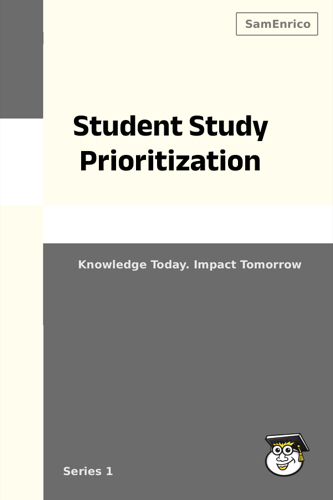
Student Study Prioritization eBook
Rank assignments and exam prep using ABCDE to impr
by Swenson Miss
Rank assignments and exam prep using ABCDE to improve grades without burnout.
Formats
Free sample
Chapter 1: The Leverage Lie--Most students believe that grades are a direct reward for hours worked. Show up, put in the time, suffer appropriately, and the transcript will reflect your sacrifice. This is the single most destructive myth in education. It convinces hardworking students to grind themselves into exhaustion while watching peers who study half as much earn better grades. The difference is not intelligence.
The difference is leverage.Welcome to the first chapter of Student Study Prioritization. Before we discuss the ABCDE method, before we talk about time blocking or active recall, we must first diagnose the disease that brings most students to this book: the belief that trying harder is the same as trying smarter.The Infinite Effort Fallacy Imagine two students preparing for the same organic chemistry final. Student A studies for ten hours straight on the day before the exam. She drinks three energy drinks, rereads her textbook chapters twice, rewrites her notes in neat colors, and falls asleep at 3:00 AM feeling exhausted but virtuous. Student B studies for six hours spread across three days, sleeps eight hours each night, spends most of her study time testing herself with flashcards, and goes to bed at 10:00 PM the night before the exam.
Who performs better?If you answered Student B, you are correct. But here is the question that stumps most students: why? Both students worked. Both wanted to succeed. Both put in significant effort.
The difference is not motivation or intelligence. The difference is cognitive science.The Infinite Effort Fallacy is the assumption that academic output scales linearly with time invested. If two hours produces a C, then four hours should produce a B, and eight hours should produce an A. This makes intuitive sense in physical labor—digging a ditch for eight hours moves twice as much dirt as digging for four hours. But studying is not digging.
The brain has physiological limits, and once you exceed them, additional hours do not just fail to help—they actively harm your performance.Cognitive Load Theory: Your Brain Is Not a Muscle Cognitive Load Theory, developed by educational psychologist John Sweller in the 1980s, explains why the Infinite Effort Fallacy is scientifically wrong. The theory divides mental work into three categories: intrinsic load (the inherent difficulty of the material), extraneous load (how the material is presented), and germane load (the work of actually learning). For our purposes, the most important finding is this: working memory has a severely limited capacity.Think of working memory as a small desk. You can only hold a few items on that desk at once—typically four to seven pieces of information. When you try to learn something new, you must hold that information on your desk while you manipulate it, connect it to existing knowledge, and file it into long-term memory.
If you overload the desk, items fall off. You forget. You get confused. You spin your wheels.Here is what most students do not understand: studying for extended periods without breaks does not increase the size of your desk. It simply keeps the desk overloaded for longer.
After about 90 minutes of focused cognitive work, most people experience a sharp decline in working memory efficiency. By hour four, you are effectively studying with a desk the size of a postage stamp. By hour eight, you might as well be napping.This is not a matter of willpower. You cannot grit your teeth and force your working memory to expand, any more than you can grit your teeth and grow taller. Cognitive load is a biological constraint, not a character flaw.The Diminishing Returns Curve Let me show you what actual learning science says about study duration.
Research on distributed practice and cognitive fatigue consistently demonstrates a curve that looks something like this:Hours 0-2: High retention, high focus, efficient learning Hours 2-4: Moderate retention, declining focus, still productive Hours 4-6: Low retention, frequent errors, minimal net gain Hours 6-8: Negative retention (you forget more than you learn)Hours 8+: Active harm (exhaustion impairs future study sessions)Yes, you read that correctly. Beyond approximately six hours of focused study in a single day, additional time can actually reduce your net knowledge. This happens for two reasons. First, fatigue causes you to make errors, and studying incorrect information is worse than not studying at all. Second, excessive studying crowds out sleep, and sleep is when memory consolidation actually occurs.I have worked with students who proudly announce that they studied for fourteen hours before a final.
They say this as if it explains their poor grade. And in a way, it does—just not the way they think. Fourteen hours of studying, properly executed, would be impossible for any human. What they actually did was perhaps three hours of real studying, six hours of exhausted rereading, and five hours of staring at pages while thinking about how tired they were. Then they slept poorly, took the exam on a fatigued brain, and wondered why their hard work did not pay off.The All-Nighter Myth: What Sleep Actually Does Because sleep is so central to the problem of overwork, we need to understand exactly what happens when you trade sleep for study time.
This is not a moral lecture about the importance of rest. This is neuroscience.During deep sleep and REM (rapid eye movement) sleep, your brain performs a process called memory consolidation. Throughout your waking hours, your hippocampus—a seahorse-shaped structure deep in the brain—acts as a temporary holding tank for new information. It records what happened, what you learned, and what you practiced. But that tank has limited capacity.
During sleep, the hippocampus transfers important information to the neocortex for long-term storage. Think of it as moving files from your computer's RAM to its hard drive.Here is the critical point: this transfer only happens during sleep. You cannot consolidate memories while awake. A student who studies for twelve hours and sleeps for four will retain dramatically less than a student who studies for six hours and sleeps for eight. The first student fills up their hippocampus but never empties it.
The second student fills, empties, fills again, and empties again—creating durable, long-term memories.Research on sleep and academic performance consistently finds the same pattern. A study of 1,500 college students found that those who averaged seven to eight hours of sleep before an exam scored significantly higher than those who averaged five to six hours, even when the short-sleeping students studied more total hours. Another study found that pulling an all-nighter increased cognitive errors by roughly 30 percent the next day, regardless of how much studying occurred during the night.This means that when you choose to study instead of sleep, you are not trading one productive activity for another. You are trading productive activity for counterproductive activity. The sleep you lost would have helped you retain what you already learned.
The studying you did instead was performed on a fatigued brain that could barely hold information. It is a double loss.Productive Procrastination: The Feeling of Busy Before we introduce the solution, we must name the enemy. Productive procrastination is the act of doing low-value tasks that feel like work in order…
This is the end of the free sample. Get the eBook to keep going. Buy now
About this book
Details
- Author
- Swenson Miss
- Publisher
- SamEnrico
- Language
- English
- Genre
- Non-Fiction, Self-Help, Study Skills
- Released
- 2026-06-09
- Pages (approx.)
- 151
- Available as
- eBook, Audiobook

Read better in the ZLOADR app
Your eBooks on your phone or tablet. Sign in with your SamEnrico account and start reading.
More by Swenson Miss
 Parental Anger Time Out GuideSwenson Miss$11.99
 Carb Cycling Tracking GuideSwenson Miss$11.99
 Addiction and Attachment PrimerSwenson Miss$11.99
 Franchising Your Local Brand Across Borders Joint VenturesSwenson Miss$11.99
 Summit of Shadows: The Untold Story of Arlene Blum and the First All-Women's Ascent of AnnapurnaSwenson Miss$11.99
 Empress of the Purple: Theodora’s Rise from the ShadowsSwenson Miss$11.99
 Understanding D Ercole SyndromeSwenson Miss$17.99
 How to Start a Hobby in Making PaperSwenson Miss$11.99
 Green Tariff Energy GuideSwenson Miss$12.99
 Testing Plan One PageSwenson Miss$12.99
 Cyber Security ConsultantSwenson Miss$11.99
You may also like
 Spaced Repetition ScienceStratton Jed$11.99
 Anki For SAT StudyForbes Dusty$11.99
 Study Then Sleep ProtocolMarch Tisa$11.99
 Procrastination Overcoming WorkbookDowns Gianna$11.99
 Flow State for StudentsEutsey Anjelica$11.99
 Flow in Learning StudyingGaskin Easter$11.99
 Flow for Students GuideGamble Breanna$11.99
 Anki For PhysicsPinkerton Kerstin$11.99
 Anki For MCAT PrepBoynton Remedios$11.99
 Anki For Language LearningManess Ka$11.99
 Anki For AviationBurnside Prince$11.99
 Active Recall Study GuideWooden Luciana$11.99