
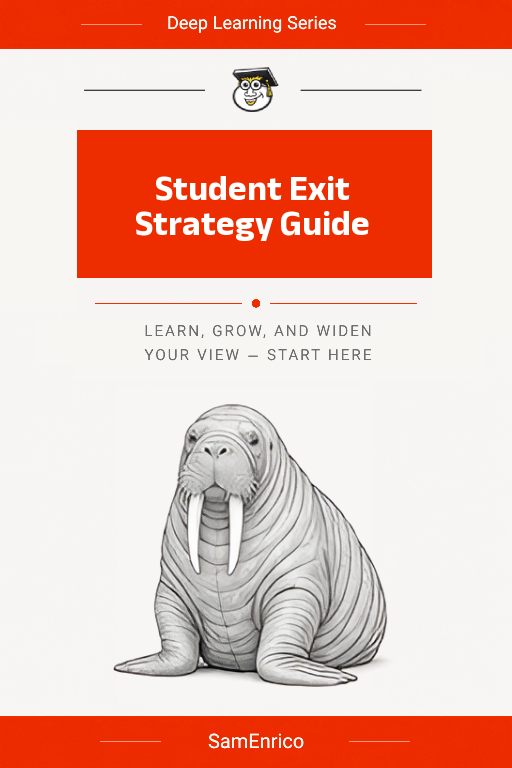
Non-FictionStudent's ShortcutTransition
Student Exit Strategy Guide eBook
Transition from student job to full-time employmen
Transition from student job to full-time employment or graduate visa after studies.
Formats
Free sample
Chapter 1: The Translation Lie--You have been lied to. Not maliciously, but systematically. Your professors, your advisors, and even your well-meaning parents have repeated the same empty promise: get a degree, and the job will follow. But here you are, weeks or months from graduation, staring at a resume that feels thin, generic, and utterly disconnected from the career you actually want. You worked twenty hours a week throughout university—sometimes thirty, sometimes more while juggling a full course load.
You showed up. You did the tasks. You collected the paycheck. And now you are realizing that none of that effort seems to matter to the employers who scroll past your application in seven seconds or less.This chapter exists because most students make a catastrophic error in judgment about their student work. They treat their campus job—or their off-campus retail shift, or their unpaid internship—as a transaction: hours in exchange for money.
They never stop to ask the question that separates graduates who land career-track jobs from those who spend six months sending applications into the void. That question is simple but devastating: What job is my student work actually doing for my future?The answer, for most students, is nothing. And that is not because the work lacked value. It is because you have not been taught the language of translation.The Student Job vs. The Career Job: A Vocabulary Problem Let us begin with a distinction that will reshape everything you think you know about your work history.
A student job is defined by input: hours worked, shifts completed, tasks checked off a list. When you describe your student job this way—and most students do—you sound like an assembly line worker. "I answered phones." "I stocked shelves." "I entered data." "I made coffee." These statements are truthful, but they are also useless. They tell an employer nothing about whether you can solve problems, manage ambiguity, or add value.A career job, by contrast, is defined by output: problems solved, money saved, processes improved, revenue generated. When you describe your work this way, you sound like a professional.
"I resolved customer escalations, reducing complaint volume by 30 percent." "I redesigned inventory tracking, eliminating stockouts during peak demand." "I automated a manual reporting process, saving my team ten hours per week." Notice the difference. The underlying work may be identical. The difference is entirely in the framing.Here is the uncomfortable truth that your career center will not tell you: employers do not care what you did. They care about what you achieved. They care about the measurable, verifiable impact of your labor.
And if you cannot articulate that impact in numbers and outcomes, you will be filtered out by the algorithm or ignored by the human reader before you ever get a chance to explain yourself in an interview.This gap—between the language of student work and the language of career work—is what this chapter calls The Translation Lie. The lie is not that you lack experience. The lie is that your experience does not count unless it came from a full-time corporate job with a fancy title. That is false. Every student job, every volunteer role, every group project, every leadership position in a student organization contains the raw material of a compelling career narrative.
Your job is to learn how to extract that material and present it in the language that employers actually speak.The Three Pillars: What Employers Actually Scan For Before we dive into the mechanics of translation, you need to understand what hiring managers are looking for when they glance at your resume. Data from a 2024 survey of over 2,500 hiring managers across the United States, United Kingdom, Canada, and Australia reveals a consistent pattern. When asked to rank the importance of various resume elements, employers placed a 3.9 grade point average dead last. Above it, in order of importance, were three factors that had nothing to do with your academic performance.Pillar One: Relevant Experience. This does not mean experience in the same industry or at the same job title.
It means experience that demonstrates you have performed tasks similar to those required in the full-time role. If you are applying for a marketing coordinator position, the hiring manager wants to see evidence that you have written copy, scheduled social media, or analyzed campaign data—even if you did those things for a student organization or a campus job. The specific context matters far less than the transferable skill.Pillar Two: Critical Skills. Employers consistently report that new graduates lack problem-framing, data interpretation, and stakeholder communication. These are not technical skills.
They are cognitive and interpersonal abilities that cut across every industry. Can you take an ambiguous problem and break it into manageable pieces? Can you look at a spreadsheet and identify what the numbers actually mean? Can you explain a complex idea to someone who does not share your background? If you can demonstrate these abilities through examples from your student work, you will stand out regardless of your GPA.Pillar Three: Demonstrated Goals.
Employers want to see evidence that you have pursued a direction, even if that direction has changed over time. A resume that lists unrelated jobs with no apparent through-line looks like a person who drifted. A resume that shows intentional choices—"I worked at the library because I wanted to develop customer service skills, then I became a research assistant because I wanted to learn data analysis, and now I am applying for analyst roles because I have built those competencies"—tells a story. The story does not need to be linear. It just needs to exist.These three pillars form the foundation of every successful student-to-career transition.
The rest of this chapter is about how to retrofit your existing work experience to hit all three pillars, regardless of how mundane or unrelated that experience might seem.The Transferable Skills Inventory: Your Most Important Worksheet Close this book and open a blank document. You are going to create what this book calls a Transferable Skills Inventory. This is not a resume. This is not a cover letter. This is a raw, unfiltered list of every single task you performed in every single student job, internship, volunteer role, and significant group project from the past four years.
Do not edit yourself. Do not judge. Just write.When you have finished, you will have a messy list that looks something like this:Answered phones at the front desk of my dorm Restocked shelves at a campus bookstore Resolved disputes between roommates as a resident advisor Created weekly social media posts for a student club Entered survey data for a psychology professor Trained three new cashiers at a retail job Organized a five-person team for a class marketing project De-escalated an angry parent during campus orientation week This list feels unimpressive. That is because you are still thinking in student-job language. Now comes the translation.Go through every item on your list and ask three questions:What problem was I solving?
(Not "what task was I doing" — what problem?)Who benefited from my work? (A manager? A customer? A team member? A professor?)Can I attach a number to…
This is the end of the free sample. Get the eBook to keep going. Buy now
About this book
Details
- Author
- Poore Allegra
- Publisher
- SamEnrico
- Language
- English
- Genre
- Non-Fiction, Student's Shortcut, Transition
- Released
- 2026-05-30
- Pages (approx.)
- 152
- Available as
- eBook, Audiobook

Read better in the ZLOADR app
Your eBooks on your phone or tablet. Sign in with your SamEnrico account and start reading.
More by Poore Allegra
 Franchising Your Local Brand Across Borders Green MarketingPoore Allegra$11.99
 Startup Tax Deduction HandbookPoore Allegra$11.99
 Gambling Relapse Prevention GuidePoore Allegra$11.99
 Postpartum HIIT GuidePoore Allegra$11.99
 Overcoming Shame and Stigma in AlcoholismPoore Allegra$11.99
 Addiction Marriage GuidePoore Allegra$11.99
 Senior Housing Cap RatesPoore Allegra$11.99
 Therapist Food AddictionPoore Allegra$11.99
 Thermopylae: The Last Stand of the Three HundredPoore Allegra$11.99
 The Poisoned Needle: Japan's Unsolved Hospital Horror (1950s-1960s)Poore Allegra$11.99
 A Collector's Handbook to the Delage D8-15Poore Allegra$11.99
 Mastering The Art of Fanzi (翻子拳) Overturning Fist, Tumbling BoxingPoore Allegra$11.99
You may also like
 Hong Kong Handover 1997Dunn Johnnie$11.99
 Zumba For Postnatal Recovery CourseNeal Christian$11.99
 Zumba for BeginnersLadner Nikia$11.99
 YouTube Comment Mining GuideHumes Pandora$12.99
 Worry Box MeditationCarlin Rudy$11.99
 Workplace Stress MeditationNguyen Lynn$11.99
 Workplace Stress and Sleep RepairHawley Ivory$11.99
 Workplace Perfectionism CureDelaney Jeffry$11.99
 Workplace Injustice Anger GuideWallen Isabelle$11.99
 Work Addiction and Burnout LinkGreenwood Ester$11.99
 Women in Yoga and WellnessBeattie Galina$11.99
 Women in Stand Up ComedyChun Evangeline$11.99