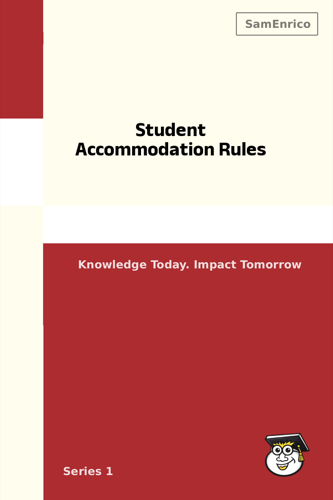
Student Accommodation Rules eBook
Understand dorm policies and landlord regulations.
Understand dorm policies and landlord regulations.
Formats
Free sample
Chapter 1: The Signature Trap...--You are sitting on the floor of your childhood bedroom. It is three weeks before you leave for university. Your phone is at 12% battery. Your mother is shouting from the kitchen, “Just sign it, you need somewhere to live!” And you are staring at a 47-page PDF on your laptop screen called Tenancy Agreement – FINAL v3 – SIGN NOW.pdf.You scroll. You see words like “indemnity,” “assignee,” “liquidated damages,” and “joint and several liability.” Your eyes glaze over.
You scroll to the bottom. There is a little box that says “I have read and agree to the terms and conditions.” You click it. You type your name. You are done.Congratulations. You just agreed to something that could cost you £5,000, get you evicted, destroy your credit score, and make you legally responsible for a stranger’s unpaid rent.
And you did it while your phone was dying and your mum was making toast.This chapter is not about scaring you. It is about arming you. Because the tenancy agreement you just signed is not a boring formality. It is the single most powerful legal document you will touch in your entire time at university. And three clauses inside it – just three – are responsible for nearly every student housing disaster.
Learn them, and you win. Ignore them, and you become the cautionary tale in next year’s edition of this book.Let us begin.The Myth of the Cooling-Off Period You have probably heard that after signing a contract, you have a few days to change your mind. This is called a “cooling-off period.” In the UK, the Consumer Contracts Regulations 2013 gives you 14 days to cancel many distance sales. In some US states, you have 48 to 72 hours. And if you believe Tik Tok, this applies to everything from gym memberships to car loans to tenancy agreements.It does not apply to most student housing.Here is the truth that no one tells you before you sign.
Cooling-off periods are designed for contracts you sign without meeting the seller in person – like buying a vacuum cleaner online. But you are signing a tenancy agreement. You have probably visited the property. You have met the landlord or the letting agent. You have stood in the room and said, “Yes, I’ll take it.” That means the cooling-off laws do not apply.In the UK, the Consumer Contracts Regulations 2013 explicitly excludes contracts for “the creation of immovable property” – which is a fancy legal way of saying “housing.” In most US states, tenancy agreements are governed by landlord-tenant law, not consumer protection law.
The result? In the vast majority of student housing contracts, there is no cooling-off period at all.The moment you click that box or scribble your signature, you are bound. If you change your mind three hours later because you found a cheaper room across the street, you cannot cancel for free. You can ask nicely. The landlord can say no.
And if they say no, you still owe the full rent for the entire term.So what do you do? Before you sign, ask one question in writing. Send an email: “Does this tenancy agreement include a cooling-off period? If so, how many days and under what law?” If they say yes, ask them to cite the specific regulation and put it in the contract. If they say no, or if they give you a vague answer, assume there is none.
And then sign only when you are absolutely sure.One exception: if you sign a tenancy agreement online without ever visiting the property or speaking to a human being from the letting agency, you might have a case for a distance-selling cooling-off period. But this is rare in student housing, and landlords have gotten very good at structuring their sales process to avoid it. When in doubt, assume you have zero cooling-off rights. Sign carefully. Sign once.
Sign for real.The Two Deposits That Will Confuse You Your contract mentions deposits. In fact, it mentions them several times, sometimes using different words. You might see a “holding deposit,” a “security deposit,” a “damage deposit,” or a “tenancy deposit.” These are not the same thing. Confusing them can cost you hundreds of pounds.Let us separate them clearly.The Holding Deposit. This is usually one week’s rent.
You pay it to the landlord or letting agent to take the property off the market while they run reference checks on you. Think of it as a “reservation fee.” The good news: if your references pass and you sign the full tenancy agreement, the holding deposit is almost always deducted from your first month’s rent. You do not lose it. The bad news: if you fail the referencing checks because you gave false information, or if you simply change your mind, the landlord can keep the entire holding deposit. They have spent time and money taking the property off the market for you.
In their mind, you owe them for that time.A few landlords try to keep the holding deposit for other reasons – for example, if their own reference checks are slow, or if they decide to rent to someone else. That is illegal. If you pass referencing and are ready to sign, the holding deposit must be returned or applied to rent. If the landlord pulls out, you get it back in full.The Damage Deposit (also called Security Deposit or Tenancy Deposit). This is much larger – usually four to five weeks’ rent.
In the UK, it is capped at five weeks for annual rents under £50,000. This money is not the landlord’s. It is still your money. The landlord holds it as insurance against damage you might cause, unpaid rent, or cleaning costs at the end of the tenancy.Here is where most students get burned. In the UK, your damage deposit must be placed in a government-approved deposit protection scheme within 30 days of you paying it.
There are three schemes: Deposit Protection Service (DPS), Tenancy Deposit Scheme (TDS), and My Deposits. Each scheme holds the money independently. The landlord cannot touch it without your agreement or a court order. If your landlord holds your deposit in their personal bank account, or in their company account, or anywhere else that is not a government scheme, that is illegal. You can sue them for one to three times the amount of the deposit.
This is not a theoretical right. Students win these cases every week.In the US, deposit protection varies by state. Some states require landlords to hold deposits in interest-bearing escrow accounts. Others have no requirements at all. You need to check your local laws.
But the principle is the same: the deposit is your money, not the landlord’s. They cannot spend it on anything other than legitimate damages or unpaid rent.Before you sign any contract, demand proof that your damage deposit will be protected. In the UK, ask: “Which government-approved deposit protection scheme will you use, and when will I receive the prescribed information?” If they cannot answer, walk away. In the US, ask: “Is my deposit held in a separate escrow account? What are the state requirements for interest?”One more thing.…
This is the end of the free sample. Get the eBook to keep going. Buy now
About this book
Details
- Author
- Blanchard Ivy
- Publisher
- SamEnrico
- Language
- English
- Genre
- Non-Fiction, Student's Shortcut, Legal
- Released
- 2026-06-07
- Pages (approx.)
- 141
- Available as
- eBook, Audiobook

Read better in the ZLOADR app
Your eBooks on your phone or tablet. Sign in with your SamEnrico account and start reading.
More by Blanchard Ivy
 Dental Human RightsBlanchard Ivy$11.99
 Pilates Mind Body HypnosisBlanchard Ivy$11.99
 Collaborative Random Input GuideBlanchard Ivy$11.99
 Massage Studio SetupBlanchard Ivy$11.99
 The Senior Support Group GuideBlanchard Ivy$11.99
 Chronic Pain Hypnosis WorkbookBlanchard Ivy$11.99
 Acupuncture for Eye HealthBlanchard Ivy$11.99
 The Magician of Madrid: Alfredo Di Stéfano and the Birth of European Football's Golden AgeBlanchard Ivy$11.99
 Glooscap's Quest: The Thunderbird and the Great FloodBlanchard Ivy$11.99
 How to Become a MenderBlanchard Ivy$11.99
 How to Produce Dental MouthguardsBlanchard Ivy$11.99
 A Collector's Handbook to the Volvo EstateBlanchard Ivy$11.99