
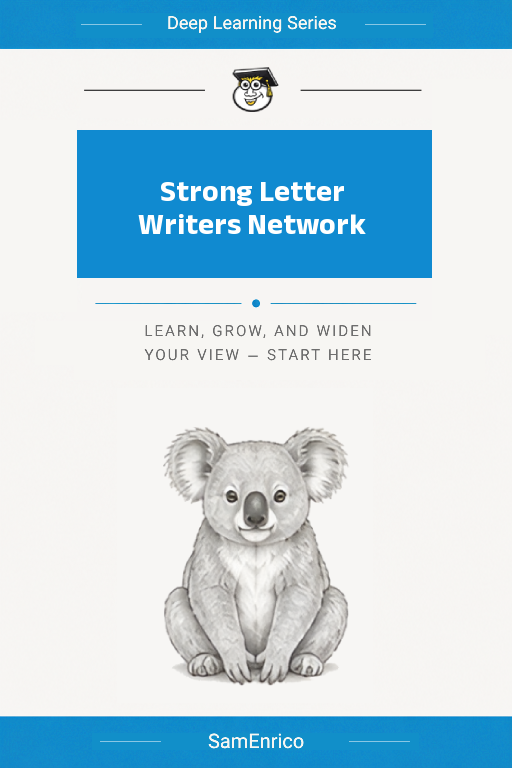
Non-FictionStudent's ShortcutRecommendation StrategyNetworking
Strong Letter Writers Network
Cultivate recommenders from thesis committee, lab
by Martin Celia
Cultivate recommenders from thesis committee, lab PIs, or course instructors who can speak to research potential.
Formats
About this book
Free sample
Chapter 1: The Visibility Fallacy--–- The email arrived at 11:47 PM on a Tuesday. Dr. Patricia Okonkwo, a tenured professor of biomedical engineering, had just finished grading twenty-three lab reports, replied to forty-one emails, and submitted a progress report to the NIH. She had one more task before bed: write a letter of recommendation for a student she genuinely liked.The student's name was Marcus. He had earned an A in her course.
He had attended office hours twice. He had been polite, punctile, and hardworking. Dr. Okonkwo opened a blank document and stared at the cursor for a full minute.What could she say? Marcus was...
good. He was solid. He was competent. She searched her memory for a specific moment—a flash of insight, a recovery from failure, a moment of unexpected initiative—and found nothing. Marcus had done everything right.
He had also done nothing memorable.She wrote: "Marcus is a good student. He completed his work on time and earned an A in my course. I recommend him for graduate studies."The letter was true. It was also useless. Marcus would later be rejected from every Ph D program to which he applied, and he would never know that the professor who liked him had written a letter that quietly, unintentionally, ended his chances.This chapter is about why that happens and how to stop it.The Most Dangerous Word in Academia"Good."It sounds harmless.
It sounds positive. When a professor calls you "good," you feel a small rush of validation. But "good" is the most dangerous word in the recommendation letter ecosystem. Because "good" is not praise. "Good" is the absence of specific praise.
"Good" is what professors write when they have no memorable data points to draw upon—when you have been invisible, even as you worked diligently in plain sight.Let us name the problem explicitly: The Visibility Fallacy.The Visibility Fallacy is the mistaken belief that because you are working hard, because you are present in the lab or the classroom, because you are earning good grades, your efforts will be seen, remembered, and translated…
This is the end of the free sample. Get the eBook to keep going. Buy now
Contents
- Chapter 1
- Chapter 2
- Chapter 3
- Chapter 4
- Chapter 5
- Chapter 6
- Chapter 7
- Chapter 8
- Chapter 9
- Chapter 10
- Chapter 11
- Chapter 12
Details
- Author
- Martin Celia
- Publisher
- SamEnrico
- Language
- English
- Genre
- Non-Fiction, Student's Shortcut, Recommendation Strategy, Networking
- Released
- 2026-05-29
- Pages (approx.)
- 151
- Available as
- eBook, Audiobook

Read better in the ZLOADR app
Your eBooks on your phone or tablet. Sign in with your SamEnrico account and start reading.
More by Martin Celia
 Patreon Creator JourneyMartin Celia$11.99
 Bean A Day LongevityMartin Celia$11.99
 CPR HandbookMartin Celia$11.99
 4-7-8 Relaxing BreathMartin Celia$11.99
 Competitive Differentiation WritingMartin Celia$11.99
 Stress Induced Inflammation WorkbookMartin Celia$11.99
 The Photo Studio Model TrapMartin Celia$11.99
 The Furious FiftiesMartin Celia$11.99
 Regis Philbin WhoMartin Celia$11.99
 The First Voyagers: The Ancient Mariners of the PacificMartin Celia$11.99
 The Windward Vision: Jan van Riebeeck and the Founding of Cape ColonyMartin Celia$11.99
 The Plastic King: How a Toy Empire Shaped a GenerationMartin Celia$11.99
You may also like
 Hong Kong Handover 1997Dunn Johnnie$11.99
 Zumba For Postnatal Recovery CourseNeal Christian$11.99
 Zumba for BeginnersLadner Nikia$11.99
 YouTube Comment Mining GuideHumes Pandora$12.99
 Worry Box MeditationCarlin Rudy$11.99
 Workplace Stress MeditationNguyen Lynn$11.99
 Workplace Stress and Sleep RepairHawley Ivory$11.99
 Workplace Perfectionism CureDelaney Jeffry$11.99
 Workplace Injustice Anger GuideWallen Isabelle$11.99
 Work Addiction and Burnout LinkGreenwood Ester$11.99
 Women in Yoga and WellnessBeattie Galina$11.99
 Women in Stand Up ComedyChun Evangeline$11.99