
Non-FictionSelf-HelpCommunication
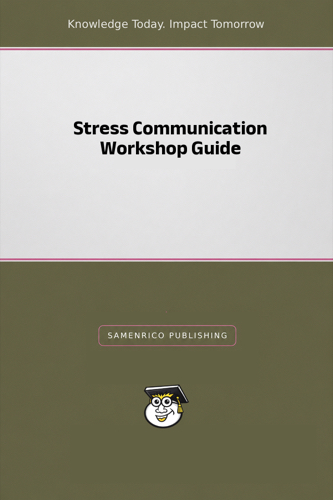
Stress Communication Workshop Guide eBook
Teaches non-defensive speaking and listening skill
Teaches non-defensive speaking and listening skills specifically for high-stress moments.
Formats
Free sample
Chapter 1: The 156-Hour Drain--–- By the time you finish reading this chapter, you will have spent approximately twenty minutes today replaying a conversation you wish had gone differently. Not a major blow-up necessarily. Perhaps a slightly sharp response to your partner about the dishes. A vague email to a colleague that you immediately regretted. A moment when your child asked for attention and you heard yourself say “not right now” in a tone you didn't recognize as your own.
Multiply those twenty minutes by three hundred sixty-five days. Divide by sixty. You are looking at one hundred twenty hours per year of shame-spiraling, rumination, and silent rehearsal of what you should have said. For many people, the number is closer to one hundred fifty-six hours. That is six and a half full days.
Six and a half days every year that you spend not living your life, but replaying the wreckage of conversations that went off the rails.This is the hidden tax of poor stress communication. It is not measured in dollars, though it certainly affects your career trajectory, your marriage satisfaction, and your parenting effectiveness. It is measured in hours of your life that you will never get back. Hours spent lying awake at 2 AM constructing the perfect comeback. Hours spent in the shower replaying what you should have said instead of what you actually said.
Hours spent avoiding the person you snapped at, which requires elaborate scheduling gymnastics that drain your cognitive energy. The 156-Hour Drain is real, it is measurable, and it is almost entirely preventable.But here is the paradox that this entire book exists to resolve: you already know how to communicate well. You know that you should use “I” statements. You know that interrupting is rude. You know that yelling doesn't work.
You know that listening is important. You know all of this. In a calm moment, sitting alone with this book, you could write a flawless guide to effective communication. You could lecture others on what they should do. You could win any argument about communication theory.
And yet, when the moment comes—when your boss publicly questions your judgment, when your partner makes a cutting remark about your family, when your teenager rolls their eyes and says “whatever”—everything you know vanishes. Your mouth opens and something else comes out. Something defensive. Something sharp. Something you immediately regret.The gap between knowing and doing is not a character flaw.
It is not evidence that you are stupid, or broken, or fundamentally bad at relationships. It is a neurological reality. Your brain is designed to prioritize survival over eloquence. And under high stress, your brain treats social threat exactly like physical threat. Being criticized activates the same neural circuits as being punched.
Being dismissed activates the same circuits as being abandoned by the tribe. Your body does not know the difference between a performance review and a predator. It only knows that something dangerous is happening, and it needs to act now.This chapter introduces the foundational distinction that will structure everything that follows: low-stakes conversations versus high-stakes conversations. The difference between these two types of interaction is not about topic or setting. It is about what your brain perceives as at stake.The Low-Stakes Reality Low-stakes conversations are the ones where your prefrontal cortex—the thinking, planning, empathy, impulse-control center of your brain—remains firmly in charge.
You experience these conversations as relatively easy, even enjoyable. You can be witty, patient, and compassionate. You can listen without interrupting. You can say “I was wrong” without feeling like you are dying. Examples of low-stakes conversations include deciding where to get lunch with a friend, discussing a movie you both watched, giving routine instructions to a colleague who likes you, or chatting with your barista about the weather.In low-stakes conversations, the amygdala—your brain's lightning-fast threat-detection system—remains quiet.
Nothing is at stake. Even if the conversation goes slightly wrong, the consequences are trivial. You choose the wrong restaurant; you still eat. You misinterpret a movie plot; no one cares. Your colleague forgets your instruction; you repeat it.
The barista gets your order wrong; they remake it. Because the stakes are low, your body stays calm. Your thinking brain stays online. You have access to every communication skill you have ever learned.Here is the cruel trick: low-stakes conversations are where most people learn their communication skills. You practice being patient with the barista.
You practice listening to your friend's story about their vacation. You practice saying “good point” to a colleague you like. And because these skills work in low-stakes settings, you believe you have mastered communication. Then a high-stakes moment arrives, and you discover that your skills were never tested. They were performed in a vacuum.
And performance is not the same as mastery.The High-Stakes Reality High-stakes conversations are the ones where your amygdala detects a threat to something you value: your reputation, your relationship, your safety, your identity, your belonging, your sense of being a good person. In these moments, your brain shifts into survival mode before you can consciously choose otherwise. Examples of high-stakes conversations include:A performance review where your job security feels uncertain A confrontation with your partner about infidelity, finances, or parenting differences A boundary-setting conversation with a parent who has a history of dismissing you A negotiation where the other person has more power than you A conversation about a mistake you made that hurt someone you love A moment when you must deliver bad news that will disappoint someone An interaction with someone who has publicly humiliated or criticized you In high-stakes moments, your brain perceives social threat as physical threat. Being criticized feels like being attacked. Being dismissed feels like being abandoned.
Being misunderstood feels like being erased. And because your brain cannot tell the difference between a social threat and a physical one, it responds with the same ancient survival machinery that kept your ancestors alive on the savanna.Here is what happens inside your skull during a high-stakes moment, in approximately the order it occurs:First, your senses detect something. A tone of voice. A specific word. A facial expression.
A silence. This sensory input travels to your thalamus, which acts as a relay station. From the thalamus, the information takes two paths simultaneously.The fast path goes directly to your amygdala. This path takes about twelve milliseconds. The amygdala does not analyze.
It does not interpret. It does not consider context. It asks only one question: “Is this a threat?” If the answer is even maybe yes, the amygdala sounds the alarm. It triggers a cascade of stress hormones—cortisol, adrenaline, norepinephrine. Your heart rate increases.
Your breathing becomes shallow. Your muscles tense. Your digestive system slows down. Your peripheral vision narrows. Blood flows away from your prefrontal cortex and toward your limbs, preparing you to fight or run.
This is the hijack. It happens before you know it is happening.The slow path goes from your thalamus to your sensory cortex to your hippocampus to your prefrontal cortex, and finally to your amygdala. This path takes about three hundred to four hundred milliseconds. On this path, your…
This is the end of the free sample. Get the eBook to keep going. Buy now
About this book
Details
- Author
- Haynes Alberta
- Publisher
- SamEnrico
- Language
- English
- Genre
- Non-Fiction, Self-Help, Communication
- Released
- 2026-06-09
- Pages (approx.)
- 124
- Available as
- eBook, Audiobook

Read better in the ZLOADR app
Your eBooks on your phone or tablet. Sign in with your SamEnrico account and start reading.
More by Haynes Alberta
 Bipolar And Work LifeHaynes Alberta$11.99
 Medical Listening Skills GuideHaynes Alberta$11.99
 Nurse Shift Distraction GuideHaynes Alberta$11.99
 Interleaving PracticeHaynes Alberta$11.99
 The Quit Smoking Erectile GuideHaynes Alberta$11.99
 Mental Health Access GuideHaynes Alberta$11.99
 The Caravan of HopeHaynes Alberta$11.99
 EQ for LGBTQIA+ AffirmationHaynes Alberta$11.99
 Scandal in the Spotlight: The Secret Affair That Shook Hollywood's Golden AgeHaynes Alberta$11.99
 Colors of Resistance: The Graffiti Revolution of Latin AmericaHaynes Alberta$11.99
 The Phantom Legion: Hannibal's Ghosts at Cannae (216 BC)Haynes Alberta$11.99
 AI Prompts for Liquidity Pool EvaluationHaynes Alberta$11.99
You may also like
 Hong Kong Handover 1997Dunn Johnnie$11.99
 Zumba For Postnatal Recovery CourseNeal Christian$11.99
 Zumba for BeginnersLadner Nikia$11.99
 YouTube Comment Mining GuideHumes Pandora$12.99
 Worry Box MeditationCarlin Rudy$11.99
 Workplace Stress MeditationNguyen Lynn$11.99
 Workplace Stress and Sleep RepairHawley Ivory$11.99
 Workplace Perfectionism CureDelaney Jeffry$11.99
 Workplace Injustice Anger GuideWallen Isabelle$11.99
 Work Addiction and Burnout LinkGreenwood Ester$11.99
 Women in Yoga and WellnessBeattie Galina$11.99
 Women in Stand Up ComedyChun Evangeline$11.99