
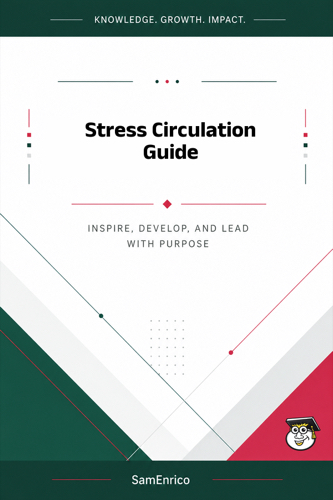
Non-FictionSelf-HelpCirculatory
Stress Circulation Guide eBook
Understand stress effects on blood flow and periph
Understand stress effects on blood flow and peripheral circulation.
Formats
Free sample
Chapter 1: Your Hands Are Lying--Your hands are cold right now. Go ahead—check. Place one palm against your cheek. Feel that chill? Most people do.
They shrug it off as “just how I am,” or blame a slow thyroid, or joke about having “bad circulation.” But here’s what no one has told you: that coldness is not a personality trait. It is not genetics. And in the vast majority of cases, it is not a thyroid problem. That coldness is a distress signal—a measurable, physiological warning that your body is redirecting blood away from your extremities to preserve your core. And it is doing so because your nervous system believes you are in danger.The average office worker’s fingertips are eight degrees Fahrenheit colder than their core body temperature.
Eight degrees. That is not a minor variation. That is the difference between a healthy, perfused tissue and one that is being starved of oxygen. Your fingers are not supposed to be cold. They are supposed to be warm, pliable, and pink—because warm tissue is well-perfused tissue, and well-perfused tissue is healthy tissue.
Cold tissue is a compromise. It is your body making a trade: your hands and feet lose blood so that your heart and brain can keep it. That trade made sense on the savanna, when a predator might chase you at any moment. It makes no sense in a heated office, sitting under fluorescent lights, responding to emails.This book exists because of a single, explosive insight that has been hiding in plain sight for decades: chronic stress is not just an emotional problem. It is a vascular problem.
The anxiety you feel before a presentation, the low-grade dread of an overflowing inbox, the tension in your shoulders as you drive through traffic—these are not abstract feelings. They are chemical events. And those chemical events are physically, measurably constricting your blood vessels, diverting flow away from your hands, your feet, your gut, and even your brain, and sending it instead to muscles that are not moving, a heart that is not racing, and a brain that is already overstimulated.You have been told that stress is “all in your head.” That is wrong. Stress is in your arteries. And until you understand that, you will continue to live with cold hands, brain fog, post-meal crashes, and a vague sense that your body is working against you.The Evolutionary Mismatch That Is Killing Your Circulation To understand why your hands are cold, you have to understand what your body thinks is happening.
Your autonomic nervous system—the part of your nervous system that runs automatically, without your conscious control—has two main branches. The sympathetic nervous system is often called “fight or flight.” The parasympathetic nervous system is called “rest and digest.” These two systems are meant to work in balance, like a gas pedal and a brake.When a zebra sees a lion, its sympathetic nervous system floods its body with norepinephrine and epinephrine. Its heart rate doubles. Its blood pressure spikes. And—crucially—its blood vessels constrict in the skin, the digits, the gut, and the kidneys.
All of that blood is shunted to the skeletal muscles, the heart, and the brain. The zebra runs. It escapes. Then it stops. The threat is gone.
The parasympathetic system takes over. Blood returns to the skin, the gut, the kidneys. The zebra grazes. Its hands—hooves—warm up.Now consider your day. You wake up to an alarm—a small stressor.
You check your phone: emails, news, social media. More small stressors. You sit in traffic. You arrive at work. You have a deadline.
You have a meeting. You have a difficult conversation. You have more emails. You drive home. You watch a stressful show.
You scroll through your phone again. You go to sleep. And then you do it all again tomorrow.Your body is not designed for this. It is designed for acute threats that last seconds or minutes, followed by long periods of recovery. Instead, you are subjecting it to dozens of small threats every single day, with no recovery period in between.
Your sympathetic nervous system is stuck in the “on” position. Your blood vessels are in a state of chronic, low-grade constriction. Your hands are cold not because of a single dramatic event, but because of a thousand tiny cuts—each email, each notification, each minor frustration—that keep your stress response simmering just below the level of conscious awareness.This is the silent epidemic. It does not show up on standard blood tests. It does not cause chest pain or shortness of breath.
It causes cold fingers. It causes brain fog. It causes that heavy feeling in your legs after a long day of sitting. It causes bloating after meals. And because these symptoms are mild and chronic, we have learned to ignore them.
We have normalized a state of low-grade vascular starvation.The Stagnation Score: A Self-Assessment Before we go any further, you need to know where you stand. The following self-assessment—the Stagnation Score—will give you a baseline measure of how much your stress response is compromising your circulation. Answer each question honestly. There is no failing grade. There is only data.Domain One: Temperature Place your palm against your cheek right now.
Is your hand noticeably cooler than your face? Now touch your bare forearm. Is your forearm cooler than your core? Now touch your shin. Is your lower leg cooler than your thigh?
Rate yourself on a scale of 0 to 10, where 0 means “every part of my body feels equally warm” and 10 means “my hands, feet, and lower legs are significantly colder than my chest and face.”Write down your number.Domain Two: Energy Think about the last five times you ate a meal—any meal. Did you feel alert and energized afterward, or did you experience a noticeable crash in energy, mental fog, or drowsiness within 60 minutes of eating? Rate yourself on a scale of 0 to 10, where 0 means “I never experience post-meal crashes” and 10 means “I almost always feel worse after eating than before.”Write down your number.Domain Three: Mood Over the past two weeks, how often have you felt irritable, snappish, or “on edge” for no clear reason? Rate yourself on a scale of 0 to 10, where 0 means “my mood is consistently calm and stable” and 10 means “I feel agitated or impatient most days.”Write down your number.Domain Four: Sensation Do you ever experience tingling, “pins and needles,” or a feeling of numbness in your hands or feet, especially when you wake up in the morning or after sitting for a long period? Rate yourself on a scale of 0 to 10, where 0 means “never” and 10 means “I experience this daily.”Write down your number.Now add your four numbers.
This is your Stagnation Score, ranging from 0 to 40.0 to 10: Your circulation is remarkably healthy. You likely have excellent stress recovery. You will still benefit from this book, but your primary work is maintenance.11 to 20: Moderate stagnation. Your stress response is beginning to compromise your peripheral circulation. You probably notice cold hands or brain fog several times per week.21 to 30: Significant stagnation.
Chronic stress is actively starving your tissues. You likely experience multiple symptoms daily and have normalized them.31 to 40: Severe…
This is the end of the free sample. Get the eBook to keep going. Buy now
About this book
Details
- Author
- Waters Claire
- Publisher
- SamEnrico
- Language
- English
- Genre
- Non-Fiction, Self-Help, Circulatory
- Released
- 2026-06-09
- Pages (approx.)
- 131
- Available as
- eBook, Audiobook

Read better in the ZLOADR app
Your eBooks on your phone or tablet. Sign in with your SamEnrico account and start reading.
More by Waters Claire
 Root Vegetables Longevity GuideWaters Claire$11.99
 Social Media Fast ResultsWaters Claire$11.99
 Pelvic Floor for WeightliftingWaters Claire$11.99
 The CPAP Therapy GuideWaters Claire$11.99
 The Silk Road's Last Emperor: How a Smuggler Built a Global EmpireWaters Claire$11.99
 Collections AgentWaters Claire$11.99
 Kigali Startup Grants GuideWaters Claire$12.99
 Delaware LLC for Foreign FoundersWaters Claire$12.99
 The Breeder's Guide to Campbell DucksWaters Claire$11.99
 How to Start a Beauty Salons BusinessWaters Claire$11.99
You may also like
 Hong Kong Handover 1997Dunn Johnnie$11.99
 Zumba For Postnatal Recovery CourseNeal Christian$11.99
 Zumba for BeginnersLadner Nikia$11.99
 YouTube Comment Mining GuideHumes Pandora$12.99
 Worry Box MeditationCarlin Rudy$11.99
 Workplace Stress MeditationNguyen Lynn$11.99
 Workplace Stress and Sleep RepairHawley Ivory$11.99
 Workplace Perfectionism CureDelaney Jeffry$11.99
 Workplace Injustice Anger GuideWallen Isabelle$11.99
 Work Addiction and Burnout LinkGreenwood Ester$11.99
 Women in Yoga and WellnessBeattie Galina$11.99
 Women in Stand Up ComedyChun Evangeline$11.99